
There is a moment, long before any spreadsheet is opened, when the guest list stops being an idea and starts feeling complicated. It helps to just sit together first. Don't talk about numbers or plus-ones. Talk about the feeling of the day you are imagining. That quiet conversation is the real beginning of your wedding guest list planning.
I have seen that the calmest couples are the ones who ground their guest list in a simple question: who are the people we cannot picture this day without?
This small, core group becomes your anchor. They are the ones who have watched your relationship grow, the people you call without a second thought. When you start here, with this circle of unwavering support, the process can shift from a task into a meaningful reflection of your life together. It is not about filling seats; it is about surrounding yourselves with the people who truly know and love you.
This visual shows that simple emotional flow, from the heart of your relationship out to the full room.
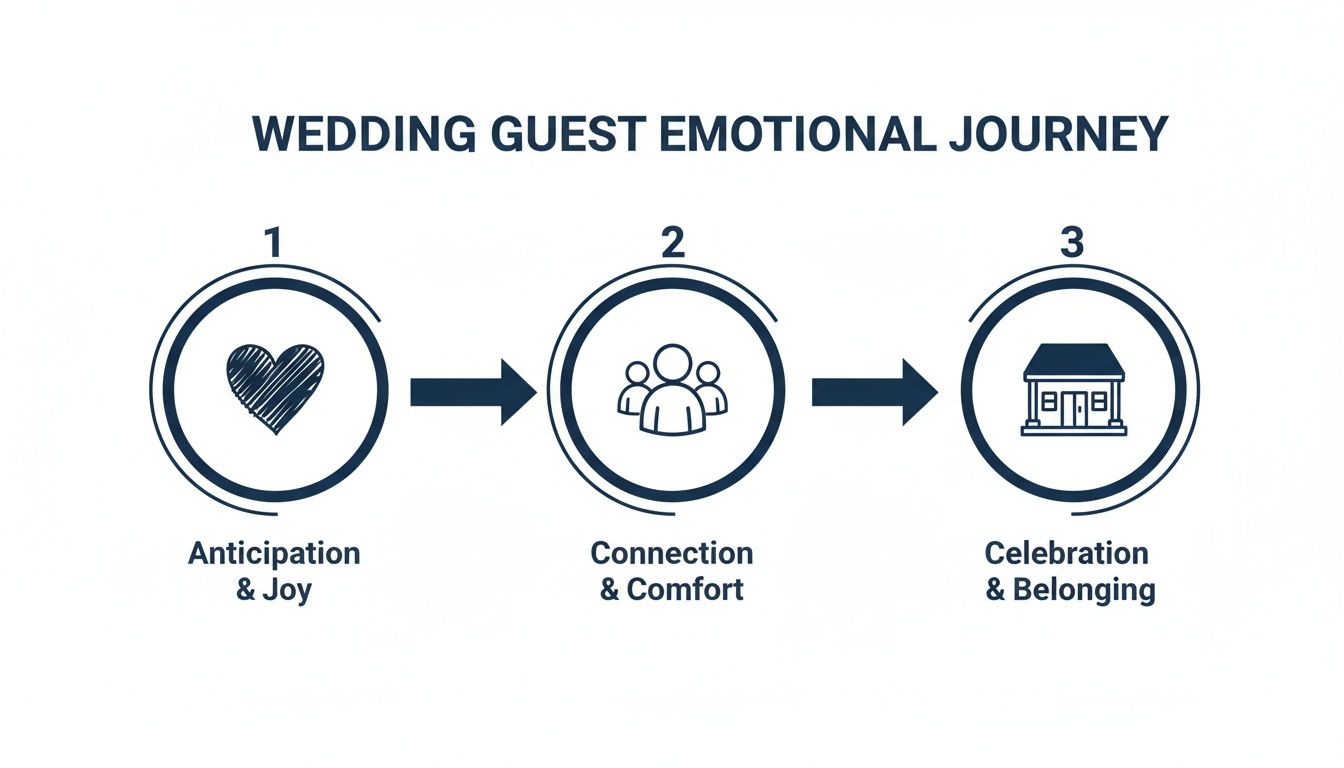
The journey always starts with your core connection and expands outward. It is a helpful thing to remember when things get tricky later.
How do we find our starting number?
Once you have that core group in mind, you can begin to think about the size of your celebration. The location often guides this decision more than people expect. Here in Muscatine, where guests might travel along the Mississippi to join you, weddings tend to find their own natural size.
Some couples envision a large, energetic gathering filling our ballroom. Others prefer the closeness of a smaller group. It is worth noting that guest counts change dramatically based on travel. A destination wedding, for instance, typically has around 65 guests, while a hometown wedding might have closer to 141. Here in North America, the average settles around 115 guests, a number that feels familiar to most.
What I have seen is that the number itself matters less than the feeling in the room. A celebration with 50 people who are deeply connected to you will always feel more full than one with 150 who barely know each other.
Keeping the Conversation Calm
This initial discussion is a key part of a much larger process. It is one of the first of many decisions you will make together, and it sets the tone for everything that comes next. Keeping this conversation grounded helps you both stay aligned when family opinions and obligations enter the picture. You might find our complete wedding planning checklist helpful for seeing how this one piece fits into the whole picture.
There is no pressure to have a final list after this first talk. The only goal is to leave the conversation feeling more connected to each other and to the kind of day you truly want.
This is not about creating rigid rules. It is about creating a shared vision that will act as your guide. When you both know what feeling you are aiming for, the individual names on the list become much easier to decide on together.
How do we decide who makes the list?

Once your core group is settled, the list naturally starts to grow. This is often where feelings of obligation and the quiet complexities of family dynamics begin to surface. I have seen many couples find a sense of calm by thinking about their guest list in layers, like ripples in a pond moving out from the center.
Your first layer is essential—the people you just discussed. They are the non-negotiable heart of your celebration.
The next layer holds your close extended family, like the aunts, uncles, and first cousins you grew up with. It also includes the friends who have been constants through different seasons of your life. These are the people whose presence would feel deeply missed.
A third layer might then include coworkers you see every day, friends from newer chapters, and perhaps guests your parents hope to invite.
Thinking this way is not about ranking people. It is about finding clarity. It turns a single, overwhelming list into smaller, more manageable groups to consider together.
To help with this conversation, I have found it useful for couples to think about their list in a few distinct layers. It is not about creating strict rules, but about giving yourselves a framework for the discussion.
A simple way to think about your guest list layers
| Guest Layer | Who This Might Include | Guiding Thought |
|---|---|---|
| Layer 1: The Core | Immediate family, bridal party, and lifelong best friends. | "We cannot imagine this day without them." |
| Layer 2: The Inner Circle | Close relatives (aunts, uncles, first cousins) and dear friends you see regularly. | "Their presence would make the day feel complete." |
| Layer 3: The Community | Good friends, valued coworkers, and maybe your parents' closest friends. | "We would truly love to have them if space and budget allow." |
| Layer 4: The Extended Circle | More distant relatives, family friends you see occasionally, and others you'd like to include. | "It would be wonderful to celebrate with them if we can." |
This is not meant to be a rigid system, but a guide. It gives you and your partner a shared language to talk through who fits where and why, making the whole process feel more intentional.
The A-List and B-List Conversation
Couples often talk about creating an A-list and a B-list. The A-list is everyone you hope can be there from the start. The B-list is for guests you would love to include if space and budget allow after the first round of RSVPs arrive.
While practical, it is a delicate subject. What I have seen work well is to simply send your primary invitations out a little earlier than usual. As you receive regrets, you can then thoughtfully extend invitations to others.
This approach feels more organic and gracious, avoiding the sense of a formal hierarchy. It allows your guest list to find its natural size without anyone feeling like a second choice.
It helps to remember that most guests will not know where they fell in your planning process. They will simply feel happy to receive an invitation to celebrate with you.
How To Approach Parental Input
One of the most common challenges is navigating requests from parents. Their desire to invite friends and family often comes from a place of pride and joy. They want to share this moment with the people who have been part of their own lives.
A conversation held early, with warmth and unity, can prevent a great deal of stress.
It helps to come to your parents with a clear understanding of your venue’s capacity and your budget. Sometimes, offering them a specific number of invitations to extend can be a wonderful way to honor their wishes while maintaining the scale of the wedding you both envision.
For example, you might say, "We have room for about 120 guests, and we would be so happy if you could help us invite 10 of your closest friends to celebrate with us." This gives them a clear, collaborative role.
When parents feel included and respected, they are often your greatest supporters. You can learn more about how the size of a wedding shapes its feeling in our thoughts on why smaller weddings feel different.
Ultimately, the goal is to create a shared understanding that honors your most important relationships and the vision you have for your day. It is a process of gentle conversations and thoughtful decisions, made together.
What do we do about plus-ones and children?
The questions around plus-ones and children always feel practical, but they are deeply personal. I have seen couples go back and forth on this more than almost any other detail.
There is not a single right answer. There is just the one that feels true to the day you are trying to create together. It helps to think of these not as strict rules you have to follow, but as decisions you get to make to shape the feeling in the room.
A Gentle Approach to Plus-Ones
Most couples wrestle with the same thing: they want single friends to feel comfortable, but they also want to keep the celebration from getting too big. It is a classic planning discussion.
A guideline that seems to bring a lot of clarity is to extend a plus-one to any guest who is married, engaged, or in a long-term, established relationship. This approach respects committed partnerships and gives you a clear, kind boundary that is easy for everyone to understand. It takes the guesswork out of it and prevents the feeling that some people were treated differently than others.
For your truly single friends and family, it is entirely up to you. Some couples know their friends will have a great time mingling as a group, while others prefer to give everyone the option to bring a guest.
What I have seen is that guests appreciate consistency above all else. When the approach is the same for everyone, it is almost always received with understanding.
Deciding on Children at Your Wedding
The conversation about having kids at the wedding is really a conversation about atmosphere. There is no right or wrong here, and I have watched beautiful weddings unfold both ways.
Some couples decide on an adults-only celebration. They might be picturing a later evening with a lively band, where their friends who are parents can truly relax and enjoy themselves. That is a perfectly acceptable choice.
Other couples cannot imagine their day without the joyful energy of little ones running around. They plan for it, maybe setting up a kids’ table or finding a quieter space for families to retreat to. Here at The Merrill, the layout can support these multi-generational gatherings, especially when families book rooms on-site. Knowing there are comfortable wedding venues with on-site lodging can make it much easier for parents to attend and manage their children’s needs throughout the night.
Communicating Your Decisions Clearly
The most important part of this whole process is not the decision itself. It is how you communicate it.
Once you have decided, just be direct and kind. The way you address the invitation is the clearest signal.
- If you are inviting a couple, address it to both of them by name.
- If the whole family is welcome, address it to “The Smith Family.”
- If you are inviting only the parents, use their names alone.
For extra clarity, you can add a small note on your wedding website. Something simple like, "We have chosen to have an adults-only reception," or "We cannot wait to celebrate with your little ones" works perfectly.
Most misunderstandings I have seen do not come from the decision, but from a lack of clarity. When guests know what to expect, they can plan accordingly and show up ready to celebrate. It is a quiet part of being a good host, and when you handle it with care, it makes everyone feel respected and welcome.
How do we manage family expectations gently?
This is almost always the most delicate part of planning. The conversations with parents about who to invite can feel heavy with history and hope. It helps to remember that those feelings usually come from a place of love. They want to share this moment with people who matter to them.
The key is to listen thoughtfully while holding firm to the vision you both share for your day. I have watched many couples navigate this by starting with the practical things—the budget and the venue capacity. When you can say, "Our space can comfortably hold 120 people," it frames the conversation around a shared reality, not just feelings.
Sometimes, giving them a clear number of seats they can help fill is the best way to let them participate without derailing your plans. When you and your partner present a united, calm front, families are more likely to understand and offer their support.
Setting the Stage for a Calm Conversation
The best time to have this talk is before any lists are made. Find a quiet moment, maybe over coffee, and approach it as a shared discussion, not a negotiation. You can start by talking about the feeling you hope to create for your wedding.
When you lead with emotion—"We are picturing a day that feels intimate, surrounded by the people who have been part of our story"—it helps your parents connect with your vision. It lands much more gently than starting with a list of rules about who can and cannot be invited.
Then you can gently introduce the practical limits. Being open about your budget and capacity gives them context. It shows you have thought things through and are not making arbitrary decisions.
What I have seen is that when parents understand the 'why' behind your decisions, they are much more likely to become your allies. It shifts the dynamic from them asking for something to all of you solving a puzzle together.
This is also a chance to acknowledge their community. You might say something like, "We know there are people who are so important to you, and we want to honor that. Given our numbers, could we set aside about 20 invitations for you to share with your closest friends?" This approach is collaborative. It shows respect while maintaining clear boundaries.
Understanding the Global Context of Guest Lists
It is also helpful to remember that guest list expectations are often shaped by culture and generation. What feels normal to one family might seem small to another.
For example, recent global wedding data shows the average wedding in India hosts 330 guests, while in the UK, it is closer to 89. In the United States, the average is around 116 guests—a number that often requires careful decisions from everyone involved. Interestingly, younger generations like Gen Z are trending toward slightly larger weddings again, with an average of 131 guests.
Knowing these numbers vary so widely can sometimes put your own family's hopes into perspective. You can read the full research on how guest lists differ around the world.
When Financial Contributions Are Involved
If parents are contributing financially, the guest list conversation can feel more complex. It is a tender spot for many couples.
The clearest path forward is to have an honest talk about this early on. If their contribution comes with the expectation of inviting a certain number of guests, it is better to know that upfront. This allows you to decide together if you can comfortably accommodate that.
If their list is larger than your venue or vision can hold, it may be time for a gentle but direct conversation about priorities. A calm discussion about what is possible within the budget can often lead to a compromise that everyone feels good about.
Ultimately, the goal is to leave these conversations with your relationships intact and your vision for the wedding clear. A little patience and a lot of quiet unity between you and your partner will make all the difference.
What happens after the guest list is finalized?
There is a quiet moment of relief when the guest list finally feels settled. The hard conversations are over, and for the first time, you can truly picture the faces that will be in the room with you. It is a milestone worth pausing to appreciate.
The next steps are about logistics, but they should be handled with the same care you gave to the list itself. This is when you move from names to information, creating a single, reliable source for everything that follows.
Choosing Your System
I have seen couples manage this beautifully with everything from a detailed spreadsheet to a simple notebook. The tool you choose matters far less than your commitment to using it consistently. Whether it is a wedding planning website or a shared document, just pick one place and let it become your guide.
This system will hold more than just names. It is where you will track:
- Mailing addresses for invitations
- RSVPs as they arrive
- Meal selections and dietary needs
- Gifts received, so you can write thoughtful thank-you notes
Keeping all of this in one place prevents a great deal of stress down the road. It becomes the document you can share with your caterer, your planner, and the venue, ensuring everyone is working from the same page.
I have noticed that the most organized couples are not necessarily the ones with the most complex tools. They are the ones who chose a simple system and used it for everything, every time.
Thinking About the Seating Chart
Once your RSVPs start coming in, you can begin to think about the seating chart. This task has a reputation for being difficult, but I find it helps to reframe it. You are not solving a complicated puzzle. You are hosting a comfortable dinner party for people you love.
The goal is to create tables where guests will feel at ease. Think about who knows each other and who might enjoy a new conversation.
A few things I have seen work well:
- Seat guests with people they know. While it is lovely to encourage mingling, most guests feel more relaxed when they have at least one or two familiar faces at their table.
- Consider personalities and energy levels. A table of quiet, thoughtful relatives might have a different feel than a table of your energetic college friends. Try to create a balanced atmosphere.
- Think about the flow of the room. Pay attention to where older guests are seated in relation to the music, or where parents with young children might need easy access to an exit.
Here in Muscatine, many of our couples find themselves blending groups who have traveled to be here with friends and family from just down the road. The seating chart is a quiet way to make everyone feel included and cared for.
The Final Count and Your Vendors
About two to three weeks before the wedding, you will provide a final guest count to your key partners—especially your caterer and the venue. This number is what drives final orders for food, linens, chairs, and place settings.
Your organized list makes this final step remarkably simple. You will be able to provide not just a number, but a detailed breakdown of meal choices and allergies. This level of detail is a quiet but significant act of hospitality. It allows the culinary team to prepare, and it ensures every guest has a wonderful meal without a single moment of concern.
An organized list is the foundation for a smooth and gracious experience. It is the unseen work that allows the day to unfold with a feeling of ease, for you and for everyone you have invited.
What about the questions that linger?
Even after the most thoughtful planning, a few questions often seem to surface. I have watched countless couples circle back to the same dilemmas, no matter how carefully they have crafted their list. These are usually the final uncertainties that keep the whole process from feeling settled.
The goal here is not to give you a set of rules. It is to offer a grounded perspective I have gained from seeing hundreds of celebrations unfold. I hope it brings a bit of clarity and helps you land on decisions that feel true to your day.
Is it okay to have a B-list?
Couples often bring this up in a quiet voice, as if it is a secret they should not admit. But it comes from a practical place—you want your venue full of people you love, but you know not everyone can make it. While the intention is sound, a formal B-list can create real hurt if people find out they were a second choice.
A gentler approach that I have seen work beautifully is to simply send your main invitations out a little earlier than usual. The standard is often six to eight weeks before the wedding, but sending them ten to twelve weeks out gives you a comfortable window.
As you get your "no" RSVPs, you can then extend invitations to others you would love to have there. It feels more organic and less like a tiered system. This lets your guest list find its natural, comfortable size without anyone feeling ranked.
Remember, your wedding day is just one moment in time. Someone who gets an invitation a bit later will likely just assume it was an oversight or that you were waiting on final numbers. They will simply be happy to be included.
What if we cannot afford to invite everyone we want?
This is an incredibly common—and very real—situation. A wedding budget has hard limits, and the cost per guest is a huge part of that equation. It is completely normal to feel a sense of loss over the people you cannot include.
It helps to first be honest with yourselves about what is actually feasible. Acknowledging the financial reality of it all takes the guilt out of the equation and reframes it as a practical decision you are making as a team. Once you have your final number, you can stand by it together.
From there, you might find other ways to include people. Some Muscatine couples host a more casual get-together at a local park or brewery a few months after the wedding. Others have a small, intimate ceremony followed by a larger, more informal reception later that evening. There are ways to share your joy that go beyond the wedding day itself.
How do we tell someone they are not invited?
In almost every case, you do not need to say anything at all. Invitations go out to those who are invited; you are not obligated to inform those who are not. Most people understand that weddings are personal and often limited by space and budget.
The tricky moment comes when someone asks you directly. I have seen couples worry about this conversation for weeks. When it happens, a simple, kind, and brief response is always the best path. You do not need to over-explain or defend your decision.
Something like, "We had to make some really tough choices to keep our wedding small, but we value our friendship and hope we can celebrate with you soon," is usually enough. It acknowledges the relationship, respects their feelings, and holds your boundary with grace. It is a response that is honest without being hurtful, and it lets everyone move forward.
At The Merrill Hotel, we see every wedding as its own unique story. If you are starting to picture what your celebration could feel like along the river, we would be honored to show you around. Learn more about hosting your wedding with us at momentsatthemerrill.com.