
It’s one of the quieter questions that comes up in wedding planning. After the guest list is settled, couples start wondering how much cake they actually need. It’s a common point of concern—the worry of ordering too much or, even worse, not enough.
The first thing to know is that a standard wedding cake serving is smaller than what you might cut for yourself at home. A baker typically plans for a slice about one inch wide and two inches long. This isn't meant to be a large dessert. It’s a few thoughtful bites, especially if other sweets are on offer.
I've seen it helps to plan for most, but not all, of your guests. A good guideline is to order enough cake for about 85% to 90% of your total guest count. This simple adjustment usually accounts for those who might skip dessert, while making sure there’s plenty for everyone who would like a slice. If you are planning a full dessert table with other options, you can often adjust that number even further, closer to 75%.
How does the shape of a cake affect the number of servings?
Sooner or later, every couple has a conversation with their baker that involves numbers and diagrams. It’s the moment you first see a chart for wedding cake serving size. For a minute, it can feel a little abstract.
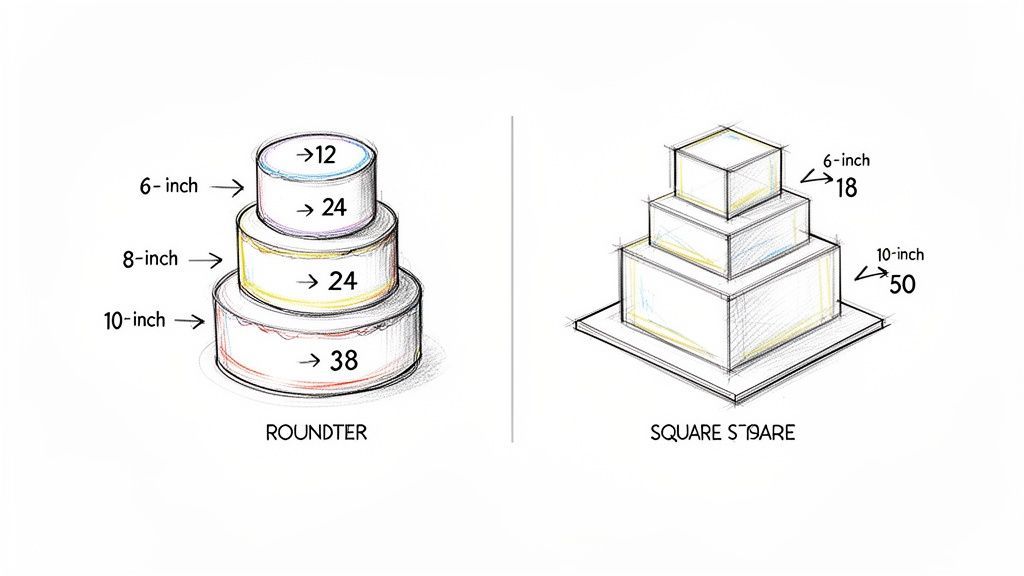
The shape of your cake tiers plays a significant role in the final serving count. It's something your baker knows like the back of their hand.
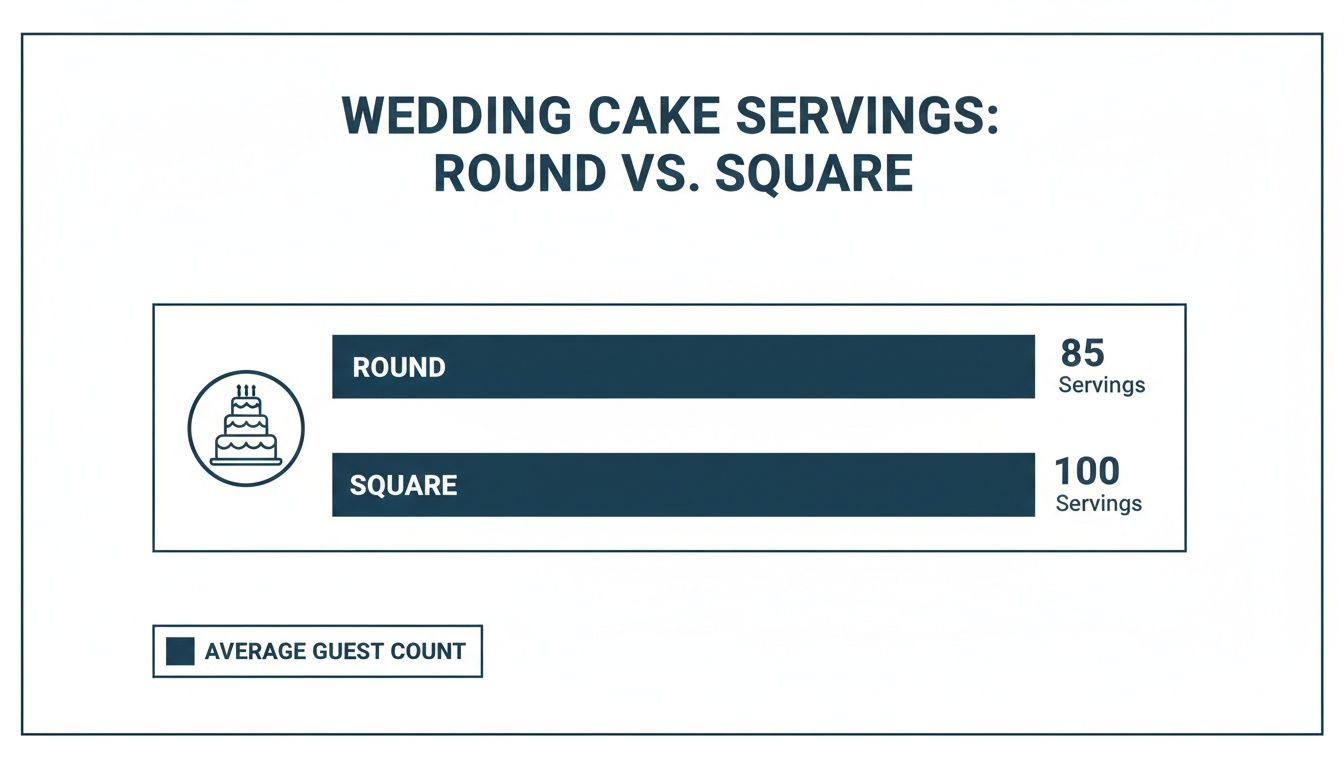
The straight edges of a square cake allow for more portions than a round one of a similar size. This is a detail your baker can walk you through.
To help with those early conversations, here’s a quick reference for common tier sizes. It helps in discussions with your baker.
A Guide to Servings Per Tier
- Round cakes are often cut by making an inner circle first, about two inches in from the edge. That outer ring is then sliced into individual servings. The process repeats, working toward the center.
- Square cakes are a bit more straightforward. They’re cut in a simple grid pattern. Because of this, a square tier will almost always give you more servings than a round one of the same width.
| Tier Size (Inches) | Round Cake Servings (Approx.) | Square Cake Servings (Approx.) |
|---|---|---|
| 6 | 12 | 18 |
| 8 | 24 | 32 |
| 10 | 38 | 50 |
| 12 | 56 | 72 |
| 14 | 78 | 98 |
Your baker will use these numbers, or very similar ones, to build a cake that matches your guest count.
It helps to remember your baker is the expert here. They understand the math and will help you match the cake to the size and style of your day, leaving you feeling calm and cared for.
This knowledge helps shift the conversation beyond just how the cake will look and into how it will actually work on your wedding day. It’s one of those quiet, practical details that helps everything flow smoothly.
How many tiers will our cake have?
A wedding cake’s height is one of the first things people notice. I’ve watched hundreds of cakes being set up here by the river, and their size is almost always a quiet conversation between a couple and their baker about the guest list.
A smaller, more intimate wedding of 50 people might have a lovely two-tier cake. A celebration for 150 guests, on the other hand, often calls for four or five tiers. It’s less about grandeur and more about simple, practical math.
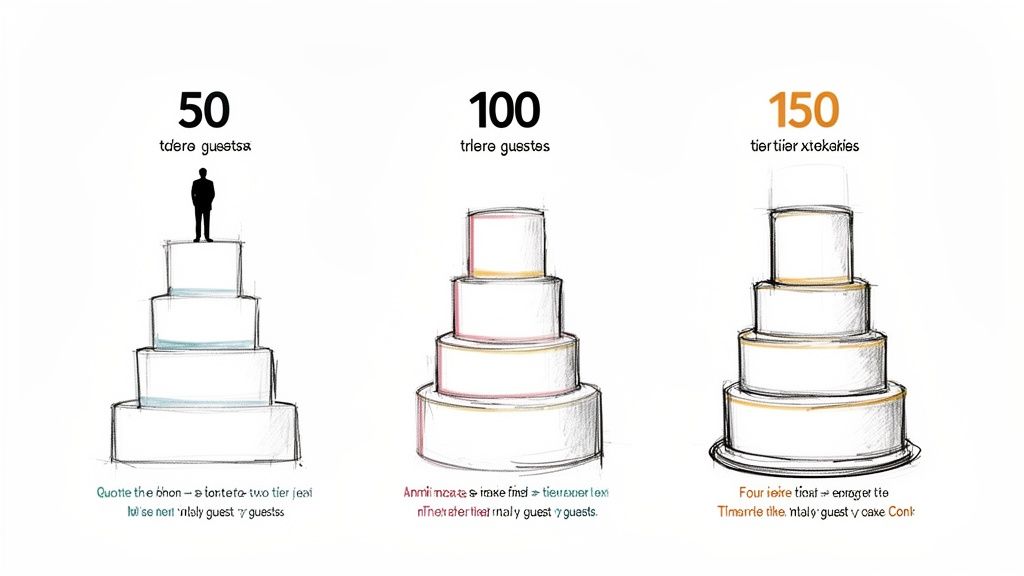
It helps to have a general idea of what to expect. Most bakers I see work with these common starting points to build a cake that fits a wedding just right.
- For 50-75 Guests: A two-tier or a small three-tier cake usually feels right.
- For 100-125 Guests: A three-tier cake is the most common choice I see come through our doors.
- For 150+ Guests: A four tiers or even a five-tier cake becomes necessary to make sure everyone gets a slice.
These are just observations, of course. The specific diameters of each layer are what really determine the final number of servings.
For larger celebrations of 150 or more—like many we host here overlooking the river—a thoughtful combination of different tier sizes becomes essential.
Knowing this allows you to focus on what matters. Instead of worrying if the cake is big enough, you can trust your baker is using a time-tested system. The goal is to find the combination that feels right for your day. It’s a quiet decision that, once made, allows the cake to be exactly what it should be: a beautiful and delicious part of your celebration.
Is there a way to have a large cake without the high cost?
For bigger weddings, a quiet solution exists that many couples find incredibly helpful. It involves having two cakes, though your guests will likely never know it.
You have the beautiful, tiered display cake for the cutting ceremony and all the photos. Behind the scenes, your caterer has what we call kitchen cakes. They are simple sheet cakes, made with the exact same recipe and flavor as your display cake, ready to be served.
This is a common practice our culinary team handles all the time. Your guests all get the same delicious slice of cake, but it lets our staff serve everyone far more quickly. When you have a guest list of 150 or more, this one detail helps the entire evening flow without a hitch.
What I've seen work well is ordering a display cake that serves a portion of your guests—say, 75 people—and then having a kitchen cake for the other 75. This takes care of a 150-person reception with ease.
It’s one of those behind-the-scenes details that takes the pressure off. Your display cake gets to be the stunning centerpiece it was meant to be, without also needing to do all the heavy lifting. This approach also keeps the numbers clearer in your overall wedding catering budget.
Ultimately, this is a practical choice that supports the grace of your reception. It ensures that when it’s time for dessert, every single guest is served promptly, and the celebration continues.
What does a "wedding slice" of cake actually look like?
It helps to have a picture in your mind of what bakers and caterers mean by a “wedding slice.” This isn’t the big wedge you’d cut at a birthday party. It’s a taller, more refined piece, cut to make sure every bite has a good ratio of cake, filling, and frosting.
There’s a quiet method to it. I’ve watched our team slice hundreds of cakes, and it’s a practiced, efficient process. It’s how we make sure the cake yields the number of servings your baker promised and that every guest gets the same kind of slice.
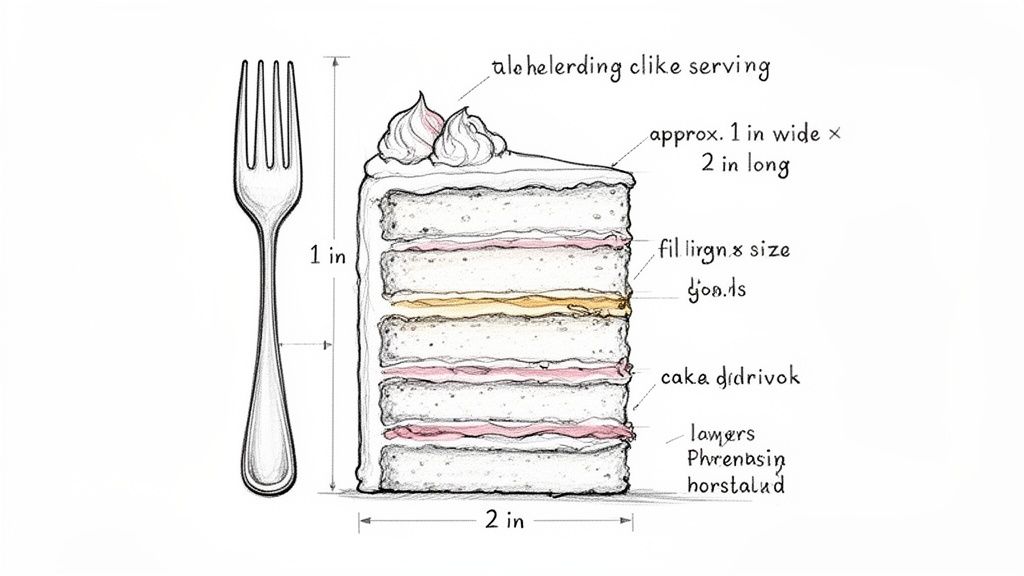
The industry standard for a wedding slice has been around for a long time. It’s a piece roughly one inch wide by two inches deep. For a typical cake with four-inch-tall layers, this offers a portion that feels elegant but satisfying.
This standard is what allows a cake to be both a stunning centerpiece and a practical dessert that serves a large crowd gracefully. It's one of those quiet details that makes a big difference in how smoothly the evening flows.
What if we want to save the top tier?
It's a quiet tradition, but one a lot of couples hold onto: saving the top tier of the wedding cake for their first anniversary. It’s a small, sweet promise of a celebration to come. If you’re thinking of doing this, it’s a good idea to mention it to your baker and your coordinator early on.
The key is to make sure the servings from that top tier are not part of your final guest count. That piece is already spoken for.
The adjustment is almost always simple. If your top tier serves 12 people but you need enough cake for 100 guests, you’ll just order a cake for 112 servings. This small bit of planning ahead ensures there are no surprises or shortages when it's time to serve dessert.
When the cake cutting comes, you can relax knowing everything is taken care of. The staff will carefully set that top tier aside, boxing it up so it’s ready for you at the end of the night. It’s a simple thing, but it’s one of those details that feels good to get right.
What if we are serving other desserts?
I’ve seen many couples here create a beautiful dessert table. It becomes its own moment in the room, filled with pastries, cookies, and sometimes a few local Muscatine favorites. When that happens, the conversation about how much wedding cake to order quietly changes.
If you’re planning a dessert bar with a lot of variety, you can usually adjust your cake order down a bit. The cake cutting is still a central, treasured moment, but the pressure to have one slice for every single person just isn't there.
With other desserts on offer, I've seen many couples feel comfortable planning for enough cake to serve about 75-80% of their guests. This accounts for people who will fall in love with another dessert, or simply aren’t big cake-eaters. It feels less like a compromise and more like a thoughtful way of looking after everyone.
For example, if you have 150 guests, ordering a cake that serves 115-120 people often feels just right when other sweets are available. This is especially true if you offer a variety, like some couples do with wedding cupcakes, which brings its own unique charm. You can read some of my thoughts on what you might want your wedding cupcakes to communicate to your guests.
Ultimately, a dessert table is about giving your guests a moment of quiet delight. It’s another way of showing care, and adjusting your cake size is just part of that thoughtful process.
A Few Final Questions Couples Ask
These are the questions that tend to come up after the big decisions are made, usually in the quiet weeks leading up to the wedding. The answers are based on what I’ve seen work best over hundreds of celebrations here.
Should our cake be kept in the fridge?
This question comes up a lot. Yes, but only for a short time. Your baker usually delivers the cake an hour or two before the reception, and we’ll hold it in a cool, safe place until it’s time for the cutting. A cake with delicate buttercream or fruit fillings can’t sit out for hours. That brief time in a cool space protects the baker's work.
Do we really have to serve everyone cake?
This is probably the biggest point of uncertainty couples have about cake. What I’ve seen work, time and time again, is planning for about 85-90% of your guests. Not everyone will take a piece, especially after a full meal or if you have other desserts. That number almost always ends up being just right.
Can we choose a non-traditional flavor?
Of course. The idea that a wedding cake has to be a certain flavor is a thing of the past. I’ve seen some wonderfully creative and personal cakes come through our doors, with flavors that mean something special to the couple. Your cake should be a reflection of you, not just a tradition.
At The Merrill Hotel, our job is to manage these quiet details so you can stay in the moment. We focus on creating a seamless experience, from the first guest’s arrival to the last dance. You can learn more about celebrating with us at momentsatthemerrill.com.