
There is a moment just before the ceremony begins, a quiet hum in the room. Guests have found their seats, the light has settled, and the first notes of music begin to play. This is when the question of who walks when becomes real.
Many couples I have spoken with feel a pressure to get this part right, as if there is only one correct way. But after watching hundreds of ceremonies unfold here by the river, I can tell you there are many ways for a walk down the aisle to feel right. Understanding the typical wedding processional order is simply a good place to start, not as a rule, but as a foundation you can build upon or gently set aside.
The purpose is to find a rhythm that feels like your own, so that when the music begins, you can feel present and ready for the moment ahead.
What is the most traditional way?
There is a sense of quiet gravity to the traditional processional. It is structured and familiar, which can bring a feeling of calm to an otherwise emotional moment. This order follows a sequence that places everyone with intention, building anticipation for the final entrance.
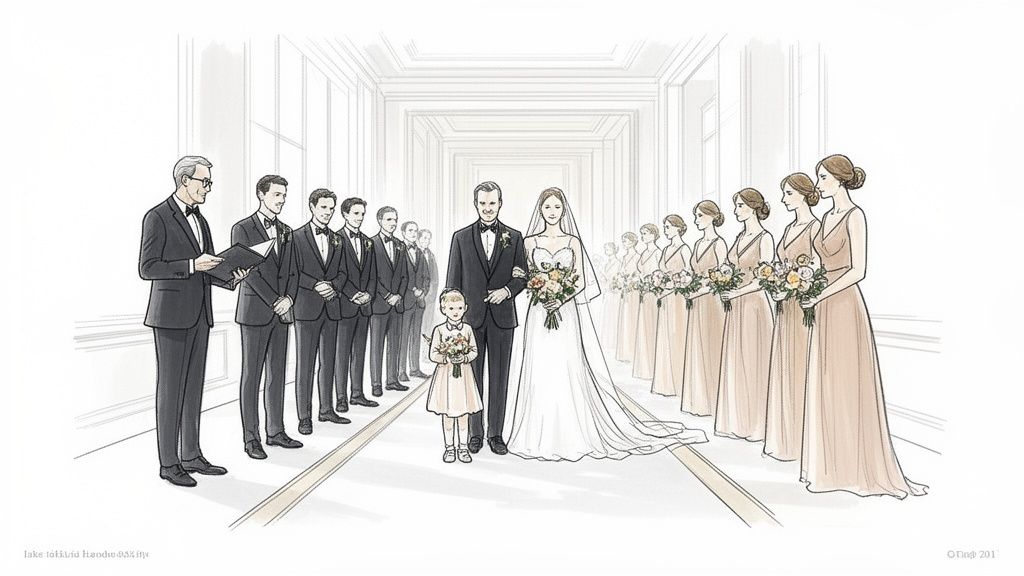
This classic approach is often chosen for its timeless feel. I have seen it work beautifully within our indoor spaces at The Merrill, where the architecture complements the dignified pace.
How this order unfolds
The sequence begins with the officiant and one partner entering, often from the side, to take their places. They are followed by the rest of the wedding party in a specific rhythm:
- Groomsmen & Best Man: They enter first, usually in pairs or single file.
- Bridesmaids & Maid of Honor: They follow the groomsmen, creating a balanced visual frame at the altar.
- Ring Bearer & Flower Girl: The children often signal the final entrance is about to happen, adding a sweet, unscripted moment.
- The Final Partner & Escort: This entrance is the final, focal point of the procession.
A few practical thoughts
Pacing is everything with this format. A slow, steady walk prevents rushing and allows each person their moment. It helps to have someone at the entrance to give each person or pair their cue to begin.
I have found that a full walk-through is one of the most valuable things a couple can do. Getting the timing right and making everyone comfortable is a key part of our rehearsal dinner guidance. You can explore some of these details in our rehearsal dinner planning checklist. This small step removes so much uncertainty on the wedding day itself.
How can we make it feel more modern?
A more contemporary approach has a feeling of beautiful symmetry. Instead of dividing the wedding party, bridesmaids and groomsmen walk the aisle together in pairs. It reflects a view of relationships that celebrates the couple’s community as a whole.
This processional order is less about tradition and more about reflecting the couple's shared life. It emphasizes equality from the start of the ceremony. I have watched this unfold many times, and the warm, natural light always seems to complement the authentic energy of this style.
How this order unfolds
The sequence feels collaborative, with the officiant often already in place. The focus shifts to the procession of pairs, creating a unified entrance.
- Wedding Party Pairs: Groomsmen and bridesmaids enter together, arm-in-arm or side-by-side. The Maid of Honor and Best Man can enter as the final pair.
- Ring Bearer & Flower Girl: They often enter just before the main event, keeping that sweet tradition intact.
- The Couple: In a departure from tradition, the couple may choose to walk down the aisle together. Alternatively, they might enter simultaneously from opposite sides, meeting at the altar.
A few practical thoughts
The key to this processional is ensuring everyone feels comfortable. During the rehearsal, I encourage pairs to find a natural pace and decide how they want to walk together. It is a small detail that makes a big difference in how relaxed they appear.
Music choice here can set a wonderfully personal tone. Many couples opt for contemporary instrumental pieces or a favorite song that reflects their personality. The processional becomes a celebration of not just the couple, but all the meaningful relationships that support them.
Can we walk in together?
Some couples choose to begin their marriage by walking in together. This approach shifts the focus from a single grand entrance to a shared, unified moment that symbolizes their partnership from the very first step. It is a choice that feels intentional and deeply personal.
This particular wedding processional order has a powerful, quiet confidence to it. I have seen it work beautifully here, especially with the wide aisle and natural light from the windows overlooking the river. It frames the couple as a team, moving forward at the same time.
How this order unfolds
In this variation, the couple becomes the centerpiece of the procession itself. The officiant and wedding party are typically in place beforehand, turning the focus entirely onto the partners.
- Officiant & Wedding Party: Often, they enter from the side or are already standing at the altar as guests are seated. This creates an immediate frame for the main event.
- The Couple: The partners walk down the aisle together. They are the start and the finish of the procession.
A few practical thoughts
Walking in sync is the key to making this feel natural. During the rehearsal, I often suggest couples practice finding a comfortable rhythm together. A brief, intentional pause halfway down the aisle to look at each other can be a lovely touch.
It is also important to communicate with the wedding party. Ensure they understand their role is to support this moment by being in place, ready to witness the entrance. This removes any confusion and allows everyone to feel present and valued.
What if our families are complicated?
Modern families are often beautifully complex, and a processional can reflect that. This approach honors blended families, multiple parental figures, and close relatives by weaving them directly into the start of the ceremony. It creates a sequence that feels true to the couple’s life and relationships.
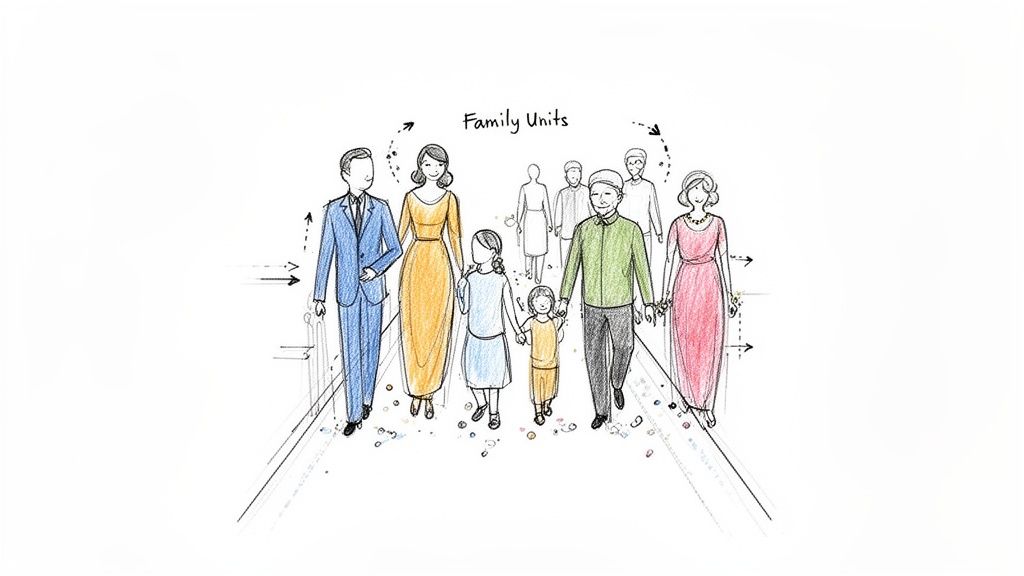
This typical wedding processional order is less about a single line and more about telling a story of connection. I have seen it bring a deep sense of meaning to ceremonies, where every person walking down the aisle represents a significant part of the couple's support system.
How this order unfolds
The beauty of this order is its flexibility. A couple can design it to honor the people who matter most, often beginning with grandparents and moving through parents, stepparents, and siblings before the wedding party. The key is thoughtful placement.
- Grandparents: Seating them first is a common way to show respect.
- Parents & Stepparents: They might walk in together as a group, in separate pairs, or with their new partners.
- Siblings: Brothers and sisters not in the wedding party can also have their own moment.
- The Couple: In some variations, like a Jewish processional, both parents escort each partner down the aisle.
A few practical thoughts
Clarity is the most important element here. Because this order is unique to the couple, it requires careful communication. A detailed diagram or a clear, written list for everyone involved is incredibly helpful.
A dedicated coordinator at the entrance becomes essential to cue each person or family unit. At The Merrill, we often use our pre-ceremony gathering spaces to brief family members so everyone feels confident. This is especially useful when considering how to incorporate family into outdoor events; you can see some thoughts on that in our guide to outdoor wedding ceremony ideas. A thorough walk-through ensures the timing feels natural and the moment is calm, not chaotic.
Can the children go first?
Some couples choose to begin their ceremony with a moment of pure, unscripted joy. Placing the flower girls and ring bearers at the very start of the processional sets a wonderfully light and family-centered tone. This alternative is less about formality and more about celebrating the family as it is.
This approach feels especially right for couples who are blending families or for those who simply want to honor the little ones most important to them. I have seen this work beautifully in our more intimate ceremony settings, where the focus is drawn immediately to the children's happy journey down the aisle.
How this order unfolds
The sequence flips the traditional order, prioritizing sweetness over suspense. The officiant and one partner are in place, and the processional begins with the youngest participants.
- Flower Girl & Ring Bearer: They enter first, often to a more gentle song, immediately capturing everyone’s attention.
- Wedding Party: The bridesmaids, groomsmen, and honor attendants follow, creating a supportive frame.
- The Couple: One or both partners make their entrance last, walking into a space already filled with warmth.
A few practical thoughts
Working with children requires patience. It helps to have a designated adult, perhaps a grandparent, waiting for them at the end of the aisle to offer a quiet hug and a seat. This small detail provides a comforting end-point for their big moment.
During rehearsals, I encourage couples to let the children practice a few times until they feel confident. Using simple language like, “You get to lead the whole parade,” makes them feel special, not pressured. It is also wise to have someone ready to give them their cue. Above all, embrace the spontaneity; a dropped basket often becomes one of the day’s most cherished memories.
What if we don't want a processional at all?
For some couples, the idea of a formal walk down the aisle does not align with their personalities. An unconventional entry removes the traditional processional entirely, choosing instead to begin the ceremony with a moment of surprise or intimacy. This is for those who want to create an experience that feels uniquely their own.
I have seen this work beautifully when couples want the focus to be on their community from the very first moment. Instead of a grand entrance, it becomes a quiet reveal, creating a warm atmosphere that feels less like a performance and more like a gathering.
How this order unfolds
There is no single way for this to happen. The core idea is to bypass the traditional sequence of walking down the aisle. Some common approaches I have witnessed include:
- The Quiet Start: The couple is already present at the altar as guests arrive and take their seats.
- A Simultaneous Entrance: The couple enters at the same time from different points, such as opposite side aisles, meeting in the middle.
- The Group Procession: The couple walks in together, surrounded by all their guests, moving from a cocktail area to the ceremony space as one group.
- A Surprise Reveal: Guests are seated, and a curtain is drawn or lighting shifts to reveal the couple already in place.
A few practical thoughts
Communication is key when you break from tradition. A small note on the wedding website or in the program helps guests understand what to expect. This approach also relies on precise coordination of timing, lighting, and music cues to feel intentional.
A thorough rehearsal is essential to ensure everyone, including your vendors, understands the flow. Photographers and videographers especially need to be positioned to capture an entrance that may happen from an unexpected place. Making sure the practical details are managed allows the moment itself to feel spontaneous and authentic. You can find more ideas for a streamlined day by reading about having the ceremony and reception in one place.
Could we use two aisles?
There is a powerful statement made when both partners arrive at the altar at the same time. This processional choice emphasizes equality from the very first moment. Instead of a sequential entrance, both partners walk simultaneously down separate aisles, meeting in the middle. It’s a modern, elegant take that feels both grand and personal.
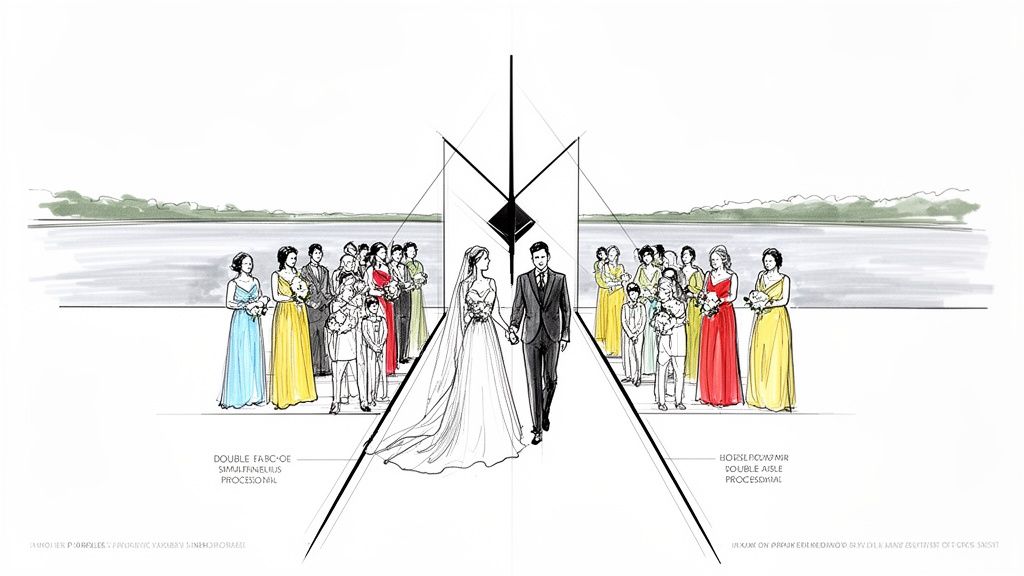
This approach is particularly striking in spaces that can accommodate two paths. I have seen our ballroom at The Merrill transformed with a simple seating adjustment to create this symmetrical effect. The view of the Mississippi River in the background adds a natural, expansive feel to such an intentional entrance.
How this order unfolds
The beauty of this processional is its symmetry. Both sides mirror each other, creating a sense of balance as the two families and wedding parties are represented.
- Officiant: The officiant is typically already in place at the altar.
- Wedding Party: Members from each side enter at the same time, walking down their respective aisles. Groomsmen on one side, bridesmaids on the other, often meeting at the front.
- Partners & Escorts: The final moment is the simultaneous entrance of both partners, each with their escort or on their own. They walk at the same pace down the two aisles.
- The Meeting: Both partners arrive at the head of the aisle together, turn to face each other, and approach the officiant as a united couple.
A few practical thoughts
Timing is the most important element to get right. This order requires a bit more coordination. Having a coordinator at each entrance point to give a simultaneous cue is essential. Music should begin at the same moment for both.
A rehearsal becomes especially important for this format. It allows both sides to practice their pacing so they arrive at the front in unison. It’s less about perfection and more about feeling comfortable with the flow. This small practice run removes any day-of anxiety and lets the moment feel natural and focused.
How the Different Processional Orders Compare
| Style | 🔄 How Complex Is It? | 💡 What Does It Require? | ⚡ How Long Does It Take? | ⭐ Why Choose It? | Good For… |
|---|---|---|---|---|---|
| Traditional Formal Processional Order | 🔄 High — many sequential cues, strict timing | 💡 High — full rehearsal, coordinator, classical music cue, photo/video positioning | ⚡ Moderate–Slow — 3–5 minutes | ⭐ Very formal & emotive; 📊 Clear visual hierarchy, predictable for vendors | Formal ceremonies, traditional couples, classic hotel interiors |
| Contemporary Paired Processional Order | 🔄 Moderate — pairing logistics, intentional staging | 💡 Moderate — rehearsal for pairs, updated photographer guidance, flexible music | ⚡ Fast — ~2–3 minutes | ⭐ Inclusive & modern; 📊 Efficient, personalized, natural for mixed parties | Inclusive couples, micro-weddings, LGBTQ+ and blended families |
| Bride & Groom Joint Processional with Wedding Party Following | 🔄 Low–Moderate — couple sync required | 💡 Moderate — couple rehearsals, photographer positioning, brief bridesmaids/groomsmen | ⚡ Fast — ~2–4 minutes | ⭐ Strong partnership symbolism; 📊 Memorable visuals, egalitarian tone | Egalitarian couples, same‑sex weddings, intimate celebrations |
| Family-Centered Processional with Multiple Family Units | 🔄 High — complex sequencing & emotional cues | 💡 High — diagrams, multiple rehearsals, dedicated coordinator, accessibility planning | ⚡ Slow — 5–7 minutes (longer) | ⭐ Deeply inclusive & meaningful; 📊 Honors blended families, creates poignant moments | Blended/divorced/remarried families, family‑focused events |
| Children-First Processional (Flower Girl & Ring Bearer Lead) | 🔄 Moderate — child unpredictability requires contingency | 💡 Moderate — child rehearsals, backup adult, safe aisle setup | ⚡ Moderate — 3–5 minutes (variable) | ⭐ Joyful & candid; 📊 Lightens mood, great for natural photography | Families with young children, blended families, relaxed ceremonies |
| Processional-Free or Unconventional Entry (Surprise/Slow Reveal) | 🔄 Variable to High — depends on theatrical/technical elements | 💡 Variable — technical crew, coordinator, guest communication, lighting/sound tests | ⚡ Very Fast to Minimal — 30s–2min or none | ⭐ Highly memorable if intentional; 📊 Creative, engaging, risk of guest confusion | Creative couples, alternative venues, tech‑enabled ceremonies |
| Double‑Aisle Simultaneous Processional (Mirror Entry) | 🔄 High — precise timing and venue reconfiguration | 💡 High — seating redesign, extra rehearsals, multi‑angle photography, coordinator | ⚡ Moderate — 3–5 minutes (timing critical) | ⭐ Visually striking & balanced; 📊 Equal attention to partners, highly photogenic | Large venues, couples seeking formal symmetry and equality |
A Quiet Final Thought
After all the diagrams are drawn and the music is chosen, what remains is the walk itself. It’s easy to get lost in the details of who stands where and when each person should begin. I have seen couples map it out with precision, only to find that in the moment, none of that mattered as much as they thought it would.
The various processional orders are simply structures. They are frameworks, not rules. They exist to bring a sense of order to a moment filled with emotion. What I have noticed is that the best choice is always the one that removes anxiety, not the one that adds it. The goal is not to perform a perfect sequence but to arrive at the front of the room feeling present.
The typical wedding processional order is the one that feels most natural to you. It is the one that honors the people you want to honor and reflects the story of how you arrived at this day.
People often ask me what guests remember most about a ceremony. It is rarely the exact order of the wedding party. It is the palpable shift in the room when one partner sees the other for the first time. It is the quiet tear a parent sheds, or the deep breath a couple takes just before they say their vows. These are the moments that last.
As you move forward, the most practical step is to revisit the options and ask a simple question: Which of these feels like us? Discuss it not just with your planner, but with each other. A grand, traditional processional might feel right in a large church, while a simpler entrance may suit a space like our ballroom overlooking the Mississippi.
Mastering the wedding processional is not about memorizing steps. It is about understanding the purpose behind them and then giving yourself the freedom to adapt. The walk down the aisle is a brief threshold. Let it be one you cross with ease, leaving the logistics behind you. What you will remember, and what everyone else will remember, is the feeling of beginning.
Here at The Merrill Hotel, we have seen countless variations of the walk down the aisle. Our spaces are designed to be flexible, accommodating everything from a grand entrance to a quiet gathering where no formal processional is needed at all. If you are looking for a place where your ceremony can feel both significant and wonderfully simple, we would be glad to show you how. The Merrill Hotel