
Nearing the end of your planning, you will likely arrive at the question of gratuities. It is one of the last, quiet details, and for many couples, one of the most uncertain.
The conversation around how to tip wedding vendors can feel complicated, but it does not have to be. This gesture is less about a required fee and more about acknowledging the people whose hands and effort shaped your day. Most couples feel a sense of ambiguity here, and that is completely normal. There is no universal rule, only norms that have formed over time.
What I have seen is that clarity on this topic brings a sense of calm. Knowing how to approach it frees you to focus on the day itself, confident that you have prepared for this final, thoughtful gesture. A tip is a personal expression of gratitude for service that went beyond what was expected. Having a sense of the customary amounts provides a helpful starting point. It prevents last-minute stress and ensures the people who supported you feel seen and appreciated. It is a quiet way to complete the circle of care that surrounds a wedding.
How do we even start to plan for tips?
There’s a quiet moment near the end of the night, after the last dance but before the final goodbyes, when a couple realizes they haven’t prepared to tip their vendors. It’s a common oversight, born from focusing on the thousand other details that make up a wedding day. A thoughtful approach to tipping is not just about money; it’s a way to acknowledge the people whose work made your celebration feel seamless.
How much should we set aside?
Couples often wonder if a tip is expected, especially for vendors who own their own business. While it is true that a tip is a gesture of gratitude, it has also become a standard part of the service industry. It can be helpful to think of it as part of your overall wedding budget.
Some couples find it easier to allocate specific amounts for each service provider.
A general guideline for a 120-guest wedding might look something like this:
- Coordinator: $250 – $500 (A flat amount is common)
- Catering Staff: $800 – $1,200 (Often based on the food bill)
- Bartenders: $300 – $400 (Typically based on the bar bill)
- Photographer/Videographer: $150 – $300 per person
- DJ or Musicians: $100 – $250 per musician
- Drivers: $20 – $50 per driver
This is just a guide. The final amounts depend on your budget and the quality of service you feel you received. For a deeper look into how these costs fit into the bigger picture, you can explore what a wedding really costs.
Who actually handles the money?
On the day of the wedding, your focus should be on each other, not on handing out envelopes. This is why designating a "tip manager" is one of the most practical decisions you can make. This person is responsible for distributing the tips to the right people at the right time.
What I’ve seen work best is when a couple chooses someone they trust implicitly to handle this. It could be your wedding planner, a parent, the best man, or maid of honor. Give them a clear list with names, amounts, and any specific instructions.
Prepare the envelopes in advance, clearly labeled with each vendor's name and filled with the correct cash amount. This small step removes all guesswork and stress from the process. When you work with a venue like The Merrill, you can ask your coordinator what is already included. Sometimes, gratuity for in-house staff is built into your package, which simplifies things considerably.
What about the catering staff and chefs?
The food and service at a wedding reception often become a central part of the guest experience. Behind every well-timed course and every cleared plate is a team of servers, bartenders, and chefs working in careful coordination. Acknowledging their effort is a thoughtful way to close out your event.

What is a common amount for the food service team?
The first place to look is your catering contract. Many venues, including The Merrill, automatically include a gratuity or a "service charge" in the final bill. It is important to ask what this covers. A service charge might go toward the venue’s operational costs, while a gratuity is typically distributed directly to the staff.
If gratuity is not included, a common guideline is to tip 18-20% of the total food bill. For the behind-the-scenes culinary team, a separate gesture is often appreciated. A tip of $100-$300 for the executive chef recognizes their work in designing your menu and leading the kitchen.
Here is a general idea for tipping on a catering bill:
- Catering Bill: $5,000 (Food only)
- Waitstaff & Bartenders: $900 – $1,000 (18-20% of the food bill, distributed among the team)
- Executive Chef: $200
- Catering Manager: $100 – $200
These figures are a starting point. The final amount should reflect your satisfaction with the service. If you're trying to understand how these amounts fit into your overall food and beverage costs, you can get a clearer picture of what wedding catering costs.
How do we get the tip to the right people?
Distributing tips to a large catering staff can be one of the more complex parts of the process. Rather than trying to thank each server individually, it is almost always better to give the entire gratuity to the on-site catering manager or banquet captain at the end of the night. This ensures the money is divided fairly among everyone, including the kitchen staff who you may not see.
It helps to ask the catering manager how tips are distributed. This simple question can give you peace of mind that everyone, from the servers to the dishwashers, will receive a portion of your thank you.
Prepare a single, clearly labeled envelope for the catering team. If you wish to tip the chef separately, prepare a second envelope with their name or title. Handing these over to the manager as the evening winds down is a simple, effective way to show your appreciation.
And the bartenders?
The bar is often a central gathering place at the reception. The bartenders do more than just pour drinks; they manage the flow and contribute to the atmosphere of the night. Acknowledging their hard work is a thoughtful gesture.
How much is right for the bar team?
The standard for tipping bartenders depends on how your beverage service is structured. If you have an open bar, a common approach is to tip 15-20% of the total bar bill before taxes and service fees. For a cash bar, where guests are tipping individually, a smaller, flat-rate tip from the couple to the team is still a kind way to show appreciation.
The question of whether to tip at all often comes up, especially if a service fee is already on your bill. It’s always best to ask your venue coordinator what that fee covers.
A sample approach for bar service:
- Open Bar: A $3,000 bar bill could warrant a tip of $450 – $600 to be split among the bar team.
- Flat Rate: Many couples choose to give a flat amount of $150 – $300 per bartender.
- Barback Staff: It's a nice touch to allocate a portion for the barbacks, often around $100 – $150.
These amounts are simply guidelines. Your decision should be based on the quality of service and your budget. If your bartenders create custom signature cocktails or handle a large crowd with ease, a more generous tip is a way to acknowledge that effort. You might also find some helpful ideas for non-alcoholic wedding drinks.
Who gives them the tip?
Distributing tips to the bar staff can be handled in a few ways. It’s wise to decide on a plan before the reception begins.
One of the most common methods is to give a single envelope to the banquet captain or beverage manager at the end of the evening. They can then distribute the pooled amount fairly among all bartenders and barbacks who worked your event.
You can ask your venue to calculate the final beverage bill just before the end of the night. Having this prepared in a labeled envelope and passed along by your designated "tip manager" ensures the team is thanked. At a venue like The Merrill, your coordinator can advise you on the best way to handle this, as gratuity for our in-house staff is often built into your package.
What about hair and makeup artists?
Your hair and makeup artists are responsible for one of the most visible, personal parts of your day. They spend hours with you and your wedding party, setting the tone for the morning. A tip is a meaningful way to thank them for their artistry and calming presence.
What is customary for the beauty team?
Like other personal service providers, it is customary to tip your hair and makeup team 15-20% of the total service fee. It’s a good practice to budget for this amount separately from their main contract fee.
A general guideline for hair and makeup:
- Solo Bridal Look: For a bridal hair and makeup package totaling $300, a tip of $45-$60 (15-20%) is a kind gesture.
- Bridal Party: If services for a group total $800, a group tip of $120-$160 is appropriate, to be distributed among the artists.
- Lead Artist & Assistant: You might give the lead artist a larger tip, such as $100, and their assistant a separate tip of $30-$50.
It helps to remember to tip for your trial appointments as well. A smaller amount, perhaps $15-$20, shows appreciation for their time and skill during the planning phase.
Who handles the payment?
The morning of your wedding can be a whirlwind of activity. It’s best to prepare for this ahead of time so the artists can leave smoothly once their work is done.
I’ve seen it work well when a couple assigns someone—a parent or a member of the wedding party—to hand the tips to the lead artist as they finish up. This ensures the artists are thanked properly without pulling you away from the moment.
Prepare a labeled envelope with cash or confirm with the lead artist beforehand if they accept digital payments for gratuity. Some stylists include gratuity in their contracts, so it’s always a good idea to ask when you book. A quick, clear question can save you stress on the day itself.
Do we need to tip our photographer and videographer?
Your photographer and videographer spend the entire day with you, from the quiet getting-ready moments to the energy of the dance floor. They are tasked with capturing the memories you will revisit for years to come. Acknowledging their effort with a tip has become a welcome and common practice.
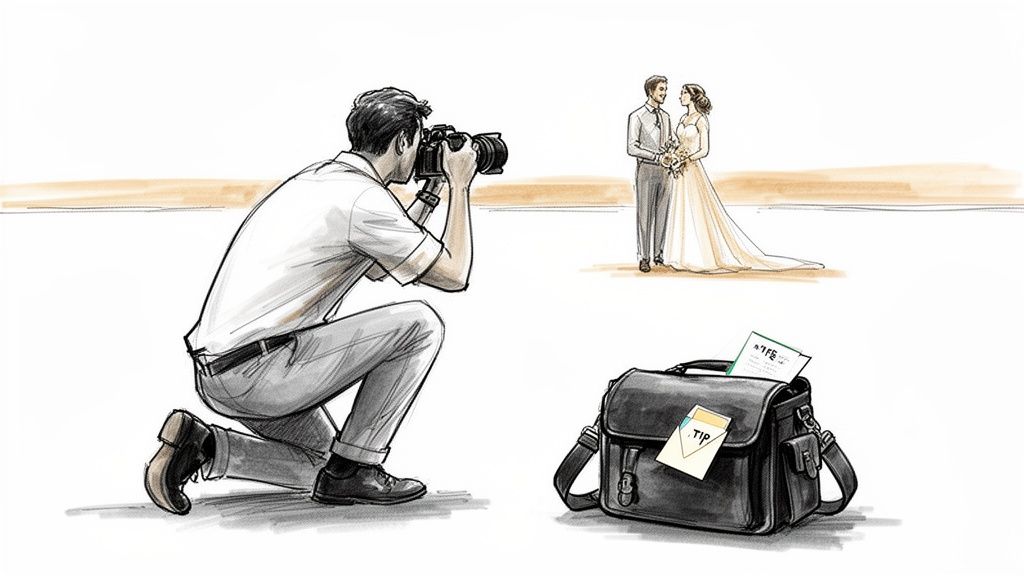
What seems right for the photo and video teams?
For these artists, tipping is often a direct reflection of your satisfaction with their presence on the day itself. While you won't see the final photos or video for some time, their ability to make you feel comfortable is worth acknowledging.
Many couples find it helpful to think in flat amounts rather than percentages for these vendors, especially if they own their business. A range of $100 to $300 per lead photographer or videographer is a very thoughtful gesture.
An example of tipping for a photo/video team:
- Lead Photographer: $200 – $300
- Second Shooter/Assistant: $75 – $150 (Handed directly to them)
- Videography Team (Lead): $150 – $250
- Drone Operator/Specialist: $100+
It is wise to separate these tips and label envelopes for each individual, including any second shooters or assistants. This ensures your gratitude reaches everyone who contributed.
When is a good moment to give the tip?
Unlike some vendors who finish their work at a set time, your photo and video team are often among the last to leave. Finding the right moment can feel tricky.
The best time is usually as they are packing up their equipment near the end of their contracted time. This is a natural pause in the evening, and it allows for a quiet, personal moment of thanks.
You can delegate this task to your wedding coordinator, a parent, or a trusted member of the wedding party. Simply give them the labeled envelopes with instructions to hand them out as the team prepares to depart. It’s a small detail that removes one more thing from your mind.
And for florists and decorators?
The flowers and decor are often what make a space feel like your wedding. A florist or decorator’s work begins long before the wedding day and ends long after guests have gone home. Acknowledging this comprehensive effort is a meaningful way to show your appreciation.
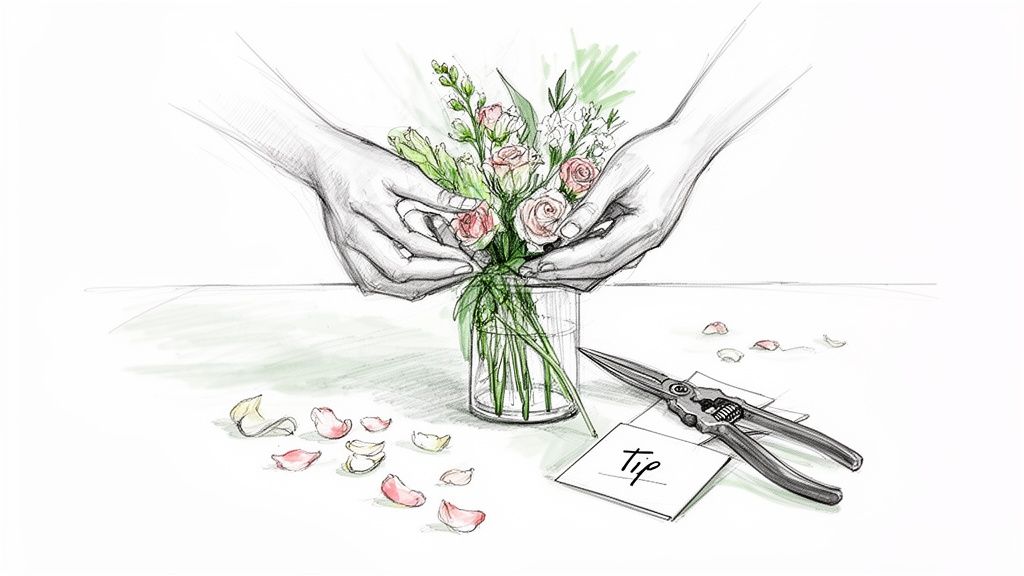
How do we decide on an amount?
When thinking about vendors like florists, it's helpful to consider both the product and the service. The team does more than deliver flowers; they are artists who execute a vision. A common approach is to tip 15-20% of the service or labor fee, if it’s itemized on your invoice. If not, a flat amount is perfectly acceptable.
For the lead designer or business owner, a tip isn’t always expected but is deeply appreciated for exceptional work. For the setup and breakdown crew, a tip acknowledges their physical labor.
A sample tipping budget for floral and decor:
- Delivery & Setup Crew: A tip of $100 – $200 for the team.
- Lead Designer: A separate tip of $100 – $250 for exceptional design work.
- On-Site Maintenance: An extra $50 – $75 if a team member stays to refresh or move arrangements.
These figures are a guide. The final amount should reflect the complexity of the design and the quality of the execution. If your floral arrangements transformed the feel of your venue, a generous tip is a wonderful way to say thank you.
Who should give them the tip?
Florists and their teams are often among the first to arrive and last to leave. This can make handing them a tip complicated. The best approach is to prepare the tip in advance and entrust it to your designated "tip manager."
It can be nice to have the tip delivered during setup. The team works hard to bring your vision to life, and receiving gratitude at that moment is a wonderful affirmation of their effort. It ensures they don't have to wait around at the end of a long night.
Prepare a clearly labeled envelope with the florist's or company's name. If you want to tip the lead designer and the crew separately, use multiple envelopes. This simple preparation ensures the people who added so much artistry to your day feel seen and valued.
What about drivers and other logistical staff?
The people who manage the movement of your day are often the unsung heroes of a wedding. From the shuttle driver ensuring guests arrive from their hotel to the valet attendants greeting each car, their work is about creating a smooth and welcoming flow.
How much is right for them?
Transportation and logistical staff often work in teams or handle specific, short-term tasks, so their tips are usually structured as flat amounts. It's often helpful to ask your venue coordinator about staff employed directly by the venue, as policies can differ.
A sample tipping budget for transportation & logistics:
- Limo or Shuttle Drivers: $20 – $50 per driver.
- Valet Attendants: $100 – $150 (This is typically a single "pooled" tip given to the lead attendant to share with the team).
- Setup/Logistical Crew: $20 – $50 per person (If they are not part of the standard catering team).
- Guest Services Staff: $50 – $100 (For a team at a hotel like The Merrill, a pooled tip given to the front desk manager is a common approach).
These amounts are suggestions. The goal is to acknowledge the individuals who made the day easier for you and your guests.
Who handles these particular tips?
Logistical tips can be the trickiest to manage because you may not interact directly with everyone involved. This is another area where your designated "tip manager" becomes essential.
Prepare separate, clearly labeled envelopes for each service. For a pooled tip like valet, one envelope marked "Valet Team" is sufficient. For multiple shuttle drivers, create an envelope for each.
Have your tip manager connect with the transportation captain or venue manager at the end of the service period. For drivers, this is usually at their final drop-off. A quick conversation with your coordinator at The Merrill can clarify which gratuities are already included, simplifying the entire process.
Does it have to be about the money?
After all the decisions are made, this question of tipping can feel like one more complicated detail. But it doesn't have to be. I have watched many couples navigate this quiet moment, and what I have seen is that the most important thing is the intention behind the gesture.
This entire conversation is built on observation, not rigid rules. There is no single "correct" way to show your appreciation. The percentages and amounts we have discussed are simply a common language for gratitude in this industry. They provide a starting point.
Think of this process less as an obligation and more as a final, thoughtful act of partnership. You chose these people to help build your day. How you close that loop is a personal decision that should feel right to you and your partner.
A note can mean a great deal
Sometimes, the most memorable thank you is not cash. I have seen couples give a small, meaningful gift to a photographer whose calm presence made them feel at ease. I have watched a planner tear up over a handwritten card that specifically mentioned how she solved a problem no one else even knew existed.
For the vendors who felt more like partners or mentors, a personal note acknowledging their specific contribution can mean as much, or more, than a tip. It shows you were paying attention.
This is especially true for business owners like photographers, videographers, or planners who own their companies. While a tip is always appreciated, they are also building a legacy of happy clients. A heartfelt review online or a personal referral to a friend is a form of gratitude that continues to give back to them.
Your final act of planning is letting go
The best thing you can do for yourself is to prepare your gratuities in advance. Designate someone you trust to be the keeper of the envelopes. Give them the list of who gets what and when. Once you hand over that responsibility, your work is done.
Your only job on the wedding day is to be present. It is to taste the food, to hear the music, to feel your partner’s hand in yours. You cannot do that if a part of your mind is still running through a checklist. Preparing for this final detail is your last act of planning, and it is an act of kindness to your future self.
Ultimately, knowing how to tip wedding vendors is about closing the circle of care that surrounded your wedding day. This is your moment to reflect that care back to the people who helped make it all happen. Handle it with thoughtfulness, then release it. Enjoy the beautiful thing you all built together.
As you consider the team that will bring your day to life, remember that the right setting can make all the difference. The team at The Merrill Hotel is accustomed to working seamlessly with all of your chosen vendors, ensuring every detail is handled with grace. We are here to provide that quiet, steady support, allowing you to focus on what truly matters. The Merrill Hotel