
The best way to write wedding vows is not to sit down and try to write a perfect speech. It usually starts with remembering the small, quiet moments you have already shared. The goal is to find words that sound like you and capture the truth of your relationship.
Where do we even begin with writing vows?
This is a question I hear all the time. It is usually asked quietly, almost like a confession. Vows seem like they should be easy, but then the blank page appears and the weight of the moment settles in.
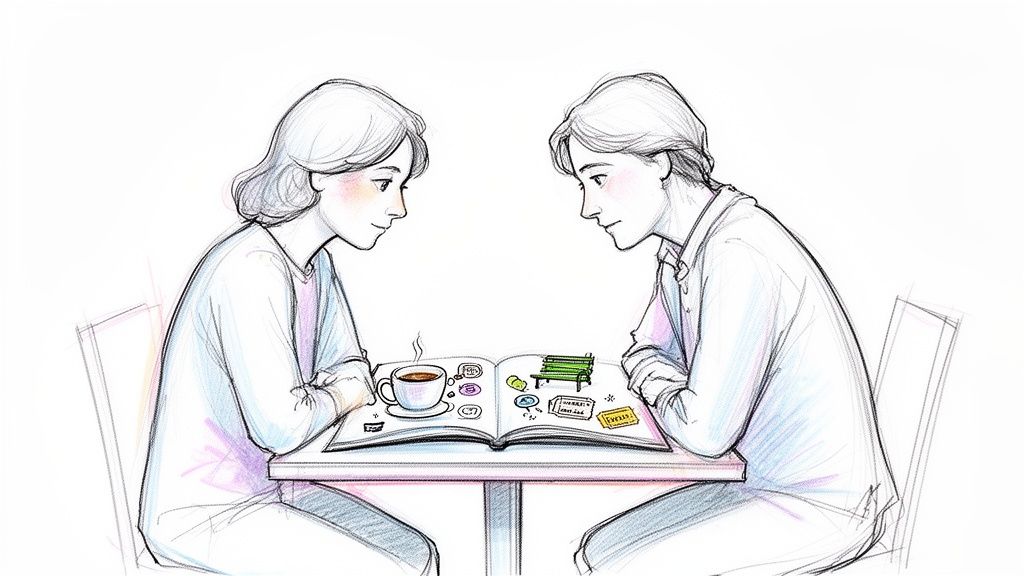
If that is where you are, know that it is completely normal. You are being asked to take an entire relationship, with all its history and future, and distill it into just a few minutes. The pressure to get it "right" can feel paralyzing.
But you are not alone in this feeling. More couples are choosing to write their own vows, moving away from formality to create something that feels more honest to who they are. What I have noticed is a real desire for authenticity, which is a good thing.
Start with remembering, not writing
Before a single word hits the page, it helps to just talk. Sit down together and share memories without any pressure to turn them into vows yet.
Just think about the small things.
- The first time you felt truly at ease with each other.
- A time you laughed so hard you could not breathe.
- A moment you saw their strength or kindness in a new way.
- A simple, everyday routine that means more than it probably should.
These little memories are the foundation. They hold more truth than grand statements ever could. This process is a lot like putting together other parts of your day, so it helps to treat it with the same gentle organization you would use for your main wedding planning checklist.
It is a common thought that vows need to be poetic. What I have seen is that the most moving vows are the ones that sound like a real conversation, just spoken with a little more intention.
The goal is not to write a masterpiece. It is just to find words that feel true. Start by collecting these small moments and feelings, and do not worry about the structure yet. For now, just give yourself the space to remember what brought you here. That is always the best place to begin.
What promises should we make to each other?
The heart of your vows lives in the promises you make. So often, couples feel they need to reach for something poetic, like promising the moon and the stars. But after watching hundreds of ceremonies, I can tell you the promises that truly connect are the ones grounded in the reality of a shared life.
They are the small, sturdy commitments that will still make sense long after the wedding day ends.
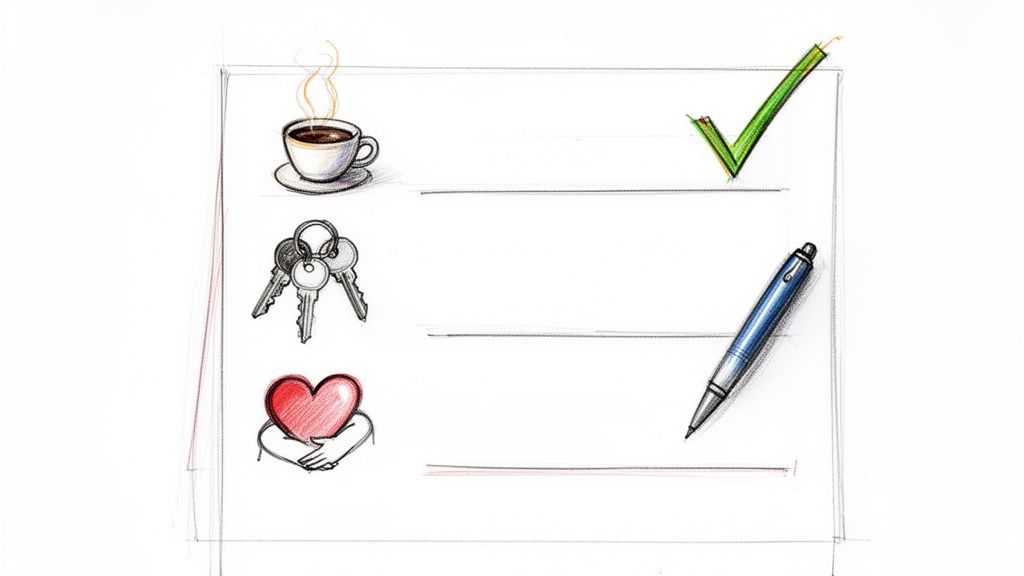
It helps to think less about vowing eternal perfection and more about the simple ways you show up for each other. A promise to always make the coffee on mornings with an early start, or to be the one who deals with the spiders, often gets a more genuine reaction than a broad promise to “always be there.” One is an idea; the other is an action.
It is these tangible acts of care that build a life together.
Turning feelings into commitments
Finding your promises is really about looking at the big feelings you have for each other and translating them into small, specific actions. It helps to think about what your partner actually needs from you and what you can realistically give.
Here in Muscatine, life has a certain rhythm tied to the seasons and the river. A promise to take a walk along the waterfront, even when life gets busy, has a real sense of place and time. Your promises can have that same grounded feeling.
The most meaningful promises are not about never having a bad day. They are about how you will get through the bad days together. They acknowledge that life is not always easy but that your commitment is steady.
This is also a chance to bring some balance to your vows. A heartfelt, serious promise followed by a lighthearted one that makes your partner smile shows the full dimension of your relationship. It is okay to promise to listen to their dreams and also promise to let them have the last piece of cake.
Finding your promises
The simplest way to start is by looking at a common feeling and finding a specific, tangible promise that reflects it.
This table can help get you started.
| Instead of a Vague Idea… | Consider a Specific Promise Like… |
|---|---|
| "I will always support you." | "I promise to be your biggest fan, even when you doubt yourself." |
| "I will be adventurous with you." | "I promise to always try the restaurant you picked, no matter how strange the menu looks." |
| "We will have fun together." | "I promise to keep our life filled with laughter, even if it is just from my bad jokes." |
| "I will take care of you." | "I promise to bring you soup when you are sick and to listen when you just need to talk." |
These types of commitments are durable. They will mean just as much in five years as they do on your wedding day because they are rooted in the kind of love that shows up every day.
How do we tell our story without saying everything?
This is a question many couples ask. They get concerned about trying to fit their entire relationship into a few minutes, worried they will leave out something important. It is a natural fear, but your vows are not a history report. They are a feeling, captured in a moment.
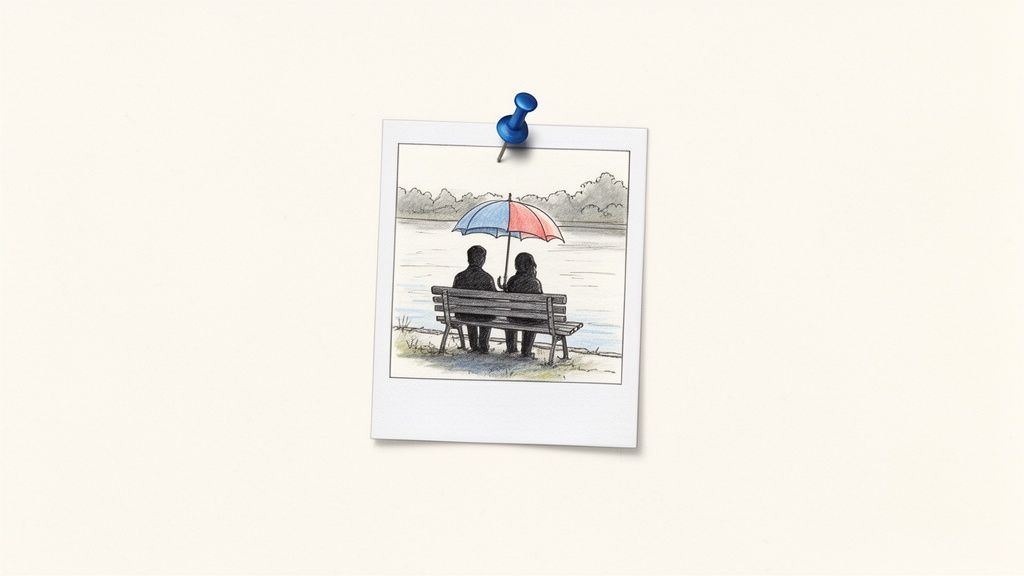
Your vows are a snapshot, not the whole photo album. The goal is to pick one or two images that get to the heart of why you are standing there. A single, well-chosen memory can do all the heavy lifting.
Choosing the right snapshot
The key is to find a memory that shows something essential about your partner or your bond, instead of just telling people about it. A story about the time they brought you soup when you were sick says more than simply stating, “you are a caring person.”
You might think about moments like these:
- A time their sense of humor turned your bad day around.
- The first time you felt like a real team, facing something together.
- A quiet afternoon when you looked over at them and just felt peaceful.
- The moment you realized your life had shifted for the better because they were in it.
These do not have to be dramatic events. Often, the simpler, the better. Here at The Merrill, I see this happen all the time during ceremonies overlooking the Mississippi. A quiet story about a rainy afternoon or a shared inside joke is what holds everyone’s attention. The power is in its truth, not its grandeur.
It helps to remember that your guests do not need a timeline of your relationship. They just need a window into why you are choosing each other. A small, specific memory opens that window.
Choosing just one or two of these moments helps you focus. Trust that a few honest details will say everything that needs to be said.
Your relationship is a vast landscape. You do not need to map it all out for everyone. Just point to your favorite view.
What does it mean to find the right words?
So many people get stuck here, worried their writing is not "good enough" for their vows. There is a quiet pressure to sound like a poet or a storyteller. It helps to let that idea go completely.
Your vows are not a performance. They are not an essay to be graded. They are a conversation with your partner, spoken in front of people you both trust. The "right" words are simply the ones that are true.
This part of the process is more about permission than instruction. It is about giving yourself permission to sound exactly like yourself.
Write in your own voice
The person your partner wants to hear from is you—the real, everyday you. If your relationship is built on inside jokes and laughter, it is okay for your vows to have some humor in them. If you are both more earnest and straightforward, your words should be, too.
I have seen over and over that the most moving vows are often the simplest. They use plain language because that is how we actually speak to the people we love. Now is not the time to try out a new vocabulary or a style that feels forced. Authenticity is always more powerful.
It helps to remember that your partner fell in love with your voice, not a more polished version of it. The way you talk, the little phrases you use—that is what will make your vows feel real.
There is a sense of relief that comes when couples finally realize this. Suddenly, the task feels less like a formal assignment and more like writing a heartfelt letter. For more ideas on keeping your ceremony personal, our guide on non-traditional vows has some gentle suggestions.
The goal is not to impress anyone. The goal is to connect. When you speak from a place of honesty, using the words that come naturally to you, that connection happens on its own. It is what everyone in the room, especially your partner, is hoping to witness.
How do we bring it all together?
Once you have the pieces—the memories, the inside jokes, the promises—the next question is almost always about how to arrange them. It can feel like holding a handful of beautiful, but disconnected, thoughts.
The goal is not to force them into a rigid structure. It is about finding a gentle flow that lets one thought lead naturally into the next. This is not about following a formula, but about giving your words a beginning, a middle, and an end so your partner can follow your heart.
What I have seen work beautifully is a simple, conversational arc.
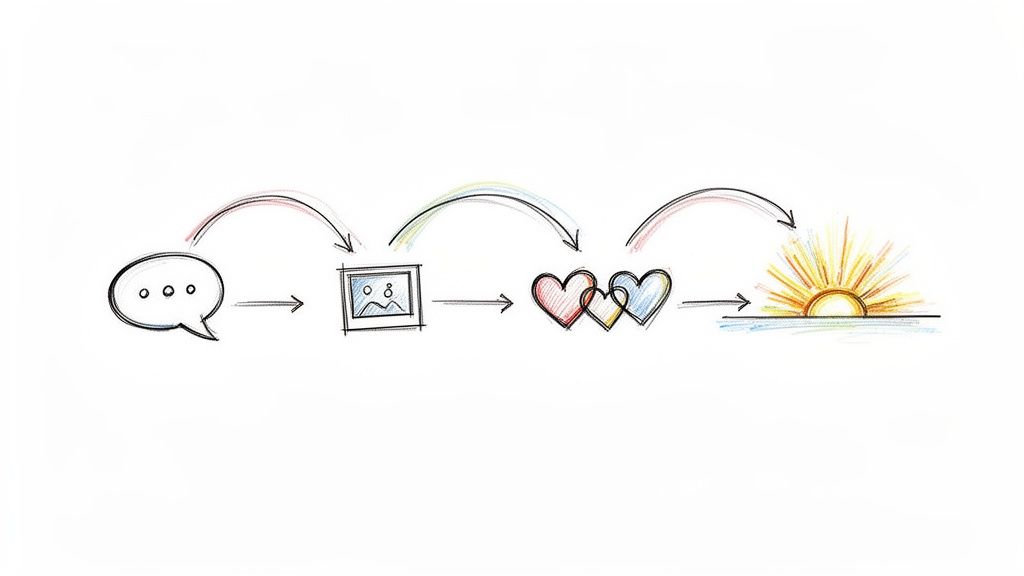
Most couples find that a simple progression helps them organize everything without feeling like they are reading from a script. It just helps create a calm, coherent whole.
A gentle path for your vows
Think of this less as a set of rules and more as a helpful guide. It is just a way to make sure your most important thoughts land clearly.
A natural progression often looks something like this:
- Start by speaking directly to your partner. Just saying their name is a simple, powerful thing. It immediately makes everything more intimate.
- Share a brief memory. Choose one of those small, specific stories. A single sentence about a moment that showed you who they are can set the entire emotional tone.
- State your promises. This is the heart of it. After you have shared a glimpse of your past, you make clear, grounded promises for your future.
- End with a look forward. Close by talking about the life you are excited to build together. It is a hopeful, steady note to end on.
This structure allows you to move from the past, to the present, to the future in a way that feels complete.
The most effective vows I have heard are not the longest. They are the ones with the clearest emotional arc. They guide the listener—and most importantly, your partner—on a brief journey.
How long should our vows be?
This is a practical question that comes up a lot. There is no perfect length, but a good reference point is somewhere between one and three minutes when spoken aloud. This usually translates to about 150 to 300 words.
That might sound short, but when you are standing up there, three minutes feels like a full amount of time. It is long enough to share something meaningful without losing the attention of your guests.
The best way to know if the length feels right is to practice reading your words out loud at a natural, unhurried pace. You will find the rhythm that feels right for you. What really matters is that you have enough time to say what you need to say, and that your partner has the same.
What should we know before the ceremony?
The time just before the ceremony has a strange rhythm. Some moments are quiet, and others are a blur. Thinking through a few small, practical details ahead of time can make a difference in how present you feel when the moment comes.
It is about making a couple of simple decisions now, so your only focus later is on your partner and your words. There is not one right way to do this, only the way that feels most steady for you.
Will you read from something?
One of the first practical things to decide is what you will hold in your hands. Some people memorize their vows, but most choose to read them. It takes the pressure off, especially when emotions are running high.
A lot of couples write their vows on a simple card that fits easily in a hand or a pocket. Others prefer a small vow book, which can become a keepsake. The object itself does not matter as much as how comfortable you feel holding it.
Whatever you choose, just make sure the text is easy to read. A slightly larger font or a clear, dark pen helps more than you would think. The goal is to be able to glance down and find your place without struggling.
Should we practice aloud?
This is a step I have seen bring so much calm to couples. Reading your vows out loud to yourself a few times in the days before the wedding is helpful. It is not a rehearsal for a performance, but about getting comfortable with the sound and rhythm of your own words.
When you practice, you start to feel the natural pauses and the flow of the sentences. You might even notice a word that feels a bit awkward to say and swap it for something that feels more like you.
This is not about a perfect delivery. It is about letting the words settle into your body, so they feel less like something you wrote and more like something you are simply saying, from the heart.
Speaking them aloud also prepares you for the emotion of the moment. It gives you a sense of what the words will feel like when you share them with your partner.
Sharing your vows beforehand
Couples often ask if they should share their vows with each other before the ceremony. There are two very different feelings on this, and both are valid.
Some couples choose to keep their vows a surprise. They like the idea of hearing those words for the first time during the ceremony, and it can create a powerful, emotional moment.
Other couples find comfort in sharing them privately beforehand. Reading them to each other in a quiet moment, maybe the day before, can ease a lot of nerves. It also lets you make sure the tone and length of your vows feel balanced. It is just another one of those decisions that comes down to what feels right for your relationship.
Remember, emotion is a part of this. Your voice might shake. You might need to pause. That is what makes it real. As you think about how your ceremony will flow, you might also want to look at the typical wedding processional order to see how all the pieces fit together.
This preparation is just about removing the small distractions so you can be fully present in a moment that is, in the end, just for the two of you.
At The Merrill Hotel, we have seen that the most memorable moments are often the quietest. Discover how our riverfront setting provides a calm and beautiful backdrop for your own story.