
Planning a smaller wedding isn't about shrinking a large one. It's about changing the focus. It’s the moment you give yourself permission to stop thinking about performance and start thinking about connection.
This choice lets you build an intimate gathering, usually with fifty guests or fewer, where every detail feels like it belongs to you. Planning this way is not a lesser version of something else. It is a decision to be intentional from the very start.
What does it mean to choose a smaller wedding?
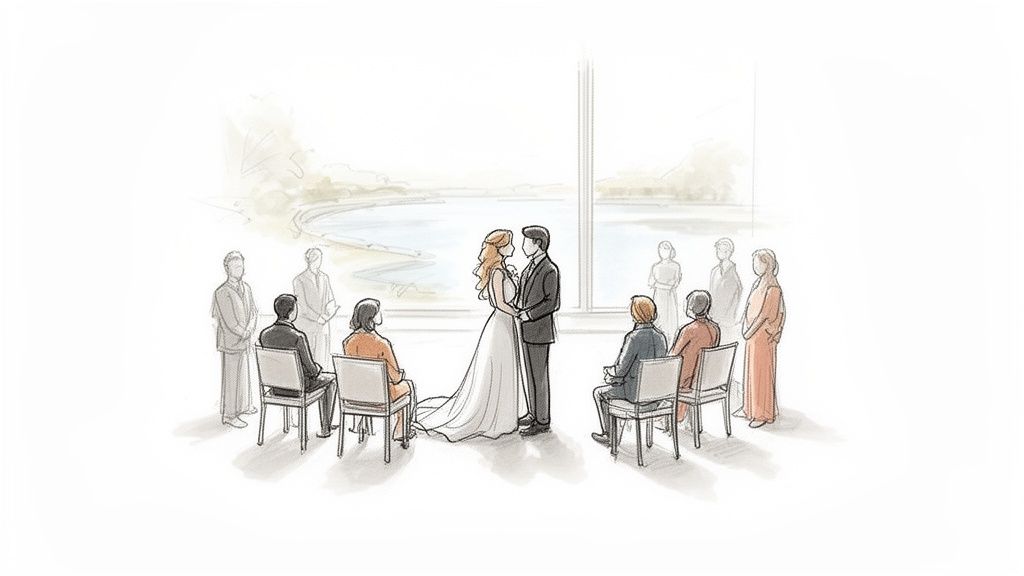
There’s often a quiet moment when a couple realizes a big, traditional wedding doesn't feel like them. I’ve seen that realization bring an immediate sense of relief. It’s a perfectly normal feeling.
Choosing a micro wedding is a move toward intimacy over spectacle. Instead of running a large production, your energy goes into creating a shared experience with the people who know you best. That one shift in perspective changes every other decision you will make.
A focus on being present
The biggest difference I’ve seen is in the feel of the day. With fewer people, the timeline loosens. There’s more room for the quiet, unscripted moments to happen. You can have real conversations with everyone there, not just quick hellos as you walk by.
This isn't an uncommon choice. In fact, one study on wedding trends showed that interest in micro weddings has grown by 335% over the last two decades. With nearly half of all couples having considered it, it’s clear people are looking for a more personal way to celebrate.
What I have seen is that a smaller wedding gives you the freedom to invest your energy, not just your budget, in what truly matters to you. The day becomes less about logistics and more about being present with each other.
How this choice shapes your planning
Once you decide on a smaller celebration, the rest of the planning starts to fall into place. The questions you ask yourself change. Instead of, "How can we fit everyone?" it becomes, "How can we make this feel thoughtful for these specific people?"
That one decision shapes everything. Here in Muscatine, that might look like a relaxed dinner watching boats on the river, or a quiet brunch where everyone can linger over coffee. The focus lands on the quality of time, not the quantity of guests.
This path isn't just about downsizing. It’s about understanding that smaller weddings often feel different because the point of the gathering is refined. It becomes a reflection of your relationship and the people who have been there all along.
Who belongs on the guest list?
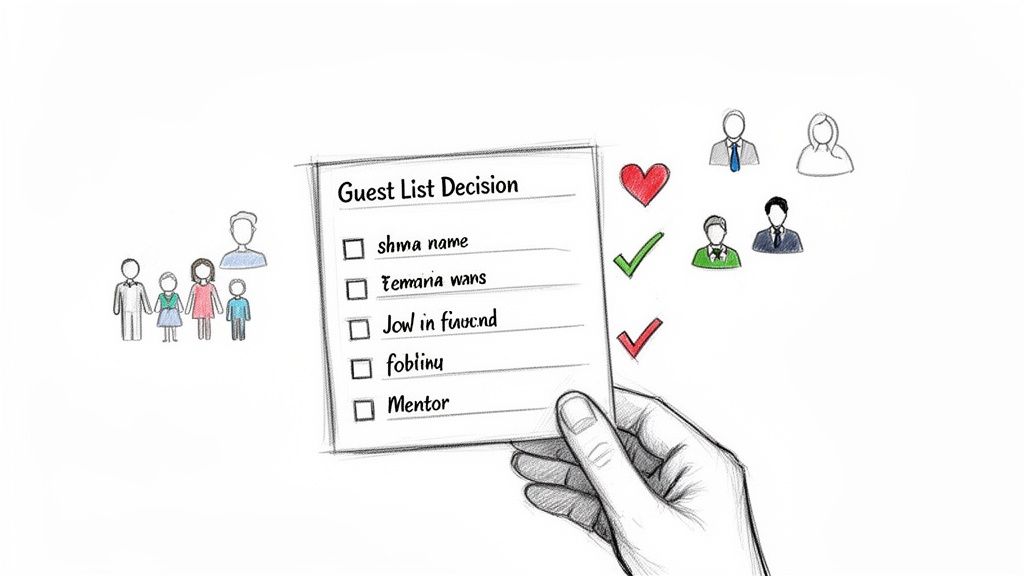
This part of planning feels the most personal, and sometimes, the most complicated. A micro-wedding guest list isn't just a collection of names. It’s the small group of people you’re building the day around.
This is usually where the first real challenges appear. It’s a normal part of the process. You are moving from the idea of a small wedding to the reality of drawing a line around a specific group of people.
It helps to remember that your goal is to create a room that feels genuinely warm and supportive, not one that simply checks off obligations.
Who comes to mind first?
When you first picture your ceremony, who do you see? Before you open a spreadsheet or think about family trees, just sit with that question. The people who come to mind in that quiet moment are almost always your starting point.
I’ve watched hundreds of couples navigate this. The ones who find clarity the fastest are those who focus on a simple thought: who could we not imagine this day without?
It’s a different question than, “Who do we have to invite?” That small change in wording can shift the entire feeling of the task.
What I've seen is that the guest list becomes simpler when it’s about creating comfort. You are choosing the people you can be your most unguarded selves with on a day that is, at its heart, incredibly personal.
A few quiet questions to ask yourselves
Drawing these lines is a thoughtful exercise. There are no right or wrong answers, only what feels true for you both. As you consider people, it might help to ask a few quiet questions.
- Who has seen our relationship grow? Think about the friends and family who have been there from the beginning.
- With whom do we feel the most at ease? Your wedding day should be a place of comfort, not performance.
- Who will add to the calm and joy of the day? The energy of the room is shaped by the people in it.
- Will we feel we had a real conversation with this person? With a smaller group, you have the time to connect with everyone there.
This process is about more than just managing numbers. Our guide to thoughtful wedding guest list planning offers a few more perspectives that couples have found helpful. It’s a delicate balance of heart and logistics.
How do we handle difficult conversations?
It’s natural to feel concern about the people who won’t be on the list. These conversations are almost always kinder and less complicated than we imagine they will be.
Most people understand when a couple chooses to have a very small wedding. Explaining your decision calmly and honestly is usually the best approach. You can simply say that you’ve decided to keep the day very small, with just your closest family and friends.
This isn’t about making excuses. It’s about sharing your intention for a day that feels personal and true to you. That gentle honesty is almost always met with grace.
How do we find our space and our people?
After the guest list takes shape, the next question is where this day will happen. For a smaller wedding, the space you choose plays a different role. It’s less about how many people it can hold and more about how it feels.
A venue for a smaller wedding should feel like it can contain the warmth of your group without the room feeling empty. You’re searching for a place that invites people to connect.
What makes an intimate space work?
I've noticed that the best spaces for these gatherings tend to have a few things in common. They almost always have beautiful natural light, which adds a certain softness to the day. They also offer a sense of privacy, creating the feeling that this time is reserved for you and your guests alone.
Here in Muscatine, something as simple as a view of the Mississippi River can set a calm, steady tone. The environment becomes another quiet guest. When you’re thinking about how to choose a wedding venue, the feeling of the space is just as critical as the logistics.
Remember, you aren't just booking a room. You’re choosing the backdrop for some of the most meaningful conversations you’ll hold onto.
Building your small, trusted team
It’s an interesting thing to watch. Even when the guest list shrinks, the team of professionals a couple works with often stays about the same size. A thoughtful event still requires coordination behind the scenes.
Recent wedding industry reports show that while 44% of couples are choosing more intimate celebrations, the number of vendors they hire has remained stable. This tells me that the support of a professional team is just as important for a micro-wedding. You can read more in the full travel and wedding report.
The key is finding people who understand the rhythm of a smaller wedding. You want a team that works to enhance the intimacy, not overwhelm it.
How a micro-wedding budget shifts
With fewer guests, couples often find their budget priorities shift. The focus moves from logistics for many to creating a notable experience for the few. This often means reallocating funds toward a more elaborate menu, better bar selections, or the photographer whose work you have always loved.
| Budget Category | Focus in a Large Wedding | Potential Focus in a Micro Wedding |
|---|---|---|
| Catering | Feeding a large number of guests efficiently. | An upgraded, multi-course meal or private chef experience. |
| Venue | Maximizing capacity and ample seating. | Unique spaces, scenic views, and architectural details. |
| Photography | Capturing key moments and large group shots. | More time for couple's portraits and candid guest interactions. |
| Florals & Decor | Filling a large space with many centerpieces. | High-end, detailed arrangements and lush, immersive details. |
| Guest Experience | Logistics like transportation and lodging. | Personalized welcome gifts and curated local activities. |
This shift isn't about spending less overall, but about spending more intentionally to elevate the details that matter most to you.
Choosing vendors who understand intimacy
When you talk with potential vendors, listen for how they describe smaller events. Do they see it as just a scaled-down version of a big wedding, or do they understand the unique opportunities it presents?
A photographer who specializes in micro-weddings knows how to capture quiet moments without being intrusive. A caterer who loves this scale can create a personal meal that feels more like an elegant dinner party.
Your goal is to gather a small team of people you genuinely trust. These are the professionals who will be present for the most personal parts of your day. When you feel comfortable with them, you can relax and be present yourself.
How will the wedding day unfold?
One of the first questions couples ask is about the timeline. When you don’t have the usual structure of a 150-person event, it’s hard to picture how the day will feel. Will there be awkward gaps?
It helps to think about the day not as a rigid schedule, but as a series of moments. You get to decide what those moments are and how they unfold. You are not following a script written for someone else.
The biggest shift I see is that the day becomes less about performance and more about presence. There’s more time. More time for a slow breakfast, more time to take a walk before getting ready, and more time to simply be with the people who gathered around you.
What does a more flexible timeline look like?
This is where the planning becomes truly personal. With intimate guest lists, couples can rethink the traditional timeline. Instead of the usual ceremony-cocktails-dinner sequence, you can build a day that reflects what you love to do. Industry data shows a 156% increase in searches for custom ceremony elements, which points to this desire for personalization. You can see more about these evolving wedding trends and insights.
This chart shows a typical order for bringing on the professionals who will help shape your day.
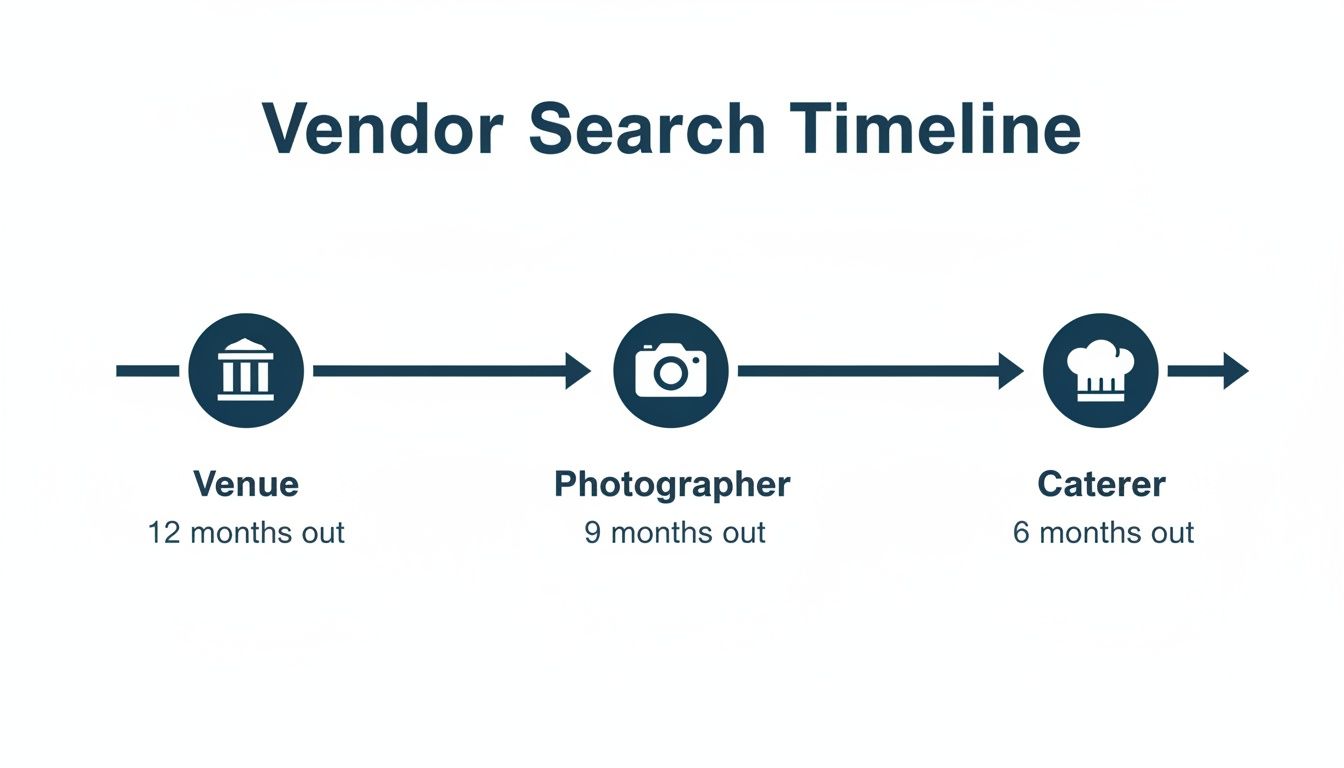
Booking the venue first gives your day a home. Next comes the photographer who will capture its feeling, and then the caterer who will design the meal everyone gathers around.
So, what could this look like for you?
- A morning ceremony followed by a long, unhurried brunch.
- An afternoon of lawn games and conversation before an intimate dinner at sunset.
- A ceremony timed to catch the last light over the Mississippi, followed by cocktails and dessert.
The day can unfold at a human pace, one that allows for spontaneity.
What I have seen is that the most memorable timelines are the ones that reflect the couple's natural rhythm. They build in time for what they value, whether that's a private moment together or an extra hour of conversation with grandparents.
Letting the day breathe
A smaller guest list means fewer moving parts. This has a calming effect on the day. Transitions from the ceremony to the reception become smoother and less hurried.
There’s no need to rush from vows to photos to dinner. You can linger. You can finish your conversation. You can take a few quiet minutes alone to watch the river and let the moment settle.
I’ve watched couples use this freedom in beautiful ways. One pair I remember took twenty minutes after their ceremony, just the two of them, to share a glass of champagne before rejoining their family. It was a small pocket of quiet that grounded them. Another couple ended their night by gathering with their fifteen guests around the fire pit on the terrace.
These are the moments a flexible timeline allows. They are often the parts of the day that are remembered most clearly. The schedule serves the experience, not the other way around.
How can we make the weekend special for guests?
A micro wedding gives you something larger celebrations often cannot. It gives you time.
With a smaller group, the celebration doesn’t have to be packed into just a few hours. I’ve seen many couples let the experience breathe over a full weekend, which feels especially right in a place like Muscatine. Here, the pace is a little slower, and it invites people to settle in.
This turns a wedding day into a personal retreat for the people who matter most. It’s a chance to make your closest guests feel truly seen and cared for.
The gentle welcome of a night-before gathering
There’s a subtle change in the air when guests arrive the day before the ceremony. The stress of travel melts away, and they have a moment to simply be there.
A welcome gathering doesn't need to be a grand production. The simplest ones are often the most memorable. It can be as easy as reserving a few tables at a local spot or hosting cocktails in a private suite.
I’ve watched these informal moments unfold time and again. This is where inside jokes are shared and friends from different parts of your life connect. By the time the ceremony begins, your guests are no longer a collection of individuals. They have become a warm, familiar group.
What I’ve seen is that the wedding truly begins at this welcome. It sets a tone of relaxation, allowing everyone, including you, to be more present for the main event.
This get-together also takes pressure off the reception. You’ve already had a chance to greet everyone, so you can relax into the flow of the next day without feeling rushed.
The quiet kindness of a farewell brunch
The morning after a wedding has its own distinct feeling. The celebration is over, and what’s left is a warm, shared memory.
A farewell brunch is a simple act of hospitality that extends that feeling. It gives everyone a soft landing before they say their goodbyes. Coffee, pastries, and a comfortable place to sit are more than enough.
This is when guests exchange numbers, share photos, and talk about their travel home. It’s a low-pressure moment that feels like a natural conclusion to the weekend. For many, it’s one of the most cherished parts of the celebration.
A look at a possible weekend flow
Thinking about the whole weekend can help you plan with intention. The goal isn’t to pack every moment, but to create space for connection. This sample flow can help you visualize how an intimate wedding weekend might unfold.
Sample Micro Wedding Weekend Flow
| Day | Potential Gathering | Atmosphere and Intention |
|---|---|---|
| Friday Evening | Welcome Reception | Informal and relaxed. Helps guests unwind and get to know one another. A chance for you to greet everyone personally. |
| Saturday | The Wedding Day | The central celebration. With a smaller group, the timeline can be more fluid, allowing for both planned moments and spontaneous connections. |
| Sunday Morning | Farewell Brunch | Casual and comfortable. A final, gentle gathering to say thank you and goodbye, allowing guests to depart at their own pace. |
Turning your wedding into a weekend experience is one of the most thoughtful things you can do for your guests. It acknowledges the effort they’ve made to be with you and gives everyone the space to connect more deeply.
Some common questions that come up
It’s natural to have questions. This path is less traveled than the traditional one, and it helps to hear from someone who has seen it unfold many times. These are the things couples quietly wonder about as they consider a smaller celebration.
How far in advance should we plan?
While a smaller wedding can come together more quickly, giving yourselves nine to twelve months is often a good amount of time. This allows you to book your preferred venue and key vendors without feeling rushed.
However, the beauty of a smaller scale is its flexibility. I’ve seen beautiful, calm micro-weddings planned in just six months. The right timeline is simply the one that lets you move at a comfortable pace.
Can we still include traditional elements?
Of course. A micro-wedding is about intention, not about eliminating traditions you love. You can absolutely have a first dance, cut a cake, and listen to meaningful toasts.
The difference is that you get to choose which elements hold significance for you. There are no requirements. I’ve seen couples have a very traditional ceremony followed by an informal, family-style dinner. It’s about what feels authentic to your story.
It helps to remember that every tradition started as someone’s new idea. Your wedding is your chance to decide which of those ideas you want to carry forward.
How do we manage expectations from family not invited?
This is perhaps the most delicate part of the process. Honesty and kindness are always the best approach. It’s something that feels much harder in your mind than it usually is in reality.
It helps to communicate your decision early, explaining that you have chosen a very intimate celebration. You might say, “We’ve decided to have a very small ceremony with just our immediate family.” Framing it as a personal choice about the style of the wedding is key.
Most people understand when you share your heart. They know this decision comes from a desire to keep the day personal and quiet, not from a lack of care for them.
Is a micro-wedding always less expensive?
It can be, but that’s not always the primary goal. The most significant savings come from the reduced guest count, which lowers catering and rental costs.
However, I have seen many couples reinvest those savings into other areas to elevate the experience for their small group. They might choose a more elaborate menu, a top-tier photographer, or personalized welcome gifts.
It’s more accurate to say a micro-wedding gives you more control over your budget. It allows you to prioritize what truly matters, focusing your resources on the details that will make the day feel special for you and the people you have invited.