
There’s a quiet shift that happens in the planning. The big decisions are made, and you start to picture the ceremony itself. That’s often when the question of a wedding arch comes up. The answer is different for everyone. Some couples build one from scratch, some use a simple kit, and others rent a beautiful piece and just focus on making it their own.
What is the point of a wedding arch?
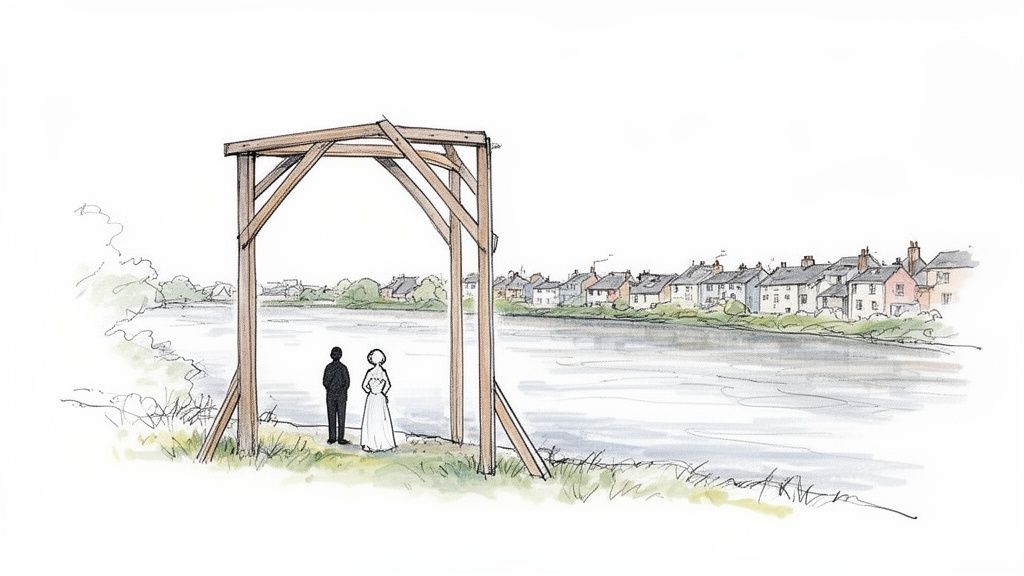
The idea of a wedding arch is rarely on the first checklist. It tends to show up later, after you’ve chosen your venue and can see the day taking shape. It’s less of a demand for a big structure and more of a quiet question about how to frame the moment you say your vows.
I’ve seen many couples take different paths here, and every single one felt right for them. The best approach is always the one that feels the most like you.
How does an arch shape the ceremony?
At its core, an arch creates a focal point. It draws everyone’s eyes and gives your ceremony a true sense of place. Whether it’s set against the wide expanse of the Mississippi River or inside a room with soaring ceilings, it carves out a backdrop just for the two of you.
For some, building that backdrop with their own hands becomes a meaningful part of the story. For others, the thought of one more project is just too much. They find their peace in renting a structure and letting a professional handle the setup.
There is no right or wrong answer here. The purpose of the arch is to serve you, not the other way around. It can be as simple or as elaborate as you want it to be.
How do time and season play a part?
It’s always interesting to see how the time of year influences these plans. I’ve noticed that as the summer builds here in Muscatine, so does the energy for planning the little details of an outdoor ceremony. Many couples seem to start thinking about their ceremony design during the warmer months.
In fact, recent search data shows that inquiries for wedding arches tend to peak in August. That timing lines up with what I see as couples finalize their plans for autumn weddings. That same data found that while floral arches are most popular in the summer, simple wooden arches hold a steady appeal all year long. You can learn more about these seasonal patterns in wedding decor planning from this research.
The question isn't just about style—it's about practicality. A wooden arch might need to be built and stained weeks ahead of time, whereas a simple draped fabric arch can be a much quicker addition. Thinking about how the arch fits into your bigger timeline can bring a lot of clarity. If you're looking for more thoughts on framing your ceremony space, you might find our guide on outdoor wedding ceremony ideas helpful.
In the end, whether you build, buy, or rent, the arch is just a quiet witness. Its job is to hold the space while you two are the center of everything.
How do we find a style that feels right?
When you first start thinking about a wedding arch, it’s easy to get lost in photos. But it helps to pause for a moment and think about the feeling you want to create. An arch isn't just a backdrop; it’s the space where you’ll make your promises. The right one feels like it belongs there with you.
Over the years, I’ve watched many couples stand before many different kinds of arches. Each one brings its own quiet energy to the ceremony. This isn't about finding the most popular design, but about finding a shape that holds your story.
How can a shape reflect our story?
A simple wooden arch often feels warm and grounded. Whether it’s a classic rectangle, a modern triangle, or even a heptagon, the natural material brings a sense of earthiness into the room. I’ve seen couples build these themselves, and the act of creating it seems to weave itself into the memory of the day.
Metal hoops and frames tell a different story. They feel clean, modern, and intentional. A circular arch, in particular, has a certain softness, creating a frame that feels complete and whole. It’s a style that doesn’t demand a lot of decoration to make a statement. Sometimes just a whisper of greenery is all it needs.
It's helpful to see how these different elements connect to your bigger vision. You can explore how these shapes and materials tie into various romantic wedding themes to create a feeling that’s truly your own.
A quiet comparison of common arch types can help you see which might feel right for your ceremony space and personal style.
A quiet comparison of arch styles
| Arch Style | What It Feels Like | Works Well For |
|---|---|---|
| Wooden | Warm, grounded, timeless, natural. | Rustic, bohemian, or classic weddings. A thoughtful DIY project. |
| Metal Circle | Modern, soft, complete, minimalist. | Contemporary or industrial-chic events. Spaces with a view. |
| Floral | Romantic, organic, lush, alive. | Garden parties, traditional ceremonies, and elegant ballroom settings. |
| Fabric Draped | Soft, ethereal, flowing, gentle. | Beachfront vows, romantic indoor ceremonies, or softening a modern arch. |
Each style sets a different tone, so it's really about which one feels most like the two of you.
What if we want something different?
Lately, I’ve noticed more couples moving away from traditional overhead structures. They’re choosing floral installations that look like they’re growing right out of the ground. These grounded arches create a beautiful, organic frame at your feet, as if you’re standing in a garden that bloomed just for that moment.
This shift feels very natural. Floral designers have noticed more requests for these "growing" installations, which make a ceremony space feel completely integrated with its surroundings. As florists are noting in guides like this one on ground-level floral trends from TheKnot.com, it’s a subtle change in architecture—moving the arch from an overhead frame to a horizontal, living part of the setting.
This style works especially well for outdoor ceremonies where you don’t want to obstruct a view, like the wide sky or the slow-moving river right here in Muscatine.
An arch doesn’t have to be something you stand under. It can be something you stand within. The goal is to create a space that feels set apart, and there are many ways to do that.
How does the setting influence our choice?
The place where you get married will always have a quiet say in your design. A tall, dramatic arch might feel right at home in a ballroom with high ceilings, but a simpler, lower design feels more appropriate in an intimate space.
Weather is another quiet advisor. Here along the Mississippi, a strong breeze is always a possibility for outdoor ceremonies. A lightweight frame with a lot of fabric can act like a sail, while a sturdy wooden structure or a grounded floral piece will hold its own. It’s a practical thought, but an important one.
The season plays its part, too. A bare, architectural arch can look striking against a spare winter landscape, while an arch covered in lush greenery feels perfect for a summer afternoon. It’s not about following rules, but about listening to what the time and place are telling you. In the end, the style that feels right is the one that lets the two of you be the focus.
Building your own wedding arch is one of those projects that feels different. There’s something steadying about it, working with your hands in the middle of all the other planning. It’s a quiet, manageable task that often becomes more than just a project—it becomes part of the story.
I’ve seen fathers and daughters build them, couples build them together over a weekend, and friends gather to create one as a gift. It grounds the process in something tangible.
The style of arches has certainly changed over the years. What started as a sturdy wooden frame has evolved into minimalist metal hoops and, more recently, organic grounded florals that feel like part of the landscape.
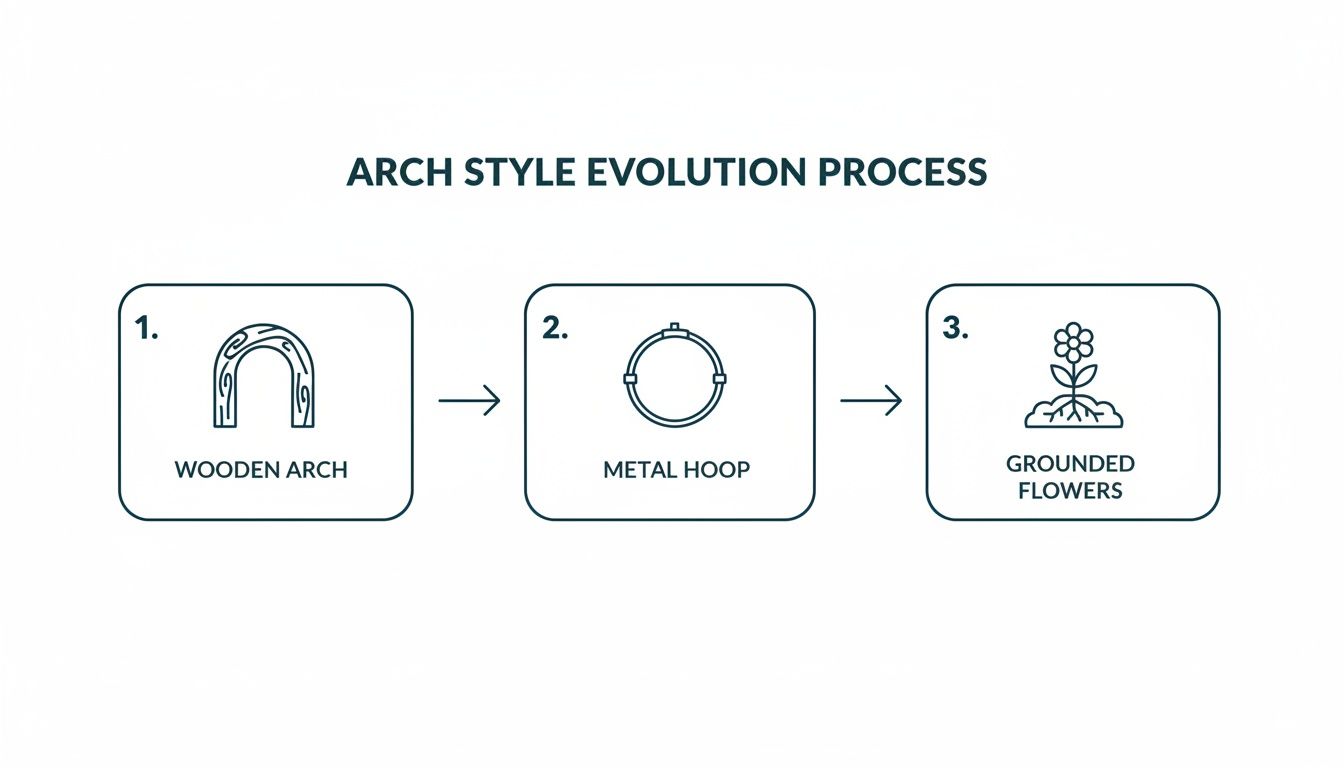
This shift shows a clear movement toward designs that feel more integrated with their surroundings, which is something to keep in mind as you plan your own.
What materials and tools are needed?
Before you start, getting everything you need in one place brings a sense of calm. You are not building a house, just a simple frame for a single moment. Most designs require only a few basic things.
For a classic wooden arch, roughly eight feet tall and five feet wide, you’ll generally need:
- Three pieces of lumber: Two 8-foot lengths for the vertical posts and one 6-foot length for the top crossbeam. Cedar or pine are good choices—they’re lightweight and have a lovely grain.
- Two shorter pieces for the base: Two-foot sections usually provide all the stability you need for the feet.
- Four support braces: These are small, angled cuts of wood that keep the corners secure and stop the arch from swaying.
- Wood screws or bolts: Screws are the simplest option, but bolts offer extra strength, which is worth considering for an outdoor ceremony.
- A drill and sandpaper: Just the basics for assembly and finishing.
The most successful projects I’ve seen always start with a clear, simple plan. A quick sketch with your measurements is all you really need.
There’s a moment, when all the pieces are laid out, that you can finally see it. It’s a good feeling. It reminds you that something beautiful is taking shape, one simple step at a time.
How does it all go together?
You’ll want to assemble the arch on a flat, level surface. A garage floor or a clear patio works well. This lets you see how everything fits together before you stand it up.
Start by creating the two base supports. Attach one of the two-foot lumber pieces to the bottom of each eight-foot post to form a ‘T’ shape. Securing this with screws from both the top and the bottom creates a sturdy foundation. It’s the part no one sees, but it holds everything up.
With the bases attached, lay the two vertical posts on the ground, parallel to each other. Now place the six-foot crossbeam across the top ends, making sure it’s centered and square. This is when it really starts to look like an arch.
Next, you'll screw the crossbeam into the top of each post. I’ve seen people drill pilot holes first, which is a small, patient step that helps prevent the wood from splitting. It makes a difference.
What about stability and a soft finish?
With the main frame connected, you can add the four small support braces. They fit into the corners where the posts meet the crossbeam and where the posts meet the feet. You’ll be surprised how much rigidity they add.
Once it's fully assembled, take a moment to sand all the edges smooth. It not only looks more refined but also protects any delicate fabrics or flowers you might add. I’ve watched florists run their hands over an arch before they begin, feeling for rough spots. A little sanding is a kindness to them and to your design.
If you decide to stain or paint your arch, it’s best to do this a few weeks before the wedding. This gives it plenty of time to dry completely so there’s no lingering scent. A natural stain that complements the wood grain always looks beautiful in the soft light of a ceremony.
Assembling your own arch is a quiet act of intention. It’s a physical thing you can point to and say, "We made that." And on the day of the ceremony, it will stand there as a simple, sturdy frame for the promises you’re about to make.
How do we add our own personal touches?
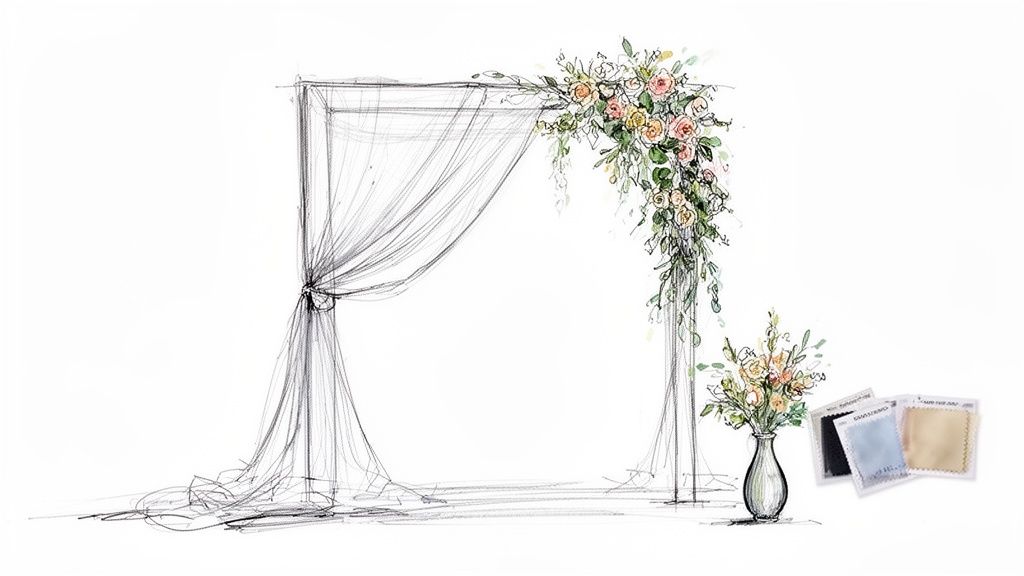
Once the arch is built, it stands like a quiet, blank canvas. The structure is there, but the part that makes it feel like yours is what comes next. This is the moment an arch stops being a frame of wood or metal and becomes part of your ceremony.
I’ve watched this happen hundreds of times. A simple wooden arch is softened with fabric, and suddenly it belongs to the couple. Flowers are added, and the entire feeling of the space changes. This is where the personality comes in.
Where can we find inspiration?
It’s completely normal to not know where to start. Many couples find themselves looking at endless photos, trying to land on a style that feels right. More and more, I see couples using new tools to help them picture the final result before they even buy the first flower.
The use of AI in wedding planning has grown remarkably fast. A recent study of over 11,500 couples found that 54% now use AI to help gather initial ideas and visualize how different elements might look together. That’s a 150% increase in just one year. You can see more on how couples are using these tools in this detailed report on wedding trends.
Using a tool to generate a few images can be a calm way to explore options. It lets you see how different fabrics drape or how certain color palettes look against a wooden frame. It’s just a starting point, but sometimes seeing a picture helps you know what you really want.
How can fabric soften the look?
One of the simplest and most effective ways to personalize an arch is with fabric. The way it moves in a slight breeze adds a lovely, gentle energy to a ceremony. I’ve seen many different materials used, and each one creates a different feeling.
- Chiffon: This is a very common choice because it’s so light and ethereal. It catches the light beautifully and adds a soft, romantic touch without feeling heavy.
- Linen: For a more natural or rustic feel, linen is a wonderful option. It has more texture and weight, which can ground the design and complement a simple wooden arch.
- Tulle: This material brings a sense of playfulness and airiness. It’s easy to work with and can be draped or gathered in many different ways.
Most couples find that six to nine yards of fabric is plenty for a standard arch. It gives you enough length to drape it gracefully over the top and let it pool at the base. You can attach it discreetly with clear zip ties or by wrapping floral wire around the back of the arch.
The goal is for the fabric to look like it was simply tossed there. The mechanics should be invisible, leaving only the soft lines and flowing movement.
How do we add flowers and greenery?
Flowers are what truly bring an arch to life. Whether you choose lush, full arrangements or just a few sprigs of greenery, they connect the structure to the natural world around it. There are a few different paths couples take when it comes to florals.
Working with a florist is a common choice. They have the experience to create something that not only looks beautiful but will also hold up throughout the day. They know how to work with the season and can suggest blooms that will fit the feeling you want to create.
For those who want to add the flowers themselves, pre-made floral swags are a good option. These are arrangements designed specifically for arches, with a sturdy base that makes them easy to attach. You simply secure them to the corners or the center of the arch with zip ties.
Another approach is to use individual stems. You can group together a few of your favorite flowers and some greenery, wrap them with floral tape, and attach them to the arch with wire. It’s a more hands-on process, but it allows for a lot of personal creativity. I’ve seen some beautiful arches decorated with just a few simple branches of eucalyptus.
It helps to remember that your arch doesn’t need to be perfectly symmetrical. Often, an asymmetrical design with one larger floral piece and a smaller one on the opposite side feels more modern and organic.
In the end, styling the arch is about adding layers that reflect you. It's a quiet process of adding color, texture, and life until the structure feels like a warm and welcoming place to begin your marriage.
What about the day of the wedding?
You’ve spent all this time designing and building an arch. It’s easy to get so caught up in the creative part that you forget about the simple logistics of the day itself. But a little forward thinking here is what keeps the morning of your wedding feeling calm.
The questions that pop up in the final weeks are always the practical ones. Who’s bringing the arch? Where does it go? How long will it take to put together?
Thinking through these small details ahead of time moves the arch from a last-minute stressor to a quiet part of the background.
Who is responsible for the arch?
One of the kindest decisions you can make is to hand this job off to someone else. It’s a task that needs a clear head and a bit of focus, which is why it’s not a job for the two of you.
This could be a trusted family member, a few organized friends from your wedding party, or a day-of coordinator. I’ve seen many couples lean on their coordinator for this, since they’re already dialed into the day’s logistics. If you're curious about what that looks like, we have a few thoughts on what a wedding coordinator does and how they create a sense of ease.
Whoever you choose, make sure you walk them through the assembly once before the wedding. A quick five-minute demo or even just a few photos on their phone makes all the difference.
How much time should be set aside for setup?
Time on a wedding morning has a way of moving faster than you expect. Even for a simple arch, it’s wise to block out at least 45 to 60 minutes for setup. This gives your team a comfortable window to carry the pieces to the ceremony spot, assemble the frame, and add the final touches without feeling rushed.
If you have a florist adding flowers, they’ll have their own schedule. It’s always a good idea to connect them with your venue coordinator so they know exactly when they can arrive and how much time they have to work.
The goal is to create a pocket of time that feels spacious. Rushing is the enemy of calm, and on your wedding day, calm is what you want most.
How do we coordinate with our venue?
Every venue has its own rhythm, so it’s important to have a quiet chat with them about your plans a few weeks out. Here at The Merrill, this is a conversation we have with all our couples.
No matter where your ceremony is, here are a few good questions to ask:
- What time can our arch be delivered?
- Is there a specific door or loading area we should use?
- Are there any restrictions on where the arch can be placed?
- What are the rules for anchoring, especially for an outdoor setup?
Some venues don’t allow staking anything into the ground. It’s good to know this in advance so you can plan on using weights, like sandbags tucked behind the legs or heavy, decorative planters. I’ve seen this work beautifully time and again.
The final piece of the puzzle is the breakdown. Confirm with your venue when the arch needs to be removed. It’s usually at the end of the night, so your designated person should be ready to handle that, too.
Once these plans are in place, you can let them go. The arch will be there. Its job is simply to frame the moment. It’s the two of you that everyone has truly come to see.
A Few Final Questions About Wedding Arches
As you work through the plans, a few quiet questions tend to surface. It’s the practical side of things. I’ve seen countless couples pause on these same points, and the answers that helped them find their way were usually simpler than they expected.
Is it cheaper to build your own arch?
Sometimes, but not always. Once you add up the cost of wood, hardware, and any tools you might need to buy, the savings can start to shrink. It’s a project that asks for both money and time.
I’ve watched some couples find real joy in building something together. That has its own kind of value. I’ve also seen the relief on the faces of others who decide that renting an arch brings a welcome sense of ease. It helps to price out both paths before you decide which one feels lighter.
How do you get a DIY arch to the venue?
This is often the most overlooked detail. Most couples who build their own arch design it to come apart, usually in a few manageable pieces. This means you’ll likely need a truck or a large SUV with the seats folded down for transport.
It’s always a good idea to assemble and disassemble it once at home before the wedding week arrives. That way, whoever is in charge of setup isn’t trying to figure it out for the first time on the day of. A quick call to your venue to confirm delivery and setup times also makes everything run smoothly.
How far in advance should you build it?
Most couples I’ve seen take on this project start about one to two months before the wedding. That buffer gives you enough time to gather materials, build at a relaxed pace, and make changes without feeling rushed.
If you’re planning to stain or paint the arch, this timeline also allows plenty of room for it to fully cure so any scent is long gone. The goal is for this to be a satisfying part of the process, not a stressful task that steals your peace at the last minute.
It’s perfectly okay if this project starts to feel like too much. The point of your ceremony is the commitment you are making, not the structure behind you.
What if this all feels like too much?
Then it is absolutely the right decision to choose another path. Your ceremony should feel like a relief, not a performance. Many couples realize that renting an arch from a local decor company or through their florist is the better choice for them.
This path simplifies everything and guarantees a professional result. Trusted partners handle the delivery, setup, and teardown at the end of the night. It frees you up to focus on being present with your family and friends. There is no right or wrong answer here, only the one that brings you the most calm.
At The Merrill Hotel, we have watched countless ceremonies unfold, each with its own quiet beauty. If you are looking for a place where the details are handled with care, we would be honored to show you what we do. You can learn more at momentsatthemerrill.com.