
You're often not asking how much to tip a caterer until the very end of planning, when the major decisions are already made and the final invoice is in front of you. That's exactly why this line item feels strangely stressful. Couples can confidently compare an indoor wedding venue in Muscatine, a large wedding venue near Davenport, or an all-inclusive wedding venue for a destination-style celebration from Chicago, then still pause over one simple question: what's the right gratuity?
The confusion usually comes from two places. First, catering advice changes based on event size and service style. Second, many contracts include fees that sound like tips but may not function like tips at all. For couples planning a wedding reception, an Indian wedding weekend, a rehearsal dinner, or even a corporate retreat, a clear framework matters more than vague etiquette.
The good news is that tipping a caterer doesn't have to feel like guesswork. Once you know the baseline percentages, how to read the contract, and how to allocate the money among the team, the decision becomes much easier.
Standard Tipping Percentages for Catering
When couples build their wedding budget, gratuity often ends up in the “we'll figure it out later” category. That's understandable. Catering invoices can include food, beverages, staffing, rentals, coordination, and service fees, so the tip line doesn't always feel obvious.
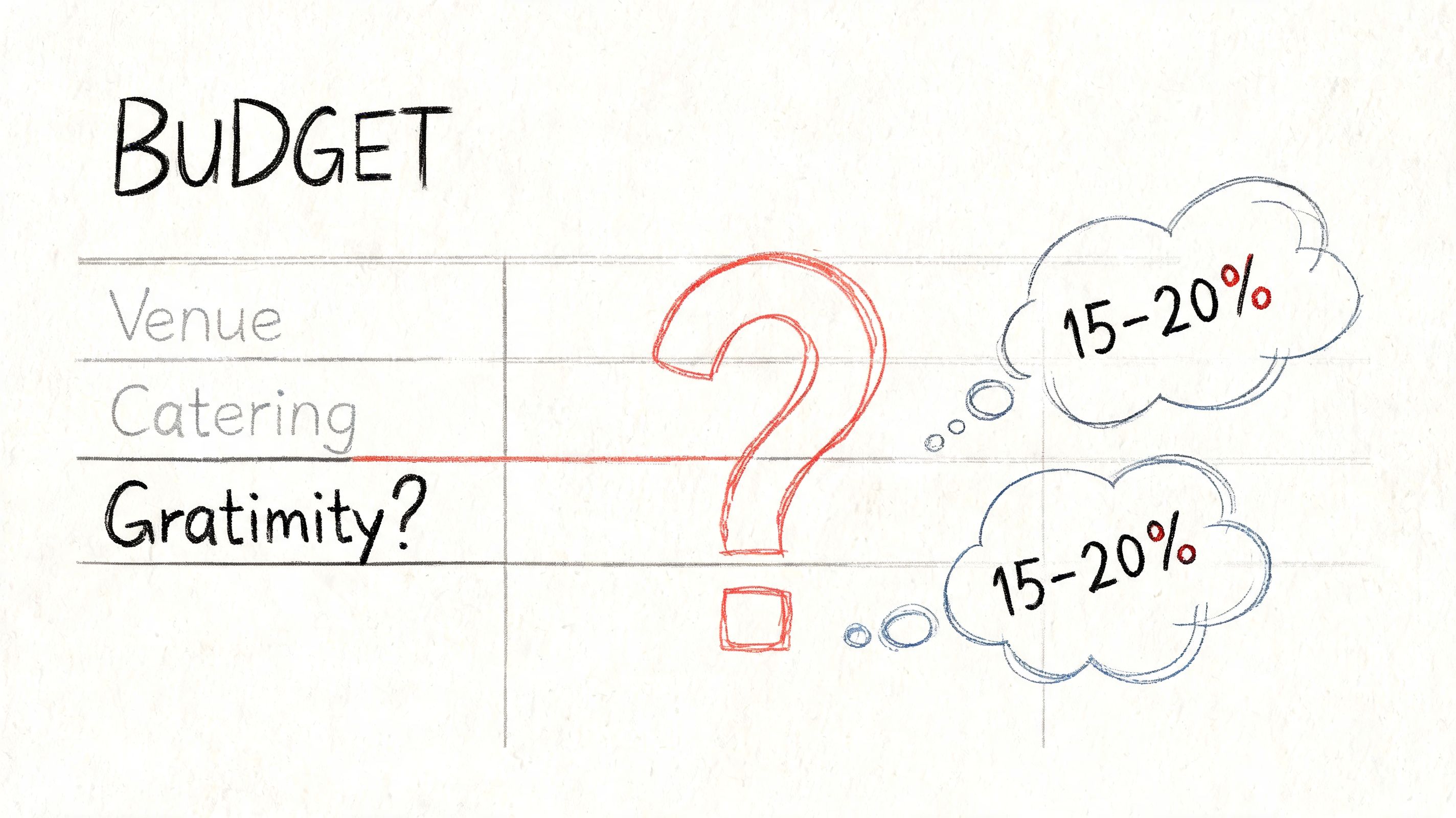
Start with the simplest benchmark. For event-size guidance, Wolfman Catering's tipping overview notes that small events up to 50 guests typically use a 10% tip, medium events of 50 to 150 guests use 12%, and large events over 150 guests commonly fall in the 15% to 20% range.
A simple way to choose your starting point
If your event is closer to a rehearsal dinner, shower, or drop-off meal with limited staffing, use the smaller-event benchmark. If your event includes full setup, servers, bartenders, coordination, and cleanup, move into the higher range.
That distinction matters because catering isn't one single service. A casual delivery order and a full reception at a luxury wedding venue operate very differently behind the scenes. One is mostly preparation and transport. The other requires staffing, timing, guest-facing service, and constant adjustments throughout the event.
Practical rule: The more your catering team is physically present and actively managing guests, the more your gratuity should reflect service rather than just food cost.
When percentage tipping works best
Percentage tipping is usually the easiest option for:
- Full wedding receptions: Best for events with serving staff, bartenders, and an on-site captain managing the flow of dinner service.
- Corporate dinners or retreats: Helpful when the event includes setup, replenishment, and cleanup over several hours.
- Large guest counts: A percentage scales naturally when the staffing and coordination needs rise with the size of the room.
When a per-person tip can make more sense
A flat amount per team member can be useful when the staff structure is clear and the service is especially hands-on. This approach often works well when you know exactly who handled your event and want to reward individual effort more directly.
For many hosts, the easiest approach is this:
- Use the event-size benchmark as your starting point.
- Check whether your contract already includes fees that affect tipping.
- Choose either a percentage on the catering bill or individual staff tips, depending on how the event was staffed.
If you're planning a large capacity wedding venue search in the Quad Cities region, comparing an outdoor wedding venue with an indoor reception venue, or considering a cultural wedding venue with a more complex service flow, these percentages give you a calm and realistic baseline before you get into contract details.
Decoding Your Contract Service Charges Versus Gratuity
The most common mistake I see is assuming that a service charge is the same thing as a gratuity. It often isn't.
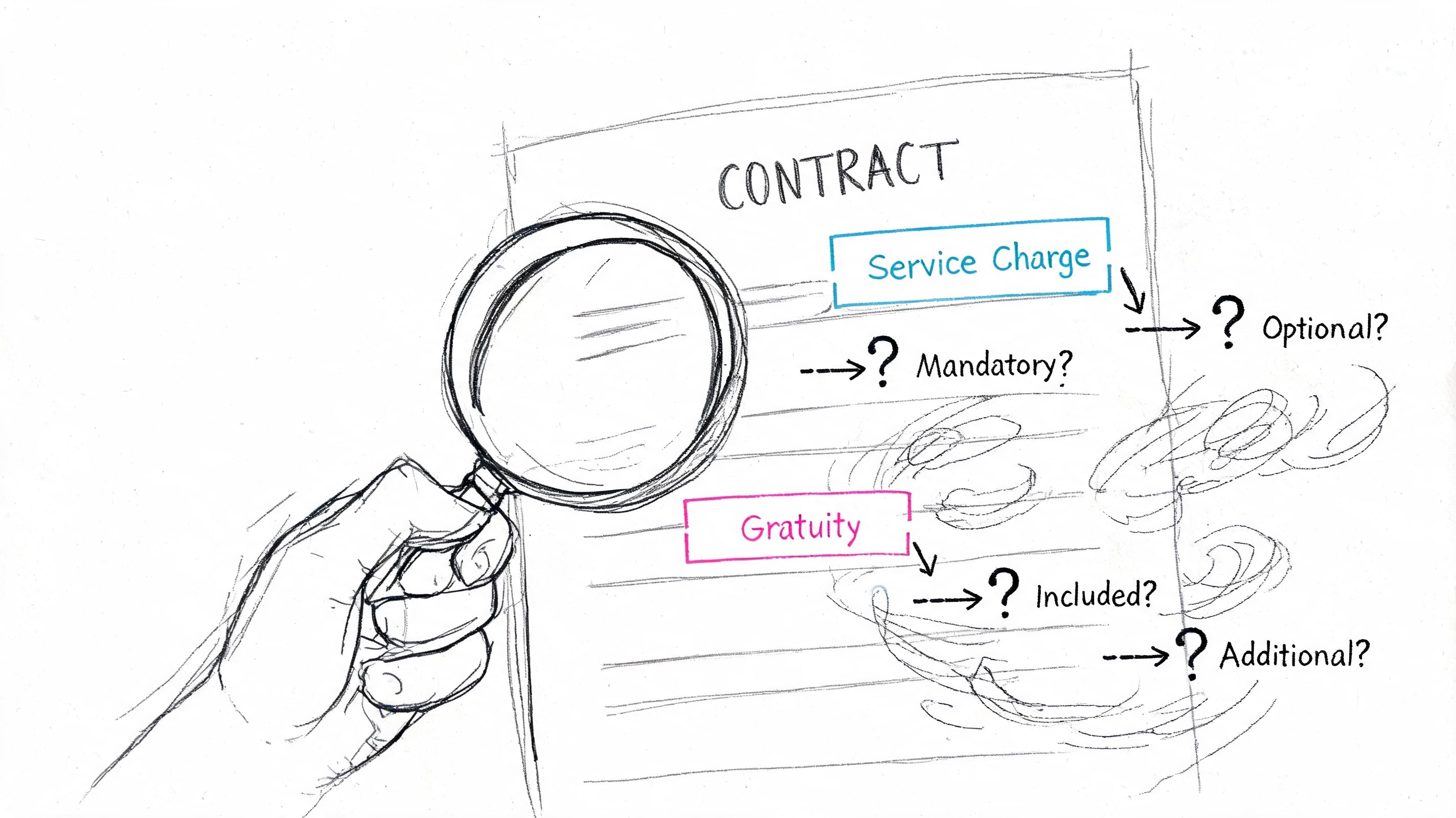
That wording trips up smart, organized couples all the time. They review the invoice, see an added percentage, and assume the staff has already been tipped. But Modern Catering's explanation of catering service fees and tipping states that contractual service charges of 15% to 25% almost never include gratuity for servers, and recommends planning for separate tips unless gratuity is explicitly itemized.
What a service charge usually means
A service charge often supports the operational side of the event. That can include administrative handling, setup logistics, equipment movement, staffing structure, and other overhead tied to producing the event. It may help the venue run the function smoothly without becoming a tip pool for the servers and bartenders your guests interact with.
That's why this question needs a direct answer before final payment is due.
Ask your venue coordinator or caterer:
- Is the service charge a gratuity?
- If not, does any portion of it go directly to servers, bartenders, chefs, or the banquet captain?
- Is gratuity listed separately anywhere in the contract or final invoice?
- If we'd like to leave a tip, what's the best way to distribute it fairly?
The contract language to look for
The key words matter. Look for an explicit line that says gratuity, not just service charge. If the contract only mentions a service fee, administration fee, staffing fee, or banquet fee, don't assume that money is being paid out as a tip.
If the contract doesn't specifically say “gratuity,” treat tipping as a separate decision.
This is especially important for couples planning a destination-style wedding weekend, a multi-event celebration, or a cultural wedding with several moving parts. A large guest count, extended timeline, or outside-vendor coordination can make the staffing side of catering more intensive, even when the invoice language looks neat and simple.
A short video can also help if you prefer hearing the distinction explained aloud:
What works and what doesn't
What works is direct clarification before the wedding week. Get the answer while there's still time to budget calmly.
What doesn't work is trying to decode the invoice at the end of the reception or assuming a generic fee covers everything. That's when couples either overpay from panic or skip tipping because they think it was already handled.
For anyone comparing a wedding venue in Muscatine, a reception venue near Bettendorf, or an event venue near Moline with in-house culinary service, this one contract question can eliminate a surprising amount of stress.
Who Receives the Tip and How to Allocate It
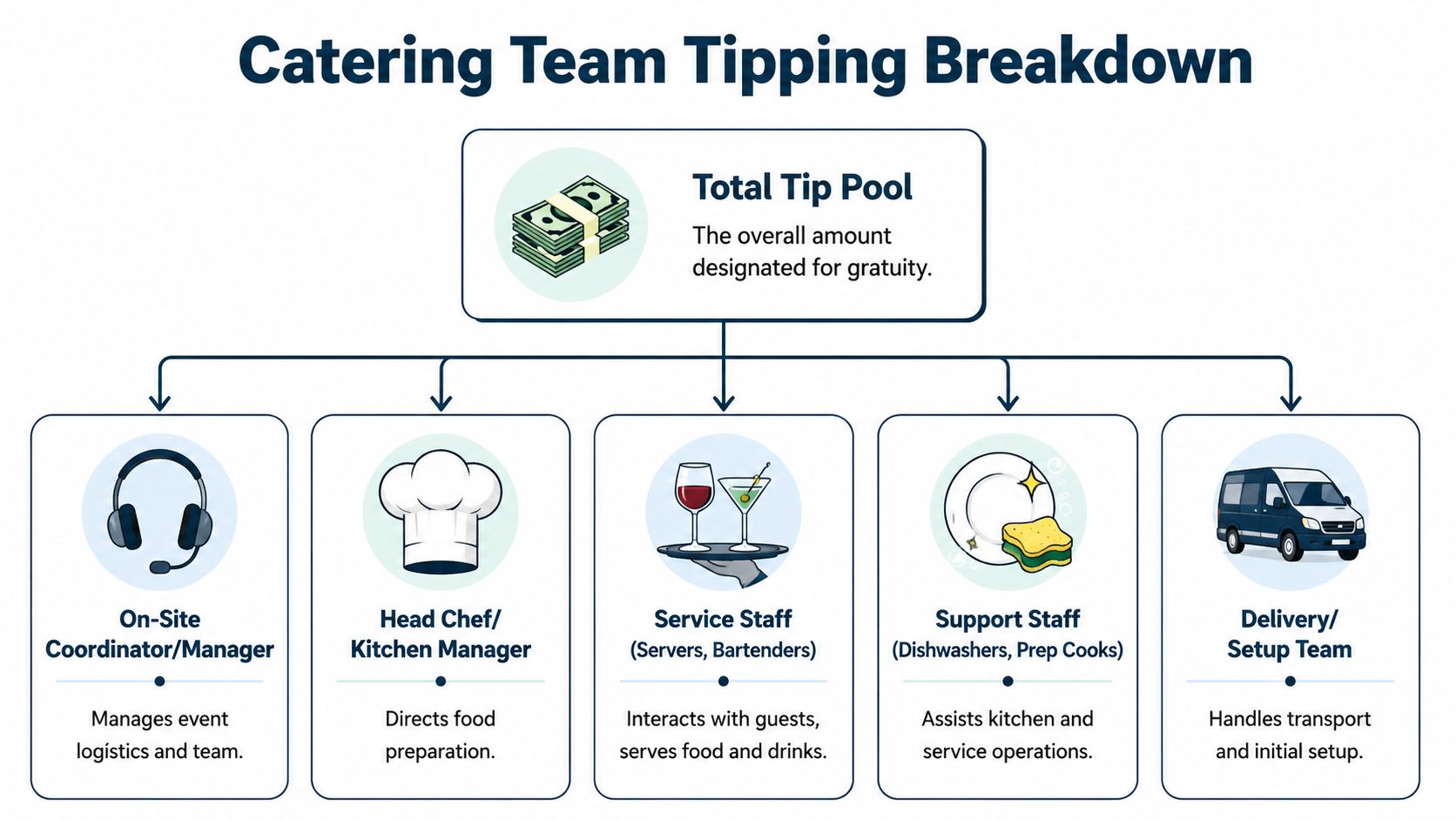
Once you've set the gratuity amount, the next question is just as important. Who should receive it? Many people think of “the caterer” as one person or one company. In practice, your event may involve a coordinator, chefs, servers, bartenders, setup staff, and support staff working in the background.
That's why a flat, undirected tip can feel imprecise. A more thoughtful approach focuses on labor and distribution rather than treating the entire bill as one simple bucket.
The labor-based method
Sixpence Events' wedding vendor tipping guidance recommends a more targeted model: allocate 20% of the isolated labor charge, then distribute that amount strategically. Their guidance suggests $35 to $50 per server, $50 to $200 for the catering manager, and $50 to $200 for executive chefs.
This method is useful because it separates service from product. If your menu includes premium ingredients or a higher food cost, that doesn't always mean the labor burden increased at the same rate. A labor-based gratuity keeps your attention on the people delivering the experience.
How I'd think about each role
Not every event has the same staffing chart, but these are the usual roles worth considering:
- On-site manager or banquet captain: This person keeps the evening moving, solves timing issues, coordinates staff, and often becomes the quiet center of the room when anything needs attention.
- Chef or kitchen lead: Guests may not always see this role, but menu execution, pacing, and food quality depend on it.
- Servers and bartenders: They're the most visible part of the catering team. They refill glasses, clear plates, respond to guest requests, and influence whether service feels polished or chaotic.
- Support and setup staff: Depending on the venue and caterer, this group may help with prep, back-of-house operations, and room resets.
Good allocation reflects who carried the service load, not just who appeared on the invoice.
The most practical way to distribute it
If you want to keep the process graceful, ask your coordinator for a final staff count shortly before the event. That allows you to prepare envelopes or approve a distribution plan in advance.
A few tips make this easier:
- Ask for names or roles: Even if you don't have every staff name, knowing the role count helps you allocate fairly.
- Use one point of contact: The banquet captain or venue coordinator can often guide the distribution so envelopes reach the right people.
- Match the method to the event: A plated reception at a large wedding venue usually deserves a more structured approach than a simple catered drop-off meal.
- Stay consistent across your vendor plan: If you're mapping out transportation and hospitality tips too, a guide on how much to tip a limo driver can help you keep the overall budget organized without mixing vendor categories together.
What often goes wrong
The most common problem isn't stinginess. It's vagueness. Hosts know they want to be generous, but they don't know the team structure, so they leave a broad amount without a plan.
The better approach is to decide in advance whether you're tipping as a pool, by role, or by labor percentage. Once that decision is made, the actual distribution becomes much simpler and much fairer.
Sample Tipping Calculations for Your Midwest Event
Examples make this easier than theory. The right gratuity can look very different at a rehearsal dinner than it does at a full wedding reception or a corporate retreat with all-day service.
For full-service weddings, Thomas Oliver's catering etiquette guide notes that 15% to 20% of total catering costs is the standard range, while casual catering delivery is lower at 10% to 15% because full-service events involve longer on-site presence, more coordination, and greater complexity.
Three common scenarios
A smaller rehearsal dinner in Muscatine usually sits near the lower end of the broader spectrum because service is often simpler. A full wedding for a larger guest count in the Quad Cities region or for a Chicago-area couple hosting a destination celebration will usually justify the higher full-service range. A corporate retreat often lands in the middle, depending on whether catering is delivered, refreshed throughout the day, or fully staffed.
Here's a simple planning table you can use alongside your venue worksheet and catering estimate.
| Event Type | Total Catering Bill | Suggested Tip (15-20%) | Per-Staffer Alternative |
|---|---|---|---|
| Rehearsal dinner | Smaller event bill | Lower end of the standard range if service is limited | Individual envelopes for the team actually on site |
| Full wedding reception | Large full-service bill | Higher end of the standard range when staffing and coordination are extensive | Combined tip pool divided among captain, chef, servers, and bartenders |
| Corporate retreat or private event | Mid-size bill with varying service levels | Middle of the range, adjusted for how hands-on the staff is | Role-based tips if staff count is known |
How to use the table without overcomplicating it
Think in layers.
First, identify whether the event is delivery, partial service, or full service. Then look at guest count, room flow, bar service, and cleanup demands. If the event includes ceremony-to-reception transitions, extended cocktail service, custom pacing, or a next-morning brunch, gratuity usually belongs closer to the full-service mindset.
If you're still balancing venue and menu costs, a separate breakdown of how much wedding catering costs can help you estimate the catering side before you set gratuity.
The cleanest budgeting method is to decide on gratuity while you're approving catering, not after the final invoice lands.
A practical Midwest perspective
For couples from Davenport, Bettendorf, Rock Island, Moline, or farther east in Naperville, Aurora, or Chicago, the venue decision often comes down to value. A large capacity wedding venue outside a major city may allow more guest count, a longer celebration, or more flexibility for cultural events. That's wonderful for planning. It also means your catering team may be doing more real-time work than the bill initially suggests.
That's why a sample worksheet matters. It keeps your decision tied to service level, not emotion in the final week.
How The Merrill Hotel Simplifies Catering Gratuity
The easiest catering experience is one where the couple doesn't have to decode anything under pressure. Clear planning removes the awkwardness from gratuity because expectations are addressed before the event, not after guests have arrived.
That's especially helpful for couples comparing a wedding venue in Muscatine with options in Davenport, Bettendorf, Rock Island, or Chicago. It's also valuable for families planning an Indian wedding venue search near Chicago, where multi-day scheduling, cultural ceremony flow, and guest logistics can make catering more layered than a standard reception.
Why clarity matters at a full-service venue
At a full-service property, catering isn't an isolated transaction. It connects to the reception timeline, room flips, bar flow, guest count management, and service pacing across the full event. That's why gratuity questions are best handled in conversation with the planning team, not guessed from the invoice alone.
Chefs Cater's guide to tipping caterers offers a helpful frame for that conversation. It suggests planning for a 15% to 18% gratuity on the total bill, or using individual tips such as $50 to $100 per chef and $25 to $50 per server.
What thoughtful coordination looks like
A strong venue process usually includes:
- Contract clarity: You can see what fees are administrative or operational and what remains discretionary.
- Staffing visibility: You know whether your event includes servers, bartenders, culinary staff, and on-site event leadership.
- Distribution guidance: You aren't left wondering whether cash envelopes, a single pooled gratuity, or added billing is the best route.
- Timing support: You know when tips are due and who should hold them if you don't want to manage that personally on the wedding day.
For destination-style weddings, this matters even more. Couples planning from Chicago, Naperville, or Aurora often want a large wedding venue with lodging, indoor and outdoor ceremony options, and a smoother planning experience than they might get in a denser urban market. Tipping should feel like part of that smoothness, not an extra puzzle.
A calmer way to approach the final week
The final week shouldn't be spent asking last-minute etiquette questions. It should be spent confirming guest arrivals, reviewing the timeline, and enjoying the fact that the pieces are in place.
That's where a coordinated venue experience helps. When a couple knows what the service charge covers, whether gratuity is already itemized, and how the culinary team is structured, they can make a decision that feels generous and measured at the same time.
A good gratuity process feels like the rest of good event planning. Clear, calm, and settled before the day begins.
This is especially useful for large wedding venue planning, all-inclusive wedding venue comparisons, and cultural wedding weekends where hospitality spans more than a single dinner service. The more moving pieces the event has, the more valuable transparency becomes.
Common Tipping Questions for Your Wedding Venue
A few questions tend to come up even after the main numbers are settled. These usually involve tastings, cultural ceremonies, outside vendors, and the logistics of how tips are delivered.
Do we tip at the tasting
Treat the tasting as part of your overall venue and catering relationship unless the venue tells you otherwise. In many cases, it's better to keep your gratitude within the final event tipping plan rather than turning each planning interaction into a separate transaction.
If the tasting involved unusual accommodation, extra customization, or a level of attention that clearly went beyond the expected scope, you can always ask your coordinator what's customary.
What about cultural weddings and multi-day events
This matters for couples searching for an Indian wedding venue near Chicago, a cultural wedding venue in the Midwest, or a large capacity wedding venue that can host several events across one weekend.
If your catering team supports additional ceremony windows, room resets, specialty service timing, or a longer event arc, build gratuity around the actual service load. The right approach is usually to discuss the full event schedule in advance and ask how staffing changes from one function to the next.
That's especially helpful for events with:
- Baraat coordination support
- Mandap-area food or beverage service
- Multiple meal periods across several days
- Outside specialty vendors working alongside the in-house team
If the venue allows outside catering, who do we tip
Keep the in-house and outside teams separate. Don't assume one gratuity covers everyone.
If an outside caterer handles food production while the venue team handles room operations, bar service, or banquet management, each group may need its own tipping plan. This is one reason couples benefit from reviewing a fuller guide on how to tip wedding vendors so catering gratuity stays coordinated with the rest of the event team.
Is cash better, or should it go on the bill
Both can work. Cash envelopes feel personal and immediate. Adding gratuity through the bill can be cleaner when the venue has a reliable internal distribution process.
What matters most is that the method is confirmed ahead of time. You don't want to discover during setup that no one knows who should hold the envelopes or whether the staff can receive a billed gratuity directly.
What if service was just average
Tipping doesn't have to be emotional or all-or-nothing. If the contract did not include gratuity and the team completed the event professionally, hosts usually still leave a tip based on the baseline they chose in advance. If service was exceptional, you can move upward within your intended range or add more directed thanks to key people.
If something went wrong, address the issue with the coordinator directly rather than trying to communicate dissatisfaction only through the tip. That gives the venue a chance to respond appropriately and keeps the conversation fair.
What helps the most
The best final step is simple:
- Review the contract wording
- Confirm whether gratuity is itemized
- Ask for the staffing plan
- Choose a distribution method before the event day
- Assign one person to handle the envelopes or final approval
That process works for weddings, corporate events, rehearsal dinners, and private celebrations. It also works whether you're local to Muscatine and the Quad Cities or planning from Chicago for a destination-style weekend with more flexibility and space.
If you're looking for a riverfront wedding venue that makes planning feel calm from the first tour to the final invoice, The Merrill Hotel offers a graceful setting for receptions, cultural weddings, rehearsal dinners, and full wedding weekends. The team helps couples from Muscatine, Davenport, Bettendorf, Moline, Rock Island, and the broader Chicago market manage details clearly, including catering, staffing, and event flow, so you can make confident decisions without second-guessing the fine print.