
It’s one of the first questions, and the one that often brings a quiet kind of stress. You may have heard a national average, a number that feels more like an answer you’re supposed to know than a helpful starting point.
These figures are not rules. They are just numbers.
The real question is not "how much does a wedding cost," but "what do we want this day to feel like?" The answer to that is where a budget begins.
The national average for a wedding often lands around $34,000, which works out to about $292 per guest. These numbers come from research like the 2026 Real Weddings Study. But a number doesn't tell a story. It can't tell you that most couples find the investment is worth it, seeing their wedding as a milestone that feels important to honor.
The goal is not to meet a certain number. It is to move from a large, intimidating figure to a personal plan that feels right for you. Thinking in terms of cost-per-guest can be a more grounded place to start. It connects the budget to something real—the people you are choosing to share your day with. A budget isn’t meant to be a restriction. It is a tool that helps you make intentional choices.
How does the number of guests change the cost?
From what I have seen, the guest count is the single decision that most shapes the final number. This is not about being restrictive. It is about understanding how one choice creates ripples that touch many others, from the size of the room you need to the number of meals you will serve.
This table offers a general perspective on how the size of a gathering often relates to the overall cost. These are not strict rules, but common ranges I have observed.
| Wedding Size | Typical Guest Count | Observed Cost Range |
|---|---|---|
| Micro-Wedding | Fewer than 50 | $5,000 – $15,000 |
| Mid-Sized Wedding | 50 – 125 | $18,000 – $40,000 |
| Large Wedding | More than 125 | $40,000+ |
Here in Muscatine, I have noticed a couple’s budget can often allow for a different kind of experience than it might in a larger city. The pace along the river feels different, and that calm often finds its way into the planning process.
It is about finding a place where the value aligns with what is in your heart. The real goal is to create a day that feels like a true beginning. That feeling has very little to do with the final number on a spreadsheet.
Where does the money usually go?
Looking at a budget as one large number can feel overwhelming. I have found it helps to see it not as a single cost, but as a collection of decisions. Each one shapes a piece of the day.
Most of that budget usually settles into five main areas: the place, the food, the memories, the feeling in the room, and the people you trust to help. Each part has a price, but it also says something about what you value. For some, the most important thing is finding a photographer who sees the day the way they do. For others, a beautiful meal is the best way to care for their guests.
Understanding these pieces can quiet the noise and turn the question of "how much does a wedding cost" into a calmer, more personal conversation.
What are the core pieces of a wedding?
When the numbers start to feel daunting, I often see couples find clarity by focusing on these five areas. They are the foundations of almost every wedding I have witnessed.
The Place: This is your venue, the physical space where your wedding happens. It sets the scene for everything else, and its cost can vary widely. It often covers the use of the space, tables, chairs, and sometimes staff.
The Food and Drink: Catering is almost always one of the largest expenses. It’s tied directly to your guest count, which is why that number matters so much. This includes everything from cocktails and appetizers to the main meal and cake. We explore this more in our guide to wedding catering costs.
The Memories: This is your photography and, if you choose, your videography. These are the people you trust to capture the quiet moments you will look back on for years. Their experience and perspective are a large part of what you are investing in.
The Atmosphere: This covers flowers, lighting, and décor—all the elements that create the feeling in the room. Some couples want a space filled with lush flowers, while others prefer the simple warmth of candlelight.
The People Who Help: This includes any planners or coordinators you hire to guide the process. They bring a sense of calm and order to the day, managing the timeline so you can stay present with your guests.
How these pieces fit together matters, too. For example, a venue that includes on-site catering and coordination simplifies things, bringing three of these core pieces into a single relationship.
Does it help to see the national picture?
It can be useful to see how these costs add up on a larger scale—not as a rule to follow, but for context. Nationally, the wedding market is substantial, reaching over $66.16 billion in the U.S. alone. While the average cost often sits around $34,200 to $36,000, those numbers change dramatically depending on where you are.
This visual breaks down some of those national averages.
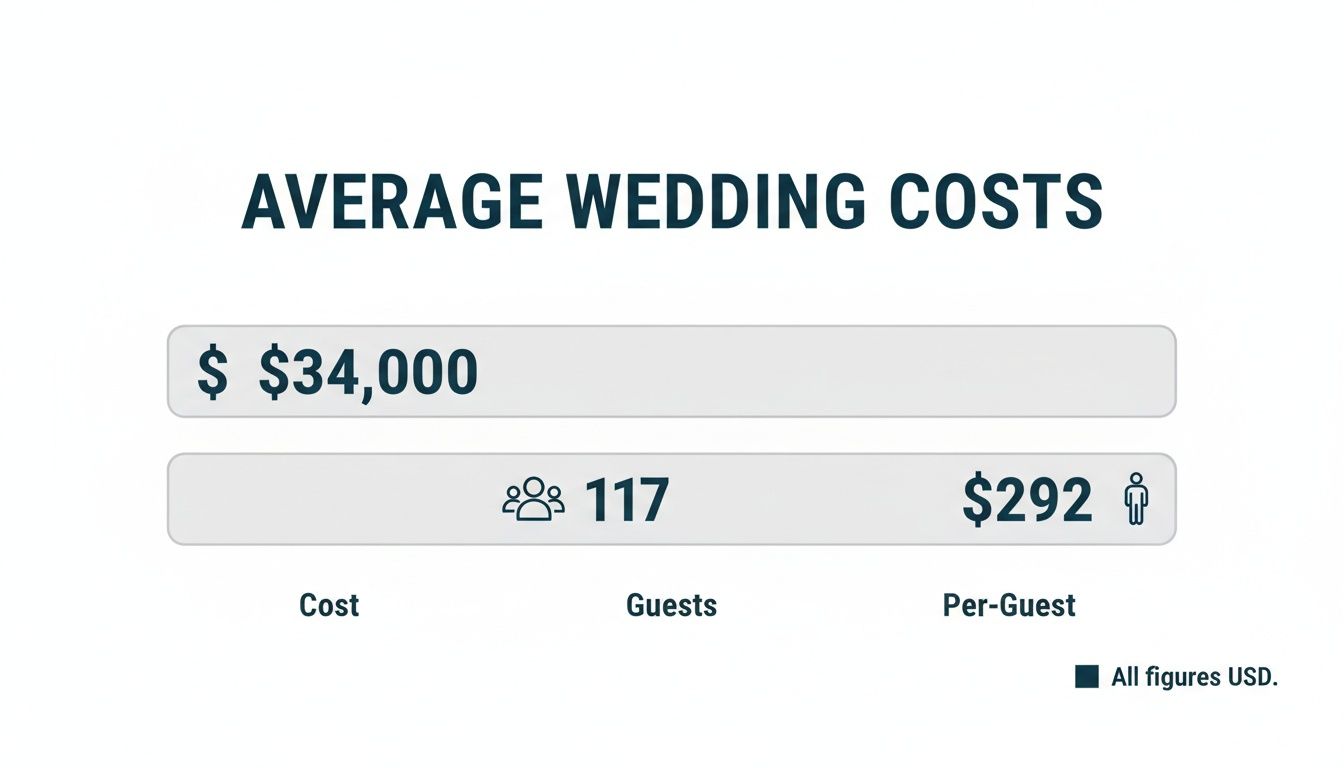
The numbers show how a total cost is built from the number of guests you invite. Costs in a state like New Jersey can be 60-70% higher than in the heartland, with Illinois weddings averaging around $38,200.
A budget is not a judgment. It is a quiet agreement between the two of you about how to care for your guests and protect the feeling you want for your day.
In the end, these numbers are just signposts. They are not your story. They simply show where the money often goes, which helps you decide where you want yours to go.
How do we create a budget that feels right?
The most peaceful wedding planning I have seen starts not with a number, but with a feeling. It begins when a couple agrees on what they want the day to feel like, not just what it will cost. This changes the entire conversation. A budget stops being a restriction and becomes a tool for making choices that protect that feeling.
Talking about money is rarely easy. It can feel awkward and vulnerable, especially when it involves family expectations and your own quiet hopes. Many couples I speak with find this to be one of the most challenging parts of the entire process. That is completely normal.
How do we find our shared priorities?
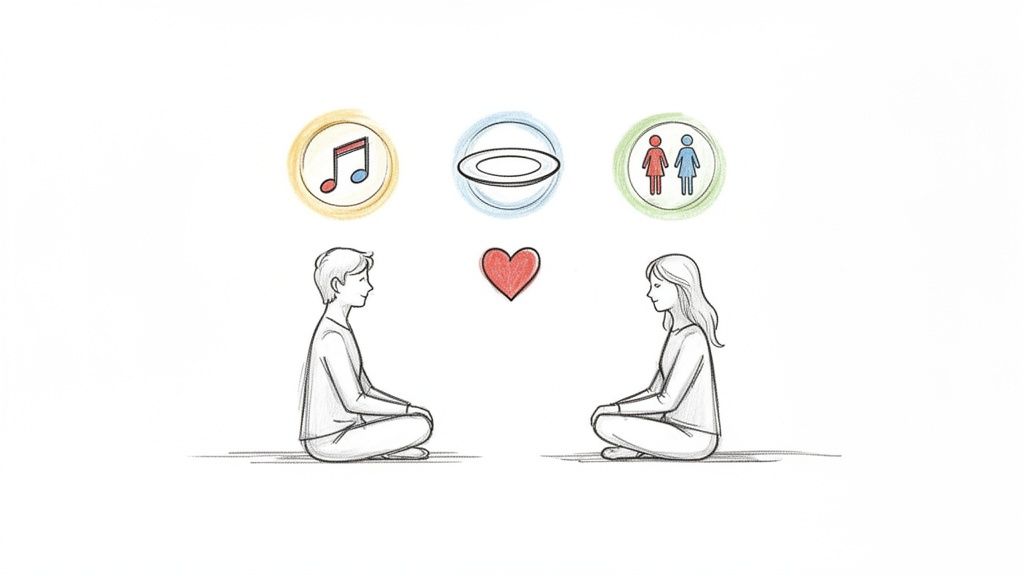
I often see couples find clarity by taking a quiet moment, separately at first. Each of you can write down the two or three things that feel most important for your wedding day. You do not have to share them right away. Just sit with the ideas.
Is it the food and drink you will share with your guests? Is it the music that will have everyone on the dance floor? Or is it the quiet relief of having every person you love in one room?
When you are ready, compare your notes. You will likely see some overlap right away. These shared values become the foundation of your budget. They are the things you agree to protect, no matter what. This simple exercise turns a stressful financial discussion into a conversation about your shared future.
How do we ground our numbers in reality?
Once you know what matters most, you can begin to look at the numbers with more calm. It’s useful to understand where your ideas might fit into the broader picture. Research from firms that study the wedding market shows that budgets fall into several standard categories. In 2026, about 37% of couples in the U.S. are aiming for a budget under $10,000. These studies also show that 52% of couples find their initial budget underestimates the true expenses. You can see more about these wedding market statistics to get a sense of the landscape.
It helps to remember that a budget is a living document. It will almost certainly change as you learn more. That is not a failure. It is a sign that you are making thoughtful, informed choices along the way.
An initial number is just a starting point. If your first estimate for photographers feels too high, it might be because that is one of your core priorities, and you will decide to adjust elsewhere. If the catering quote is lower than expected, that might free up room for the live band you both wanted.
The process is about balance and perspective. It is about building a plan that honors your priorities and brings a sense of ease, not anxiety. When the budget is rooted in what you both value, the financial decisions become much clearer. They are simply choices that serve a shared goal: a day that truly feels like you.
How does location change the cost conversation?
Your wedding’s location does more than just frame the photos. It changes the entire conversation you have about cost. Here along the Mississippi River, the pace itself feels different, and that almost always extends to how couples approach their plans. There is a real shift that happens when you step away from the energy of a big city and into the rhythm of a smaller town.
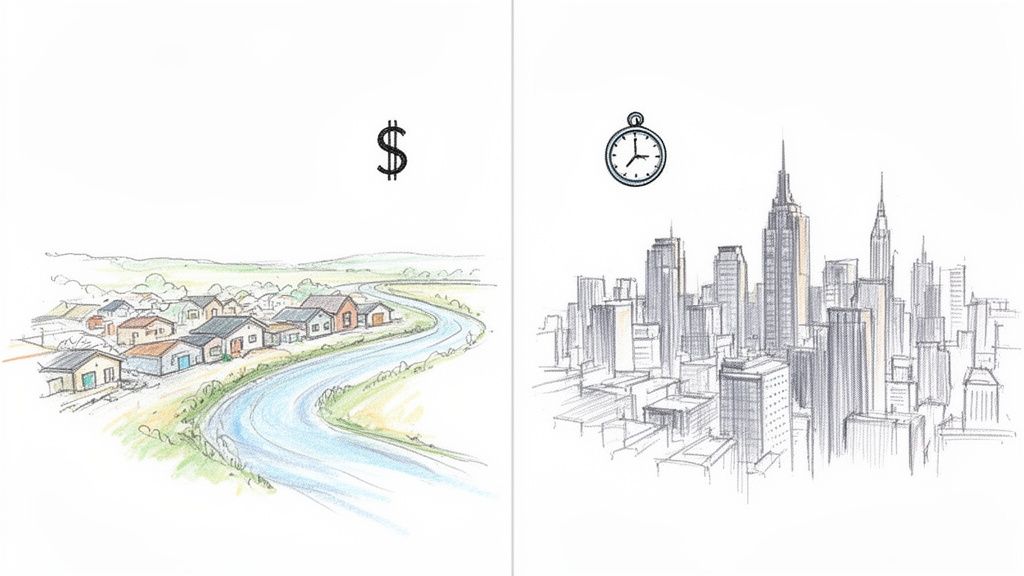
I see it happen all the time with couples visiting from places like Chicago or Des Moines. They arrive with a certain set of expectations for what their budget can get them. More often than not, they are surprised by what they find here in Muscatine. It is not just that things are less expensive—it is that their budget suddenly does more than they thought it could.
What is that feeling of found space in a budget?
What I have watched happen over and over is that a change of scenery can feel like discovering extra room in your budget you did not know was there. In a major city, a specific number might cover a beautiful reception. Here, that same number can often cover an entire weekend experience.
Suddenly, that budget might comfortably hold the rehearsal dinner, the ceremony, the reception, and even a farewell brunch, all in one place. The compromises a couple thought they would have to make—like cutting the guest list or letting go of a favorite detail—do not seem so necessary anymore.
This is not about finding a "cheaper" option. It is about finding a place where the value aligns with your hopes for the day, creating a sense of financial ease that lasts the whole weekend.
For so many couples, this discovery changes the whole feel of planning. The question of "how much does a wedding cost" starts to feel less about limitations and more about possibilities. The focus shifts from what you have to give up to what you can joyfully add.
What does “value” really mean for a wedding?
Value is not just about the lowest price tag. For most couples I work with, value is about simplicity. It is peace of mind. It is knowing your guests have a lovely place to stay just an elevator ride from the party. It is the relief of having one team handle the food, the space, and the flow of your day.
When you look at locations outside of big metro areas, you find this kind of bundled value more often. A venue with on-site lodging, for instance, immediately simplifies things for everyone. You can see how this impacts the numbers in our guide to destination wedding costs. It takes away the need for shuttles and coordinating travel, which quiets a major source of stress and expense.
The real value, as I see it, is when a place feels right not just in your heart, but in a way that gives you financial breathing room. It is the feeling that you are making a wise, sound decision as you start your life together.
In the end, the place you choose does more than just provide a backdrop. It sets a tone. It can offer a sense of calm and abundance that makes the entire process feel more grounded and joyful.
What if our number is smaller than the average?
I have seen a quiet worry settle in when couples look at national wedding cost averages. It is the fear that a smaller number on a budget sheet somehow equals a lesser day. That is just not how it works.
The worth of a wedding has nothing to do with its final price tag. I have watched hundreds of celebrations unfold right here, and some of the most peaceful, heartfelt moments I have ever seen happened on a Tuesday afternoon with just twenty people in the room.
Choosing an intimate wedding, a micro-wedding, or even a weekday celebration is not a compromise. More often, it is a deliberate and beautiful choice.
Is a smaller wedding an intentional choice?
A shorter guest list often gives you more real time with every single person you have invited. An off-season date can bring a calm, relaxed feeling to the whole day, free from the hurry of a peak-season weekend. These are not decisions made from limitation. They are made from a clear sense of what feels right for you.
I have noticed that couples who go this route often talk about a sense of relief. They give themselves permission to let go of expectations that were never really theirs in the first place. You can read more about how these gatherings have their own rhythm in our article on why smaller weddings feel different.
The most memorable weddings are not the most expensive ones. They are the ones that feel most like the couple themselves.
There is a real beauty in a day that feels focused and personal. It might be a heartfelt toast where every guest gets to share a story. It might be the quiet joy of a ceremony where you can see every single face.
How can we redefine what a wedding looks like?
A smaller budget does not mean giving up what matters most. It just asks you to be creative and put your resources toward what will bring you the most joy.
A Weekday Wedding: Here in Muscatine, a Wednesday in October can be just as stunning as a Saturday. The river is just as lovely, and there is a quietness to a midweek event that can feel incredibly special.
An Intimate Guest List: Choosing to celebrate with only your closest family and friends is a powerful move. It means your time and energy are spent with the people who truly shaped your lives.
Focusing on One or Two Priorities: Maybe your priority is an unforgettable meal or a photographer whose work you have admired for years. A smaller scale can let you invest heavily in those few things, rather than spreading a budget thinly across dozens of details.
It helps to remember your wedding is not a performance for other people. It is the start of your life together. The goal is to plan a day that is a true reflection of your love, leaving you feeling confident and whole, no matter the size of your budget.
After all the spreadsheets and calculations, there is a moment where the conversation quiets down. The question “how much does a wedding cost?” is almost never just about the money. It is another way of asking, “what do we want this day to feel like?”
The numbers are just a map. They help you get to where you are going, but they are not the destination itself. They cannot capture the feeling of seeing each other for the first time, or the sound of your favorite people laughing together in one room.
What should we remember?
I have noticed something that happens after the last payment is sent and the final details are confirmed. On the day of the wedding, no one is thinking about line items. They are not mentally running through the cost per plate or the price of the flowers.
Instead, I see them holding hands a little tighter just before the ceremony. I watch them catch each other’s eye during the toasts, completely lost in that one moment. The numbers did their job, and now they fade. All that is left is the experience.
What I have seen, time and again, is that the focus always shifts. It moves from what the day cost to what the day feels like. It always comes back to the person standing next to you and the warmth of being surrounded by everyone you love.
This is not a realization that arrives at the end. It is a perspective you can carry with you through the whole process. It is the most valuable thing to hold onto.
What is the feeling that lasts?
At times, the numbers will feel loud. That is normal. There will be moments when quotes and budgets take up more mental space than you would like them to. When that happens, try to anchor yourself in the feeling you want to have when the day is over.
Will you remember the exact price of your photographer? Or will you remember how they caught that quiet, unscripted glance that passed between you? Will the final catering bill be the memory, or will it be the feeling of sharing an incredible meal with the people who traveled all this way just for you?
Holding onto that is what keeps the planning from feeling like a task. It keeps the focus where it should be: on the two of you and the commitment you are making. The rest is just noise. When the day is done, it is the feeling, not the figures, that remains.
What other questions tend to come up?
As couples move through the planning, a few quiet questions always seem to surface. They are the practical details that emerge after the big decisions have settled. Having a sense of them ahead of time can make a difference.
Are there costs people often forget?
Yes, almost always. A few things tend to surprise couples later in the process. Gratuities are a common one—a way to thank the teams bringing your day to life that is not always built into the initial quotes.
Alterations for wedding attire can also vary. And the smaller things, like postage for invitations or the fee for a marriage license, add up quietly in the background.
It is not about accounting for every single dollar from day one. It is about building a little breathing room into your budget. That small buffer for the unexpected is what I have seen bring the most peace of mind.
Is an all-inclusive venue a better choice?
This decision really comes down to what feels calmer for you. For some couples, having the venue, catering, and rentals handled in one place simplifies everything. It reduces the number of conversations and contracts, creating a sense of ease.
For others, selecting each vendor individually feels more personal. It allows them to shape the day with more distinct choices. Neither way is better.
The real question to ask yourselves is this: does having fewer points of contact feel more manageable, or does having more control over the details feel more true to who you are? The right answer is whichever one makes the process feel steady.
How can we discuss the budget without stress?
This is a conversation almost every couple finds difficult. I have found it helps to start not with numbers, but with feelings.
Before you open a spreadsheet, sit down together. Have each of you quietly write down the three things that matter most for the wedding day itself. Is it incredible photos? A band that keeps everyone on the dance floor? Or just having all your favorite people in one room?
See where your priorities overlap. This creates a shared foundation. When you do start talking about numbers, you are no longer just discussing line items. You are talking about how to protect what matters most to both of you, together.
At The Merrill Hotel, our goal is to bring a sense of calm and clarity to your planning. We believe a beautiful wedding weekend can feel both graceful and grounded. To see how we bring that vision to life along the Mississippi River, you can learn more about our approach.