
Most couples ask about videography at the same point. The venue is chosen, the photographer feels obvious, and then someone says, “Do we want video too?” Right behind that comes the harder question. How much do wedding videographers cost, really?
The short answer is that wedding videographers in the United States usually cost between $1,500 and $3,500, with The Knot’s 2024 Real Weddings Study reporting a national average of $2,300. At the lower end, some basic packages start around $1,200, and high-end productions can go well over $10,000, depending on experience, location, and what is included, as outlined by Shutter and Sound’s wedding videography pricing overview.
That range is wide enough to make anyone feel a little unsteady. It is not a sign that you are missing something. It is a category with a lot of variation.
In towns along the Mississippi and across Eastern Iowa and the Quad Cities, couples are usually trying to answer a more specific question. Not what videography costs in Los Angeles or San Francisco, but what feels realistic here, where wedding weekends tend to move at a different pace and travel distances are a little more manageable.
The Question of Videography and Its Real Cost
What I’ve seen is that the first number couples hear can shape the whole conversation, even when that number comes from a place that does not feel much like home.
National averages are still useful. They give you a frame. But they are only a starting point.
If you are building a wedding budget in this part of the Midwest, it helps to hold two truths at once. Videography is a real investment, and local pricing is often more grounded than what you see attached to major metro markets. That means the answer is not only “how much does a videographer cost,” but also “what does that cost look like here, for us?”
What the national range tells you
The national figures tell you that videography is not a minor add-on. It is often a meaningful line item in the budget because you are paying for coverage on the day and the work that happens after.
That broader context can be helpful if you are also trying to understand your full wedding spending picture. A look at how much a wedding costs overall can make the videography number feel less isolated and more manageable.
What feels more realistic locally
The harder part is that there is no strong bank of market-specific pricing data for Iowa or the Quad Cities in the same way there is for larger cities. National content leaves that gap. For couples planning in Eastern Iowa, that often means sorting through a lot of information that is technically true and not fully useful.
What I’ve noticed is that couples here usually do best when they treat the national average as a ceiling for context, then ask what kind of coverage they want. A shorter day, a single videographer, and a simple film can land very differently than full-day coverage with multiple camera operators and several edits.
A price range is only helpful when you know what kind of day it is meant to cover.
There is also a practical side to weddings in this region. Some celebrations are compact. Some are full weekends. Some bring in guests from Chicago, Iowa City, Cedar Rapids, or the Illinois side of the river. The shape of the day matters as much as the market.
That is why the price itself is rarely the whole story. It is the first question, but not the deciding one.
What Makes One Videographer Cost More Than Another
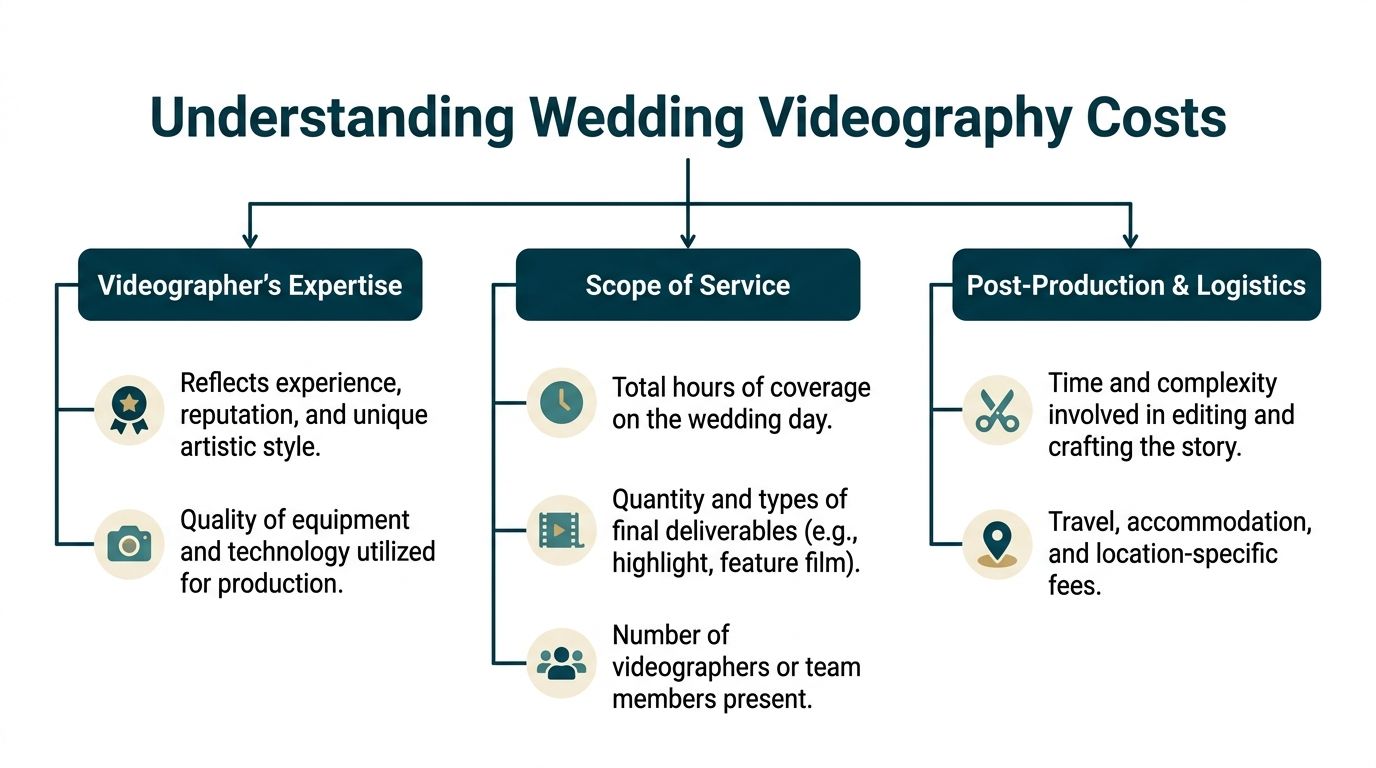
A lower price is not always a bargain. A higher price is not always excess. Much of the difference comes down to what kind of coverage a team is providing and how much work happens after the wedding is over.
Time on the wedding day
The first difference is simple. Hours matter.
A team covering only the ceremony and part of the reception is taking on a very different job than a team arriving during getting-ready and staying through the dancing. More hours usually means more footage, more coordination, and more moments to organize into something coherent later.
This is also where couples begin to notice the overlap with photography. If you have already looked at average wedding photographer cost, you have probably seen the same basic truth. The visible hours are only part of what you are paying for.
How many people are filming
One videographer can do a lot. But one person can only stand in one place at a time.
That matters during vows, entrances, speeches, and the quieter reactions that happen a few feet away from the obvious moment. A larger team can cover more angles and catch more of the room without rushing.
For some weddings, one calm, capable person is enough. For others, especially larger guest counts or a day spread across several spaces, an extra person changes the final film in ways couples feel even if they cannot name them.
The editing is where much of the work lives
This part surprises people.
A basic package may involve 10 to 20 hours of editing, while a more elaborate cinematic film with multiple angles, drone footage, and detailed finishing can take 40 to 60 hours of post-production work, according to 1021 Events’ breakdown of wedding videography costs.
That difference explains a lot.
A simple edit can still be lovely. It may give you the heart of the day without much layering. A more involved film usually asks the editor to shape a narrative, blend sound carefully, balance multiple cameras, and make the whole thing feel smooth rather than pieced together.
Equipment and reliability
Couples generally do not care what camera model someone carries, and they should not have to. What matters is what that gear allows.
Better sound capture matters during vows and toasts. Stable footage matters when people are moving quickly. Backup equipment matters when a wedding day keeps going no matter what.
In practice, this is what often separates a hobbyist price from a seasoned one. Not branding. Not bigger promises. Just a steadier setup and fewer weak spots.
The question is rarely “why is this one more expensive?” It is usually “what problems has this person already prepared for?”
Style changes the workload
There is also a real difference between documentation and storytelling.
Some couples want a clean record of the ceremony and speeches. Others want a film that feels like the day did. Those are not the same job. One leans toward coverage. The other asks for curation, pacing, and a stronger editorial hand.
Neither is wrong. But they are priced differently for a reason.
What Should I Expect to Receive for My Investment
For many couples, the easiest way to understand value is to stop thinking about videography as one product. It is usually a set of deliverables, each with a different purpose.
The short film many couples watch first
This is often the piece watched first. It is the film that brings back the feeling quickly.
You see the movement of the dress, the look before the ceremony, the room settling before vows, the way laughter sounds different when everyone is tired and happy at the end of the night. It is not meant to show everything. It is meant to bring you back.
The longer edit people grow into
This is the one many couples appreciate more as the years go on.
A longer documentary-style edit usually gives space to the ceremony, the toasts, and sometimes full sections of the day as they happened. It is less about pace and more about memory. You may not watch it as often, but when you want to hear voices clearly again, this is usually what matters.
What couples often learn later is that the longer version holds the things nobody thought to treasure in advance. A parent’s cadence. A friend’s nervous speech. The room before dinner when everyone was still a little formal.
A good example of the emotional side of wedding film looks like this:
What the final set often comes down to
It helps to ask what you want to relive.
- If you want the feeling quickly, the highlight film often matters most.
- If you care about hearing the words again, full ceremony and speech edits matter.
- If family could not attend, complete coverage becomes more meaningful.
- If you are private, you may value a film that feels personal rather than highly produced.
There is no single right package. There is only the version you are most likely to return to.
How Our Day at The Merrill Might Look on a Budget
Couples usually exhale a little at this point. Abstract numbers can feel heavy. Real scenarios are easier.
One of the gaps in national pricing content is that it does not tell couples much about Midwest wedding markets. A useful point of reference is that while national content centers on averages around $2,300, couples in Iowa and the Quad Cities can often find experienced local videographers in the $1,800 to $3,000 range because regional wedding budgets are often 20–30% lower than the national average, as noted in Tower Video Photo’s discussion of wedding videography costs in Midwest markets.
That does not mean every wedding lands there. It means the local market often gives couples a little more room.
A smaller weekday gathering
A Friday wedding with a shorter timeline often asks less from a video team.
The getting-ready portion may be brief. Guest count may be smaller. The day may stay mostly in one place. In that kind of setting, some couples choose focused coverage that prioritizes the ceremony, portraits, and a short stretch of the reception.
What I’ve seen is that this works best for couples who care most about preserving the emotional center of the day and do not need every hour documented.
A fuller Saturday celebration
A larger Saturday wedding creates a different shape.
There may be more formalities, more family movement, a longer reception, and more simultaneous moments happening across the room. That often makes fuller coverage feel worthwhile. Not because a larger wedding is better, but because there is more to catch and more that can be missed.
In a place like Muscatine, where guests may arrive from several directions and settle in over the course of a weekend, the day can unfold in layers. Video tends to reflect that.
A practical comparison
Here is a simple way to picture it.
| Scenario | Guest Count | Typical Coverage | Estimated Local Price Range |
|---|---|---|---|
| Friday micro-wedding | Smaller gathering | Key parts of the day, shorter timeline, one videographer | $1,800 to $3,000 |
| Saturday wedding with full reception | Mid-size to larger gathering | Broader day coverage, likely more complex editing | $1,800 to $3,000 |
| Full weekend feel with more moving parts | 150+ guests | Extended coverage, more coordination, possibly added crew | Can move above the common local range depending on scope |
The table is intentionally simple because local pricing depends less on a fixed citywide number and more on the shape of the day.
Around the river, logistics are often gentler than in a major city, but a wedding with many locations or a long timeline still changes the work.
What changes the cost most in these scenarios
A few choices usually shift the number more than anything else:
- Coverage length: Fewer hours can be enough if you care most about the ceremony and early reception.
- Guest count and pace: More people often means more activity to cover, even in one venue.
- How many edits you want: A short highlight film is different from wanting ceremony footage, speeches, and a longer feature.
- Whether the team is local: Travel is not always dramatic here, but distance still affects a quote.
That is why two weddings with similar guest counts can receive very different proposals. They may not be asking for the same thing.
Are There Ways to Be Thoughtful with This Budget
A couple will sometimes stand in our lobby after a tour, look at the full list of vendors, and realize video is the line item they are still unsure about. That hesitation is normal. Around Eastern Iowa and the Quad Cities, couples are usually not trying to buy the biggest package. They are trying to choose something they will still feel good about once the flowers are packed up and the day has passed.
The clearest way to spend wisely is to decide what the film needs to do for you.
Some couples want clean audio of vows, toasts, and the small things they know they will forget. Others care most about a short film that brings back the feeling of the day at The Merrill. The river outside, guests gathering in the ballroom, a parent straightening a cuff before the ceremony. Once that priority is clear, it becomes much easier to shape a package that fits.
A smaller package can still feel complete.
Choices that often help couples spend with more intention
A few adjustments tend to protect the experience without paying for pieces you may not value later:
- Choose the deliverable you will watch. A strong highlight film often means more to couples than a longer set of edits they rarely revisit.
- Trim coverage where less is happening. If you do not care about every part of hair and makeup or the very end of open dancing, shorter coverage may be enough.
- Ask about Friday or Sunday availability. In our area, dates outside a peak Saturday often come with more flexibility.
- Ask what is included before adding extras. Drone footage, raw footage, teaser edits, and social clips can all raise the quote. Some couples want them. Some do not miss them at all.
- Consider whether photo and video are easier from one team or separate teams. A combined team can simplify communication. Separate teams sometimes give you a better fit creatively.
The best savings usually come from reducing scope with care, not from lowering standards.
Where couples tend to regret cutting too far
I have seen the difference between a lean plan and a strained one. A lean plan is intentional. A strained one asks one person to cover too much, too quickly, with too little time for sound checks, lighting changes, or the natural delays that happen at almost every wedding.
That is often where disappointment starts. The footage may exist, but the vows are hard to hear. The room looked warm in person and muddy on film. Important family reactions were missed because the timeline left no margin.
If the budget is tight, it usually makes more sense to keep fewer hours with a steady videographer than to stretch for full-day coverage from someone who feels unprepared.
Planning support can help here too. Couples who are comparing vendor priorities often find it useful to look at how much a wedding planner costs, because a smoother timeline gives every vendor a better chance to capture the day well.
Thoughtful spending often looks like protecting the parts you will care about years from now.
What Questions Help Find the Right Person
By the time you are speaking with videographers, price matters a little less than fit. This person will be close to you during private parts of the day. You do not need a performer. You need someone whose presence feels steady.
Questions that open up real answers
Some of the best questions are the plain ones.
How do you usually move through a wedding day?
Their answer tells you whether they work with minimal disruption, direct more actively, or prefer to blend into the background.What parts of a wedding do you pay closest attention to?
This reveals what they notice. Reactions, sound, atmosphere, family dynamics. People tend to film what they naturally value.How do you capture vows and toasts clearly?
Couples do not always ask this, but they should. Good audio is one of the first things people miss when it is missing.
Questions that protect the experience
You can also ask about the parts couples only learn to care about after seeing a wedding day unfold.
- Have you worked in spaces with changing light or weather?
- If the timeline shifts, how do you adapt?
- Who will be there on the day?
Those questions are not fussy. They are practical.
What to listen for
The right answers often sound calm. Not flashy. Not overly rehearsed.
You are listening for someone who understands that a wedding has motion to it. Family members run late. A room gets dark. A toast goes long. The flower girl changes her mind. A good videographer usually answers in a way that makes all of that seem survivable.
That steadiness matters. It affects not only the final film, but also how the day feels while it is happening.
A Final Thought on Capturing the Day
Years from now, most couples do not wish they had chosen the most elaborate package because it was elaborate. They wish they had a film that lets them step back into the room.
That may be a short highlight. It may be a full ceremony edit. It may be something modest and beautifully made.
What matters is that it feels like your people, your voices, your weather, your pace, your day.
Here in Muscatine, you notice that weddings carry their own kind of weather even indoors. The river light changes. People settle in. The day gathers itself. A good film keeps some of that. Not just what happened, but what it felt like when it was happening.
If you are planning a wedding weekend along the river and want a place that feels calm, warm, and easy to move through, The Merrill Hotel offers that kind of setting naturally. Couples often find that when the space itself is steady, many of the planning decisions around it become clearer too.