
You book the wedding venue. You start sketching the ceremony, the reception, the guest flow, the menu, the music. Then the guest list becomes real, and a second layer of planning appears. Your people are driving in from Davenport and Bettendorf. Family is coming from Chicago, Naperville, Aurora, and across Illinois. A few relatives may even turn the weekend into a mini vacation.
That’s the moment a hotel room block stops being a line item and starts becoming part of your hospitality.
For couples planning at a luxury wedding venue, a large wedding venue, or a destination-style reception venue in the Quad Cities region, lodging affects almost everything guests will remember. Did check-in feel easy? Did grandparents have to travel between multiple properties? Did the wedding party have a calm place to gather before the ceremony? For Indian wedding venue celebrations and other cultural wedding venue events with several moving parts, lodging becomes even more important because guests often arrive and depart on different schedules.
A well-managed room block makes people feel looked after before they ever step into the ballroom. It gives your weekend shape. It helps guests say yes with less stress. And if you’re comparing venues with built-in accommodations, it can also simplify the entire planning experience, especially at wedding venues with on-site lodging.
The Art of Welcoming Your Wedding Guests
A couple can spend months choosing flowers and still feel unsettled once hotel questions start arriving. Where should everyone stay? Is there a group rate? What if guests book too late? What about older relatives, families with children, or friends coming in for only one night?
Those questions matter because they sit right at the intersection of logistics and care.
At a large wedding venue or all-inclusive wedding venue, the room block often becomes the guest experience anchor. It tells people, “You belong here. We thought this through.” That matters whether you’re hosting an indoor wedding venue celebration in Muscatine, an outdoor wedding venue weekend near the river, or a cultural wedding venue event with multiple ceremonies and gatherings.
Why the room block changes the feel of the weekend
A hotel room block is not only about discounted rooms. It creates a shared home base. Guests recognize one another in the lobby. Families naturally gather for coffee. The wedding party has a place to reset between events. Welcome bags and itineraries are easier to distribute.
That’s especially helpful for destination-style weekends. Couples from Chicago and the broader Illinois market often want a beautiful setting without the pace and cost pressures of a major city. When the hotel, ceremony, and reception venue work together, the weekend feels smoother for everyone.
A good room block removes tiny frictions that guests remember. Parking confusion, split accommodations, and last-minute rate changes can make a polished event feel harder than it needed to be.
Where this matters most
Some weddings feel the impact more than others:
- Large guest counts: More travelers means more chances for confusion if lodging isn’t organized.
- Indian wedding venue celebrations: Multi-day schedules, family clusters, and varied arrival times make centralized lodging far easier.
- Outdoor wedding venue weekends: Guests often want to stay nearby rather than drive after evening events.
- Event venue near me searches by traveling couples: Many are not only comparing ceremony spaces. They’re asking how the full guest experience will function.
When couples understand that, the hotel room block starts to feel less like admin and more like hosting.
Decoding Hotel Room Block Contracts and Terms
Most stress around a hotel room block comes from unfamiliar language. Once you understand the terms, the contract usually feels much less intimidating.
The foundational definition is simple. A hotel room block is a reserved group of at least 10 rooms at a negotiated rate, with open (courtesy) blocks and guaranteed (attrition) blocks as the two main structures, according to DPNAK’s guide to hotel room blocks.
Courtesy block and guaranteed block
Think of a courtesy block as a held section of seats at a restaurant. The hotel sets rooms aside for your guests until a deadline. If some rooms go unbooked by the cutoff, they return to general inventory. For most weddings, this is the lower-risk option.
A guaranteed block is different. You commit to a performance level. If the contract includes an attrition requirement, you may owe money if the rooms don’t pick up as agreed.
Here’s the cleanest side-by-side comparison.
| Feature | Courtesy (Open) Block | Guaranteed (Attrition) Block |
|---|---|---|
| Risk to couple | Lower, because unbooked rooms are typically released at the cutoff without financial penalty | Higher, because the contract may require a minimum pickup |
| Best fit | Most weddings, especially if guest travel patterns are still uncertain | Larger events or peak dates where holding rooms firmly matters |
| Typical size | Often smaller and easier to start with | Often used when the hotel wants a stronger commitment |
| Cutoff date | Important, because rates and availability can change after release | Important, because it affects final adjustments and liability |
| Main watchpoint | Communicating the booking deadline clearly | Understanding attrition language before signing |
The terms that matter most
A few contract words deserve close attention.
- Cutoff date means the deadline for guests to reserve inside the block. After that, unbooked rooms are usually released.
- Attrition rate is the share of the block you’re expected to fill under a guaranteed agreement.
- Rooming list usually refers to a list of who is staying in which room. Some wedding blocks are guest-pay individual reservations, so this may be lighter than in corporate events.
- Concessions are perks the hotel includes as part of the deal. These might involve parking, breakfast, or upgraded accommodations.
The easiest way to understand attrition
Attrition sounds technical, but it’s really a simple threshold.
If a guaranteed block carries an 80% attrition requirement, then your group needs to book that minimum share. In the examples outlined by DPNAK, a 10-room block at 80% attrition requires 8 rooms to be booked, and a 25-room block over two nights equals 50 room nights total, with 40 room nights needed at 80% pickup under that structure.
Practical rule: If you can’t comfortably predict guest pickup, don’t sign a guaranteed block just because the rate looks attractive.
What couples often misunderstand
The biggest mistake is assuming all “blocked rooms” work the same way. They don’t. Two hotels may offer similar rates but very different obligations. One may give you flexibility. The other may hold you responsible for rooms guests never reserve.
That’s why couples searching for a wedding venue in Muscatine, Davenport, Moline, or Rock Island should ask not just, “Can you do a block?” but, “What happens if some rooms don’t book?”
Once you ask that question early, the right path usually becomes obvious.
Your Wedding Room Block Timeline and Checklist
A room block works best when it moves on the same timeline as the rest of the wedding. Couples who wait until invitations are about to go out often find themselves with fewer choices, less negotiating power, and more guest confusion.
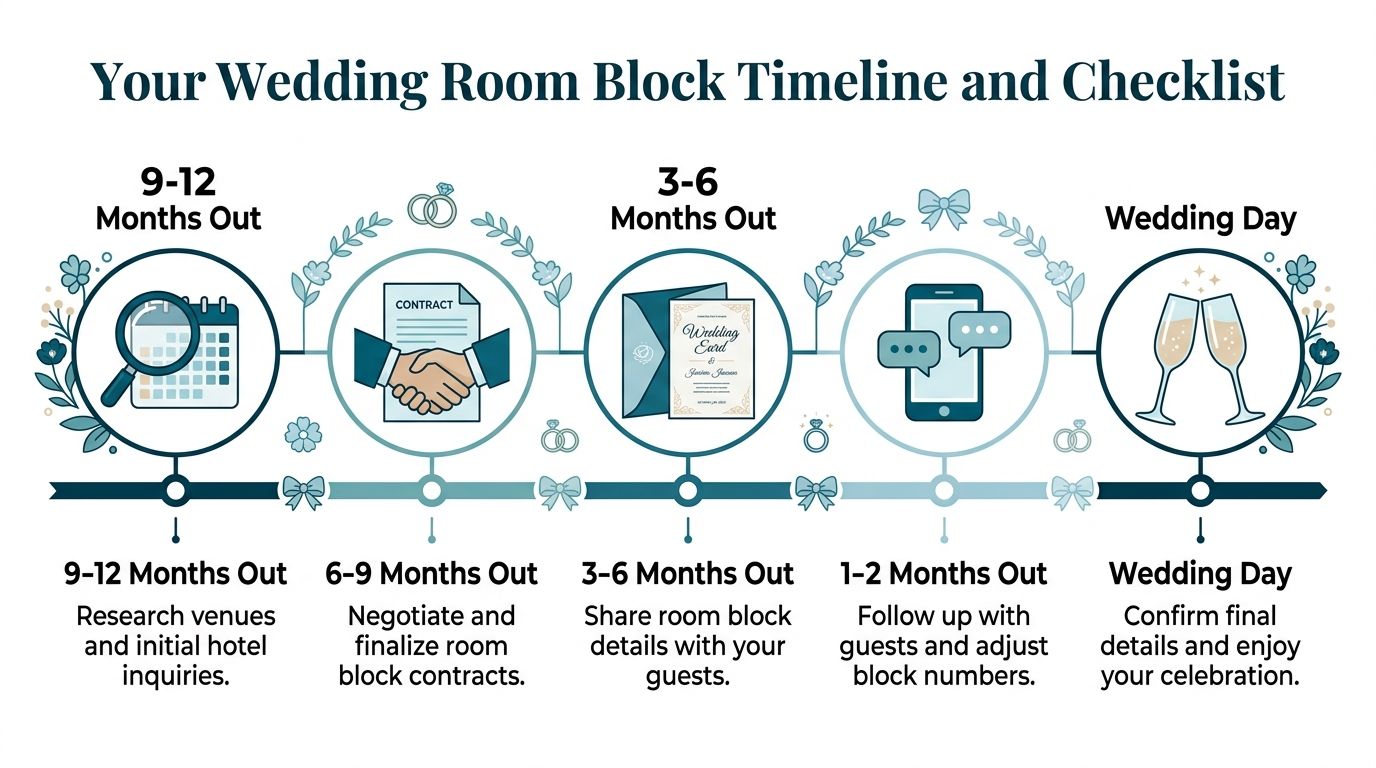
If you’re still setting your broader planning calendar, this guide on when to book wedding venue helps place lodging decisions in context with your venue timeline.
9 to 12 months out
This is when room block planning belongs on your radar, especially for a large capacity wedding venue, an Indian wedding venue near Chicago, or any reception venue hosting a full weekend.
Start with your guest map, not your total headcount. Who is likely traveling? Who may stay with family? Who will want to remain on-site or nearby rather than drive?
At this point, focus on these tasks:
- List likely hotel guests: Build a rough household count for out-of-town guests.
- Compare one to three hotel options: Too many choices can scatter guests and weaken the experience.
- Ask how the hotel handles wedding blocks: You want to know whether the property leans toward courtesy or guaranteed structures.
- Check event flow: If you’re planning a rehearsal dinner, sangeet, brunch, or farewell gathering, ask whether those pieces can connect to the lodging plan.
6 to 9 months out
This is the decision window. You estimate how many rooms to hold and negotiate the contract details.
A practical sizing method is to focus on out-of-town households rather than individuals. One common formula is to take 70% of your traveling guests, divide by two, and add a 10% buffer. Using that formula, 60 traveling guests would suggest around 23 rooms, according to Engine’s wedding room block FAQ.
That formula isn’t perfect, but it’s a sound starting point. It works because rooms are usually booked by couples or families, not one room per guest.
3 to 6 months out
Now the block needs to become visible.
Guests won’t use the rate if they can’t find it easily. Many couples lose pickup at this stage without realizing it. They mention the hotel once on the website and assume everyone saw it.
Use multiple reminders:
- Wedding website: Include the booking link, cutoff date, and any room-type notes.
- Save-the-dates or invitation inserts: A short lodging note can help guests act earlier.
- Family outreach: For cultural weddings or large family networks, share the details with key relatives who will spread the word quickly.
- Wedding party communication: Friends and attendants often book late unless given a direct reminder.
The room block doesn’t fail because guests dislike it. It usually fails because the information reached them too late or in too many scattered places.
1 to 2 months out
This is the monitoring phase. Check pickup regularly and compare it to your expectations. If the block is moving well, ask whether additional rooms can be added. If it’s moving slowly, encourage anyone who still needs lodging to reserve before the cutoff.
This is also when guest patterns become clearer. For a cultural wedding venue event with multiple days, some guests may stay for the entire weekend while others reserve only the main-night stay. That’s normal. The key is staying in touch with the hotel so the block reflects real behavior.
A simple checklist helps here:
- Review current pickup
- Identify VIP guests who haven’t booked
- Confirm cutoff timing
- Ask whether any direct bookings can be matched to the block
- Finalize welcome bag or arrival note logistics
Wedding week and arrival day
By the final stretch, the work shifts from selling the block to smoothing the arrival.
Confirm the booking instructions one last time for any stragglers. Share parking details. Make sure key family members know where to go. If your celebration spans ceremony, reception, and next-day events, one clean itinerary can prevent a lot of confusion.
Guests rarely comment on a room block when it runs well. They feel that the weekend was easy.
How to Negotiate Your Room Block for the Best Value
Negotiation works best when you stop thinking of it as haggling and start treating it like event design. You’re not trying to “win” against the hotel. You’re trying to match the contract to the way your guests will book.
That’s especially important for couples planning at a large wedding venue, a cultural wedding venue, or a destination-style event venue near me where guests may arrive on different days and reserve in different ways.
Negotiate the structure before the perks
Most couples start by asking for upgrades. The stronger move is to ask about the contract mechanics first.
The most useful negotiation point is often the attrition method. When negotiating, it’s smart to prefer a cumulative method, which calculates pickup based on the total block rather than by day, and to ask for housing audits so reservations made outside the official booking link can still count toward your total, as explained in Stova’s room block attrition guidance.
That matters because weddings rarely book in a perfectly even pattern. Friday might fill differently than Saturday. A cumulative method gives you a fairer picture of actual group performance.
What to ask for
Not every hotel will say yes to every request, but these are reasonable conversation points:
- Lower commitment risk: Ask whether the hotel can shift you toward a courtesy block or soften the attrition terms.
- A better cutoff timeline: Couples often need a little more time than the first contract offers.
- Audit support: Ask the hotel to review off-block reservations that may belong to your guests.
- Guest-facing value: Breakfast, parking, or booking flexibility often matters more than a slightly lower rate.
- Event linkage: If you’re also booking a rehearsal dinner, brunch, or welcome event, mention the total business you’re bringing.
For wedding weekends with multiple events, the total package often gives the sales team more room to help.
Simple language that works
You don’t need a formal script that sounds like a lawyer wrote it. Clear, calm language works better.
“We expect some guests to book late and some to call directly. Can we use a cumulative attrition method and include housing audits so those rooms still count if they stay within the event dates?”
Or:
“We’d like to keep the guest experience simple. If the block performs well, can we add rooms later rather than overcommitting at the start?”
That kind of wording tells the hotel you understand the basics and want a practical agreement.
A lodging option can also be discussed alongside your venue planning if you’re comparing properties with suites and guest accommodations, such as 2 bedroom suite hotels.
Where larger cultural weddings need a different strategy
Indian weddings and other multi-day cultural celebrations often need a more customized approach. You may have family staying several nights, guests attending only the main reception, and vendors or close relatives who need room access at specific times.
In those cases, negotiation should reflect the event rhythm. Ask which nights are likely to be strongest. Ask how the hotel wants to handle shoulder nights. Ask whether reservations outside the direct link can still be reviewed and credited. A contract built for a one-night corporate group may not fit a wedding with ceremony, reception, family gatherings, and brunch spread across several days.
A short explainer can help if you’re preparing for that conversation:
Good negotiation doesn’t make the contract aggressive. It makes it realistic.
The Merrill Advantage for Your Destination Wedding Guests
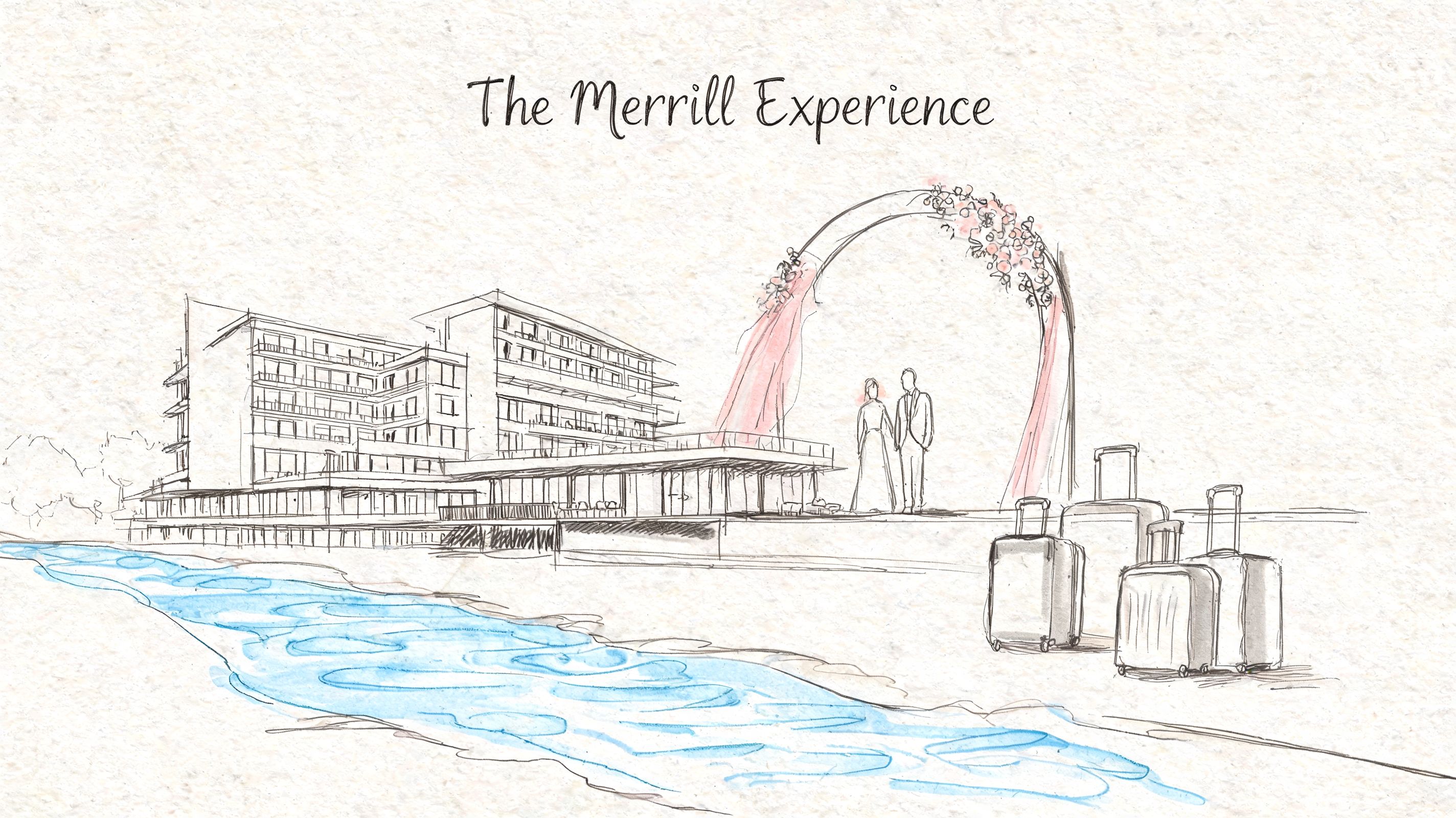
The most comfortable room block is often the one that doesn’t require guests to shuttle between separate worlds. They sleep in one place, gather in one place, and celebrate in one place. That’s where a hotel-based wedding venue changes the feel of the entire weekend.
For couples planning a wedding venue in Muscatine or comparing options across Davenport, Bettendorf, Moline, Rock Island, and the wider Quad Cities region, that kind of setup reduces friction in ways guests feel immediately. No hunting for the reception venue after check-in. No splitting relatives across distant properties. No added stress for older guests after an evening celebration.
Why destination-style couples care about this
Couples coming from Chicago, Naperville, Aurora, and broader Illinois markets often want the feeling of a getaway wedding without making guests deal with a complicated travel weekend. A riverfront property can offer that destination atmosphere while keeping the logistics manageable.
That’s especially useful when guests are traveling for more than the ceremony itself. If the weekend includes a welcome gathering, ceremony, reception, and farewell brunch, on-site lodging creates a natural rhythm. People settle in. They stay present. They don’t spend the weekend commuting.
Why this works for cultural and multi-day events
An Indian wedding venue or cultural wedding venue needs more than a ballroom. It needs flexibility across time, family structure, and event format. Multi-day schedules work better when everyone has a shared base for dressing, gathering, resting, and moving between events.
At a property like The Merrill Hotel, couples can align guest rooms with a full wedding weekend that may include rehearsal dinner, ceremony, reception, and brunch, while also supporting larger layouts and cultural event flow. That’s not about hype. It’s a different planning model than booking a stand-alone venue and then trying to coordinate lodging elsewhere.
A strong fit for micro-weddings too
This isn’t only a large wedding conversation. Smaller celebrations often benefit just as much from a well-matched block.
For intimate events with 10 to 30 guests, a courtesy block at a scenic hotel can be especially suitable, and one cited trend notes a 35% rise in courtesy block inquiries for rural venues, with stronger fill rates when paired with on-site events like brunch, according to River House’s room block discussion.
That rings true in practice. A small wedding feels more connected when everyone is staying close, meeting casually in the lobby, and extending the celebration into the next morning.
Guests experience a wedding weekend differently when the venue and the lodging support the same story.
What couples should evaluate
If you’re comparing a luxury wedding venue, an indoor wedding venue, or an outdoor wedding venue with lodging options, ask practical questions:
- Can guests walk easily from room to event spaces
- Can the property handle multiple event formats across the weekend
- Will family groups feel comfortable gathering on-site
- Can cultural ceremonies and custom layouts be accommodated
- Will guests understand where to be without constant transportation planning
Those answers often matter more than a slightly lower rate at an unrelated hotel. Convenience, clarity, and comfort are what guests remember.
Common Questions About Managing a Hotel Room Block
Even with a good contract, a few questions come up almost every time.
What happens if we don’t fill the block
It depends on the block type you signed. With a courtesy structure, unbooked rooms are generally released at the cutoff. With a guaranteed structure, your liability depends on the attrition terms in the contract.
That’s why the contract language matters more than the phrase “we have a block.”
How do I know whether guests are actually using it
Watch the pickup rate, which is the pace at which rooms are being reserved from your block. In broader event housing, block utilization averages 30% to 40% and has been declining as guests book directly for loyalty points, which is why regular audits with the hotel matter if you want off-block bookings credited where possible, as noted by PCMA’s discussion of event housing block dilemmas.
If you’re managing your own wedding, ask for periodic updates rather than waiting until the final weeks.
What if guests call the hotel directly instead of using our link
This happens often. Include the exact group name on your website and in your emails, and remind guests to mention it when booking. If the hotel allows audits, ask whether direct reservations made within your dates can be reviewed and attached to your group.
How do we estimate rooms for a multi-day Indian wedding
Start with households and event participation, not total invitations. Some guests will stay for the full run of events. Others may come in for only one night. Family VIPs, older relatives, and wedding party members should be identified early because their lodging patterns are often the least flexible.
For cultural wedding venue weekends, the cleanest plan is usually a primary block for close family and core guests, then a second layer of lodging guidance for everyone else.
If you’re looking for a venue that can host the celebration and the stay in one place, The Merrill Hotel offers riverfront event spaces, guest accommodations, and wedding weekend support for couples planning from Muscatine, the Quad Cities, and the Chicago area.