
There’s a quiet moment, usually right after the venue is booked and the date is set, when a couple asks, “So… when do we tell people?”
This is when the reality of the day begins to take shape. That first piece of communication, the save the date, moves from a line on a planning list to a real question. It’s more than a trend. It’s a kind and practical gesture.
I’ve seen countless couples breathe a sigh of relief once their save the dates are in the mail. It is an act of care, giving your guests the notice they need to truly plan to be there. Sending them out 6 to 12 months ahead of the wedding is a good place to start.
This early notice gently quiets that feeling of not knowing where to begin. Many couples find that sending this first message brings a sense of calm. You can see how this fits into the bigger picture in our planning a wedding checklist.
For guests traveling from Chicago, Iowa City, or even just across the river, this notice allows them to arrange time off and travel without a last-minute scramble. It’s something you notice more in towns like Muscatine, where family and friends often journey from a distance to gather along the Mississippi.
It helps to remember that a save the date is not about having every detail decided. It is about giving the people you love the one thing they need most to celebrate with you: time.
This first step sets a considerate tone for the entire journey. It’s the moment the planning truly begins for everyone else, and it starts with a simple, thoughtful note. It is a quiet act of generosity that makes it easier for your favorite people to be standing with you on your day.
How Far In Advance Should We Send Them?
The question of timing always comes up. There are guidelines, but what I’ve seen work best are timelines built around thoughtfulness, not rules.
For most weddings, sending your save the dates 6 to 8 months ahead of time gives people the breathing room they need. Many of the couples I see have guests traveling from the Quad Cities, Des Moines, or just across the river in Illinois. Giving this much notice is a quiet way of showing you care about their journey to be with you.
What if people have to travel?
If your wedding feels like a destination for most of your guests, or if you have a lot of family coming from farther away, you will want to extend that timeline. Sending a heads-up 9 to 12 months in advance is a considerate buffer.
It is a simple act that allows them to manage their own lives. They can book time off work, arrange for childcare, and plan for the trip without feeling rushed. It is one of the first, most practical ways to make sure the people you love can actually be there without added stress.
This timeline shows how your notice connects directly to your guests' ability to plan.
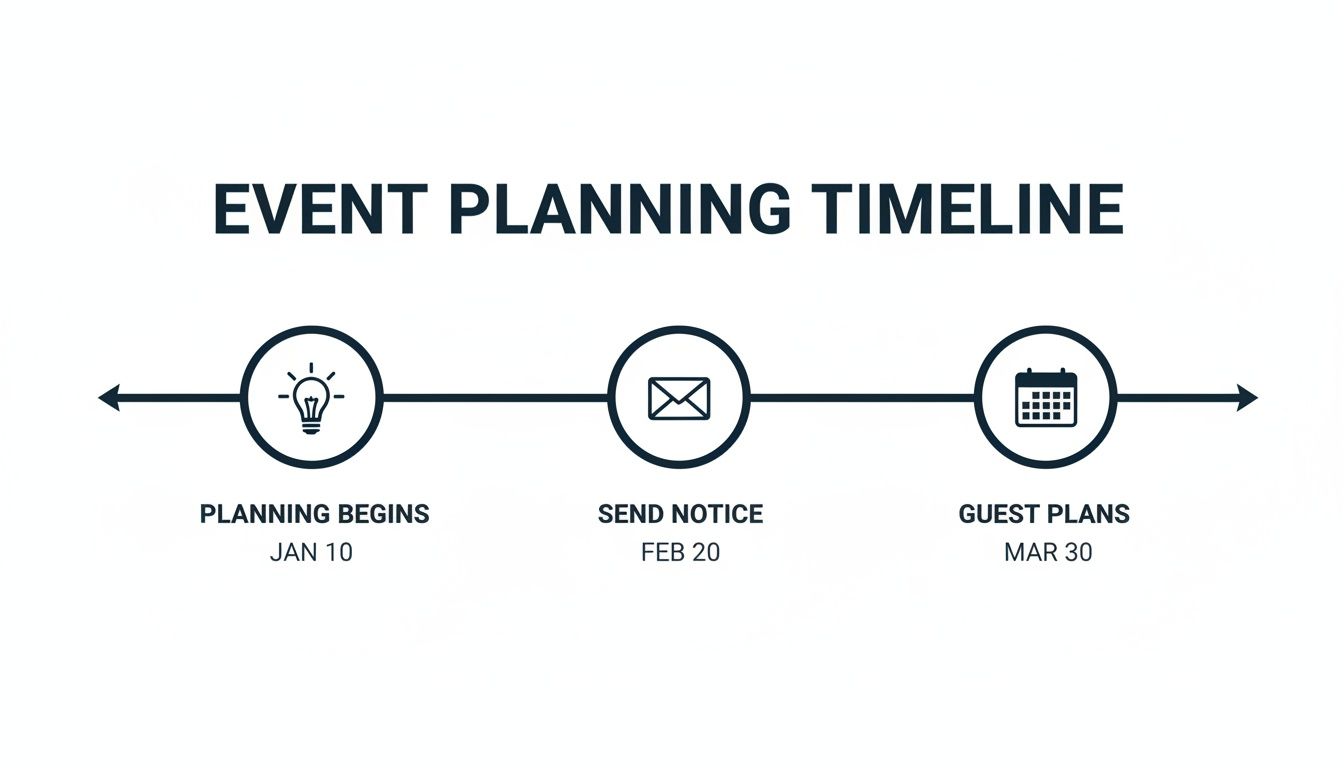
The real insight here is seeing how a simple card becomes a genuinely useful tool for your favorite people, turning intention into attendance.
To make it clearer, I have put together a simple guide. It might help you decide when to notify your guests based on your wedding's circumstances.
Recommended Timing for Sending Save the Dates
A simple guide to help you decide when to notify your guests based on your wedding's circumstances.
| Situation | When to Send | A Gentle Note on Why |
|---|---|---|
| Most guests are local | 6 months | Gives everyone plenty of time without being too early. |
| Many guests are traveling | 6-8 months | This is the standard for a reason. It respects their time and budget. |
| It’s a holiday weekend | 8-10 months | You’re competing with other plans. Give them a reason to choose you first. |
| It’s a destination wedding | 9-12 months | This isn't just a date; it’s a vacation. Give them time to plan for it. |
Ultimately, these are just starting points. You know your guests best.
Why does the timing really matter?
Ample notice has a clear, practical impact. Because so many people have limited vacation days, that advance warning is often what allows them to confidently say yes. It’s a courtesy that translates directly into better turnout. You can find more on the history of this tradition over at Digby & Rose.
It helps to remember the goal is not to follow a rule, but to make it easy for your favorite people to show up for you. The timeline is simply a tool for that.
This same way of thinking applies to deciding when to secure your venue—another choice that sets the foundation for everything else. If you’re at that stage, you can read more of my thoughts on when to book your wedding venue.
In the end, the timing of your save the date is a signal. It tells your guests that their presence is important to you, and you want to make it as simple as possible for them to be there. It’s a small detail that makes a big difference in how they feel as they prepare to celebrate with you.
What Information Do Our Guests Actually Need?
Couples often feel a quiet pressure to get every detail just right. I have watched many of them worry over wording and design, but what I have seen is that clarity always matters more than anything else. This is not the time for every last detail.
At this early stage, your guests need just enough information to mark their calendars. Think of it as a quiet promise of more to come, not the full story.
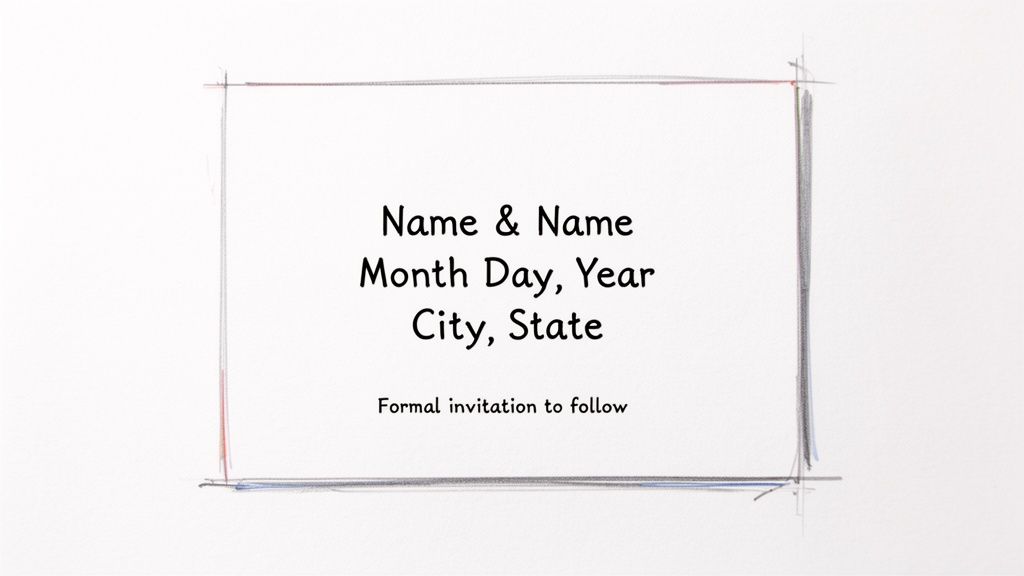
This first notice is simply about the when and the where. It is a heads-up, not a handbook.
The Core Essentials
The most helpful save the dates I have seen are the simplest ones. They focus only on what’s needed for guests to start making their plans.
- Who: Your names are all that’s needed to let them know who is celebrating.
- When: The date of the wedding.
- Where: Just the city and state is fine.
That is it. This is all the information required to hold the date.
What should we leave out?
There is a natural urge to share everything at once, but it is often kinder to hold some details back. Specific venue addresses, start times, and registry information can wait for the formal invitation. Adding too much now can create confusion before you have even had a chance to finalize your plans.
A simple phrase like “Formal Invitation to Follow” is one of the most useful lines you can include. It calmly manages expectations and reassures guests that more information is on its way.
A wedding website can be a thoughtful addition, but it is not a requirement. If you do include one, it acts as a quiet resource for travel and accommodation details—especially for those coming into Muscatine for the weekend. We have noticed this helps guests get a feel for the weekend ahead. You can learn more about how to manage those early responses by reading our guide on how to RSVP for a wedding.
This first communication is about giving your guests the gift of time. By keeping it simple, you give them exactly what they need and nothing more.
A Paper Card Or A Digital Message?
Sooner or later, every couple pauses here. The paper card or the digital message. It is a quiet decision, and there really is no wrong answer. Only what feels right for you.
There is a certain warmth to a mailed card. A real, tangible piece of good news in a stack of bills. It is something your guests can hold, put on the refrigerator, and glance at with a smile. It feels intentional.
At the same time, a digital announcement has a practical elegance. It is immediate, clean, and has become a normal way to share your plans. It reaches guests in an instant and simplifies one more step in a long planning process.
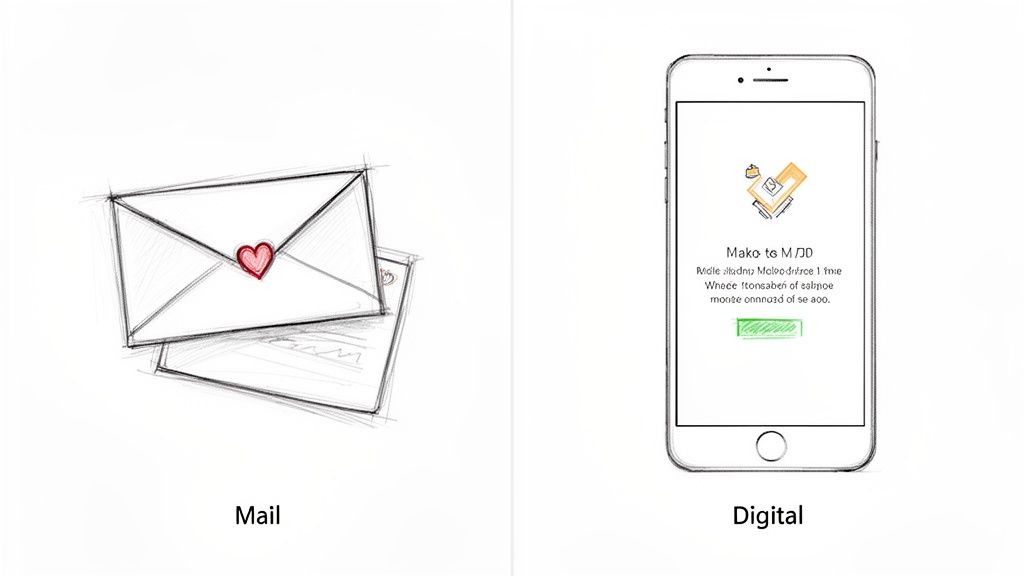
The shift toward e-announcements is not just about cost or convenience, as many resources like Save the Date point out. It reflects how we all communicate now. For many guests, an email or a beautiful digital card is just as welcome and far easier to keep track of.
Can we do both?
I have watched many couples find a thoughtful middle ground. They will send a beautiful paper card to their immediate families and older relatives, the ones who truly appreciate that tradition. Then, they send a clean, simple digital notice to friends and younger guests.
This approach honors both tradition and practicality. It lets you tailor the experience, which is always a kind thing to do. The goal is to feel good about your choice, free from the pressure of trends or what you think you should do.
It helps to remember that the method you choose is far less important than the message itself. The warmth and care come from you, not from the paper or the screen.
Whether it arrives in a mailbox or an inbox, the purpose is the same. You are giving your favorite people a happy reason to circle a date on their calendar. Choose the path that feels most like you. That will always be the right one.
Who Should Receive One?
The guest list is often a point of quiet anxiety. Deciding who gets a save the date can feel like a heavy decision to make so early in the process.The guidance here, though, is simpler and firmer than in most other parts of planning. After hundreds of weddings, I have seen one rule hold true: if someone gets a save the date, they must also get an invitation. It is the clearest way to be kind and set expectations from the start.
It is a known challenge to finalize a guest list this far in advance. Feeling uncertain about the final count is completely normal.
How to manage the guest list now?
Many couples navigate this by sending that first notice only to the people they are absolutely certain will be invited. Your must-haves. The immediate family and closest friends you cannot imagine the day without.
This gives your core circle the time they need to plan, especially if they are traveling to be here in Muscatine. The rest of the list can be settled closer to when you send the formal invitations, without causing confusion or hurt feelings.
It helps to see this not as making a final cut, but as sending the first wave of good news. A smaller, definite list for your save the dates is perfectly fine.
A Small Act of Clarity
Another detail that brings a lot of peace is how the envelope is addressed. Being specific from the very beginning is a small act of kindness that goes a long way.
Clearly naming who is invited on the envelope—for example, "Mr. and Mrs. Smith" versus "The Smith Family"—prevents future awkwardness. It offers gentle clarity about plus-ones or whether children are included in the celebration.
This small effort at the start ensures there are no difficult conversations down the road. You are simply giving your dearest friends and family a joyful heads-up. That is all it needs to be.
Where Did This Tradition Come From?
There is a point in the planning, usually after the big contracts are signed, when the smaller details start to feel overwhelming. A save the date can feel like just another thing on the list. Another decision, another expense.
It helps to remember why they exist in the first place. It was not always a tradition.
Save the dates became common for a simple, practical reason: the world got smaller, and families spread out. Weddings grew. Guests started traveling from farther away, and a formal invitation sent a few weeks out just was not enough notice anymore.
What began as a thoughtful heads-up—a way to give loved ones time to book a flight or ask for time off work—slowly became the standard we know today.
A Practical Act of Kindness
The idea of sending a dedicated save the date is actually fairly new, only becoming widespread in the last couple of decades. Before that, even etiquette experts suggested just a few weeks' notice was enough. But as weddings became weekend-long events, that timeline stopped working.
Giving that early alert is one of the most effective ways to ensure the people you want there can actually make it. You can find more on this evolution from wedding experts at Wedgewood Weddings.
It helps to remember this when you are in the middle of planning. A save the date is not another pressure point. At its heart, it is a thoughtful and practical way to care for your guests.
I have seen so many couples breathe a little easier when they reframe it this way. The tradition did not start as an obligation but as a solution. It was the answer to a quiet question: "How can we make it easier for the people we love to be here with us?"
Knowing this often brings a sense of calm to the process. It puts the focus back where it belongs—on gathering the people you care about, here along the river, to celebrate.
A Few Quiet Questions I Often Hear
It is usually in the quiet moments of a tour, or over the phone weeks later, that the same few questions come up. They are almost always asked in a low voice, as if the couple is worried the answer will be complicated.
It never is. These are the small points of doubt that surface for nearly everyone. Thankfully, the answers are simpler than you think.
What if we do not have all the details yet?
This is perfectly fine—in fact, it is the entire point of a save the date. All your guests truly need at this stage is the date and the city.
It gives them the most important information right away so they can clear their calendars. The rest of the specifics will come with the formal invitation, and that is what your guests expect. You do not need every detail locked in to send this first, thoughtful notice.
Should we send them for local weddings too?
Yes. I have seen this become more and more common, and for good reason. Even for guests who live nearby, life gets busy.
A save the date is a welcome courtesy. It allows them to protect your wedding day on their calendar before other plans take root. It is a simple gesture that is always appreciated, no matter how close or far your guests are.
We had to postpone. How do we handle this?
This happens, and the best way forward is with clear and calm communication. A simple note with a heading like ‘Change of Plans’ or ‘Save Our New Date’ works well.
You can send a new card or a digital message that plainly states the new date. Most couples include a short, honest line like, “We’ve decided to postpone our celebration. Please save our new date of…” Your guests will understand and appreciate the direct update.