
There’s a point in planning when the big decisions feel done, but a different kind of quiet concern settles in. It isn't about choosing colors or food anymore. It's the hum of small questions, all asking for an answer at once.
This is where a day of coordinator steps in. Their role is to quiet that hum so you can be present for your own wedding day.
What is their role, really?
Most couples don’t see the need for this kind of help until late in the process. The contracts are signed and the vendors are booked. But then a new thought appears: who will make sure everything actually happens on the day?
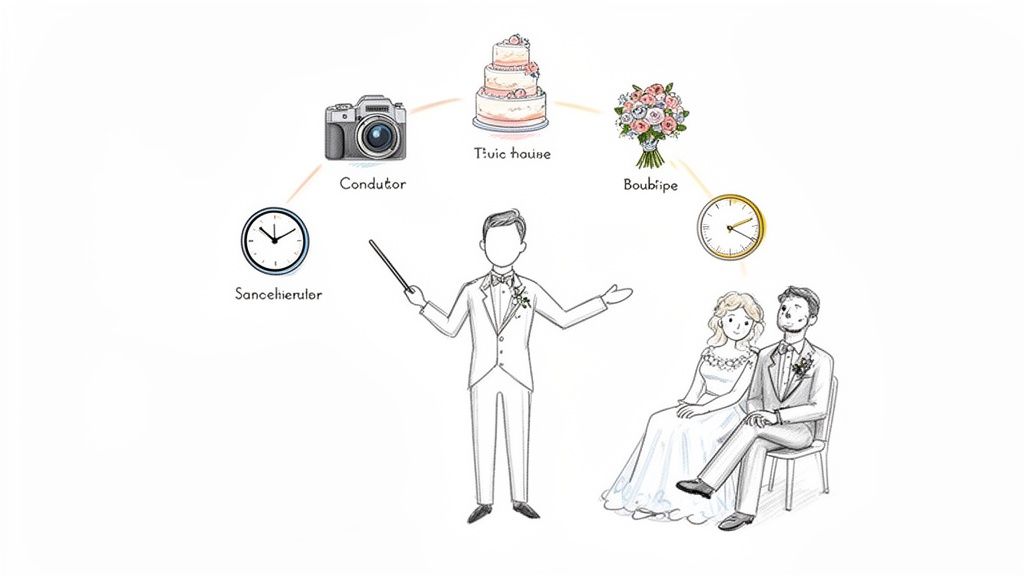
I’ve seen this moment countless times. A coordinator’s job isn’t to pick the music or the flowers. Their role is to be the conductor for the orchestra you’ve already put together, making sure every part works together.
Think of them as the one point of contact for everyone.
- They are the one confirming arrival times with your photographer and florist.
- They are the one guiding the wedding party through the ceremony processional.
- They are the one answering a vendor’s quiet question so your mom doesn’t have to.
Their real purpose is to run the timeline so you can stay present. A wedding day shouldn't feel like a checklist. It should feel like a series of moments you actually get to live in.
This becomes especially true when you have guests traveling to be with you, maybe spending the weekend in a place like Muscatine. You want to be with them, not directing a delivery truck or trying to find a misplaced boutonnière.
Ultimately, a day of coordinator carries the mental load of the day for you. Their work is what allows you to let go of the details and just experience your wedding as it unfolds. It’s a role born from one simple need: peace of mind.
What does a day of coordinator handle?
Couples often ask what a day of coordinator really does. From what I’ve seen, their best work is the work you never notice. They’re the quiet presence making sure the day unfolds, letting everyone else just be in it.
Their job is to become the one person everyone turns to. Instead of your DJ asking you about the first dance song, or a vendor asking your mom where to set up, they find the coordinator. That one small change completely shifts how a couple gets to experience their own wedding.
The quiet guardian of your timeline
A coordinator is the keeper of the day’s rhythm. They hold the timeline you’ve all agreed on and gently keep things moving, often without anyone realizing it.
If the toasts run a little long, they’re the one who quietly signals the kitchen to hold dinner service. If a bus with guests arrives a few minutes early, they manage it before a single person in the wedding party even knows. They handle the unexpected so it doesn’t interrupt the moments that matter.
I remember one summer wedding where the floral delivery was running late. The couple had no idea. Their coordinator calmly handled the calls and had a backup plan in place long before guests started to arrive. That’s the kind of peace of mind they bring.
They don’t just manage tasks. They absorb the logistical questions and small worries that would otherwise fall to you or your family, protecting your attention for the moments that matter.
The central point for all your vendors
It’s not unusual for a wedding to have more than a dozen different vendors, from photographers to lighting teams to the person delivering the cake. A day of coordinator becomes the conductor for the entire team you’ve hired.
They become the single point of contact for every vendor question, problem, or last-minute change.
Here’s a quiet look at how their presence reshapes the day’s responsibilities.
How the day's responsibilities shift
| Responsibility | Without a Coordinator (Often the Couple or Family) | With a Day Of Coordinator |
|---|---|---|
| Vendor Questions | Vendors ask the couple, a parent, or a maid of honor. | All vendors report directly to the coordinator. |
| Timeline Cues | A designated family member tries to keep track of the schedule. | The coordinator gives cues to the couple, DJ, and photographer. |
| Problem Solving | The couple or their family must deal with unexpected issues. | The coordinator handles hiccups quietly behind the scenes. |
| Final Payments/Tips | The couple or a parent has to distribute envelopes. | The coordinator manages final payments and tips discreetly. |
| Setup Oversight | The couple or family members check on décor and table setups. | The coordinator ensures everything is set up to the couple’s plan. |
Ultimately, having a coordinator allows the couple and their families to feel like guests at their own celebration. You can focus on each other, knowing all the operational details are in capable hands.
To see how these duties fit into a real-world schedule, you can take a look at our reception timeline template.
When does their work actually begin?
The name “day of coordinator” is one of the most confusing terms in weddings. It gives the impression that someone just shows up on the morning of, ready to take over. I’ve seen that assumption create unnecessary stress for couples. The reality is quite different.
Think of it less as a single day of work and more as a thoughtful handoff. This transition usually starts about four to six weeks before your wedding. It's the point where you finally get to pass along all the plans you’ve spent months putting together.
This is when the mental weight really starts to lift. You no longer have to be the keeper of every last detail.
The handoff period
During this time, you’ll share all your signed contracts and vendor information. You’ll walk your coordinator through the day you’ve imagined. From there, they take the reins.
Your coordinator will be the one to reach out to the photographer, the florist, the DJ, and the bakery. They introduce themselves and become the new point of contact for every logistical question. They confirm arrival times and make sure all the final details are in place. This step alone is where I see couples finally start to breathe.
This visual shows how a coordinator’s involvement isn’t just on the wedding day, but a process that begins weeks before.
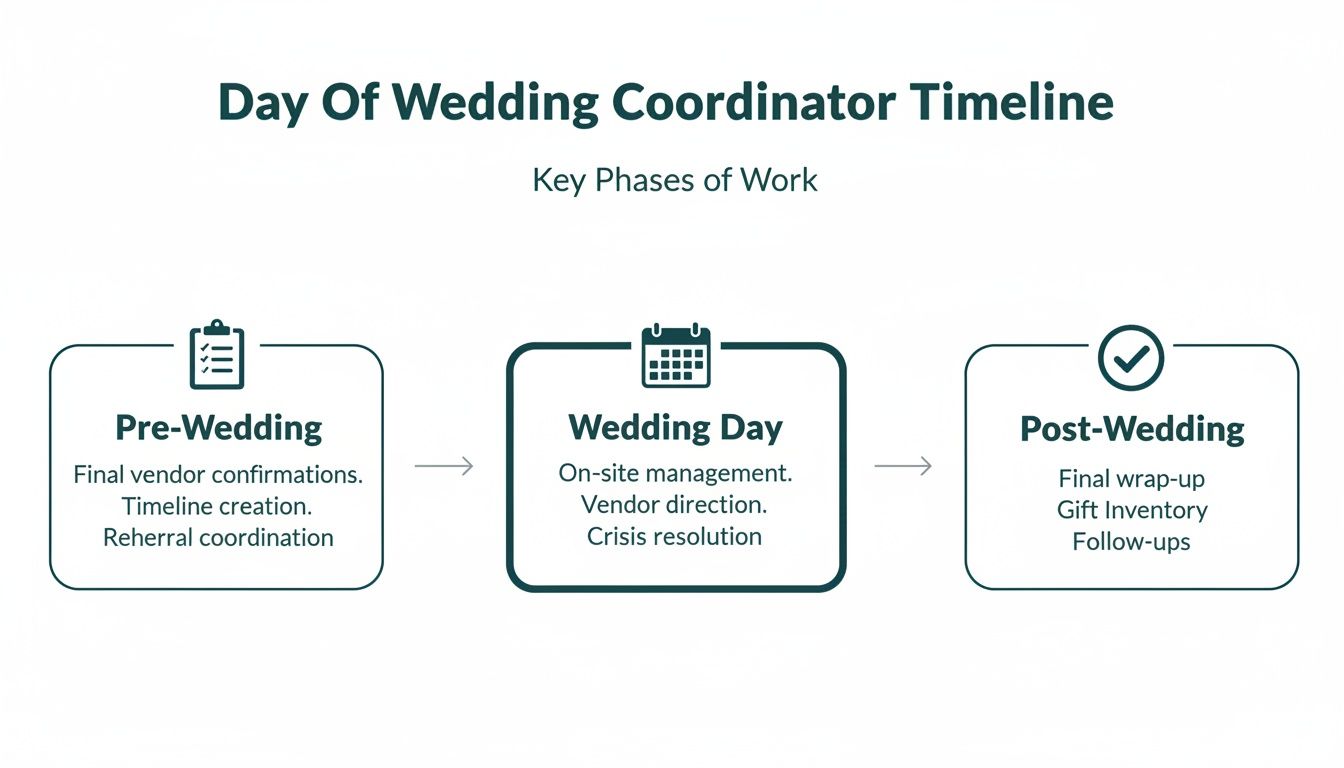
As you can see, the 'day of' is really just the final step.
The goal is to build a master timeline that actually works in the real world—one that accounts for all the small, moving parts of the day. It’s a surprising amount of quiet work. Before the first guest even arrives, a coordinator will have already dedicated 15-20 hours to making sure everything runs smoothly.
This period is essential. It lets your coordinator step in with confidence because they truly understand the day you’ve planned. By the time your wedding weekend arrives, especially for those traveling to Muscatine, all you have to do is be present. You can trust that someone else is watching the clock. To see how this fits into your larger schedule, our planning a wedding checklist offers some helpful context.
How is this different from a venue coordinator?
It’s one of the most common points of confusion couples run into, and for good reason. A venue coordinator and a personal wedding coordinator seem to do the same thing. They work toward the same goal, but they arrive at it from different places. Their focus, and their loyalty, are in two different worlds.
Here at The Merrill, our role is to be your venue coordinator. Our attention is on the property. We make sure the ballroom is set exactly as you envisioned, that the lighting feels right as the sun goes down, and that our food and beverage service unfolds seamlessly. Our job is to deliver on the promise of the building.
A personal wedding coordinator is different. Their focus is entirely on you.
Two roles, one goal
Their loyalty belongs to your timeline, your vendors, and the personal rhythm of your day. They aren’t tied to the venue; they’re tied to making your specific vision happen within it.
A venue coordinator makes sure the room is ready for your arrival. Your personal coordinator makes sure your photographer is in place to capture the moment you see it. One is focused on the space, the other on the people moving through it.
You really feel the difference in the small, unplanned moments. When a groomsman’s button pops off minutes before the ceremony, it’s the personal coordinator who has the sewing kit ready. When your officiant gets stuck in traffic, they’re the one quietly adjusting the timeline behind the scenes so no one feels the pressure.
Our team at the venue makes sure the foundation is solid. The building is ready, the staff is in place, and everything The Merrill provides is exactly where it should be. A personal coordinator then builds your story on top of that foundation.
Understanding what is a wedding coordinator and where their responsibilities lie brings a lot of peace of mind. The roles don’t overlap—they complete each other. One takes care of the house. The other makes it feel like home for the day.
How do I know if I need one?
The question of hiring a day of coordinator isn’t always about how complicated the wedding is. It’s usually about how you want to feel when the day finally arrives.
It comes down to a few quiet questions. When the photographer shows up while you’re getting ready, who will be there to greet them? If the DJ has a question right before the ceremony begins, who will have the answer? If you spend the morning answering calls and directing people, how will that change the way the day feels?
Many couples think about asking a friend or family member for help, and sometimes that works. But it brings up another question. Do you want that person to work on your wedding day, or do you want them to be able to simply celebrate with you?
A different kind of quiet
There’s a certain calm that comes from knowing one person is there just to protect the flow of the day. It’s a quiet reassurance, especially when you have guests who have traveled a long way to be with you. For couples hosting friends and family in a place like Muscatine, you want your time to be about connection, not coordination.
This person’s job is to let you be present.
A coordinator also brings a practical kind of relief. With 60% of couples pointing to budget management as a major source of stress, it’s worth noting that the right vendor can actually ease that pressure. A good coordinator often helps couples stay on track and avoid the small, unexpected costs that add up. You can find more insights on how vendors shape wedding budgets over at saradoesseo.com.
Who will hold the details?
Ultimately, the choice comes down to this: on your wedding day, who do you want to be the keeper of all the small details?
Some couples are natural organizers and feel better holding onto the clipboard themselves. For others, handing it over is the final, freeing step in the entire planning process.
There is no right answer here. It’s about knowing yourselves and deciding what will bring you the most peace. It’s about creating the space to experience your wedding day not as its manager, but as the reason for it all.
A quiet word on letting go
When couples look back on their wedding day years later, they don’t usually talk about how the linens were folded. They don’t mention that the ceremony started three minutes late.
What they remember are the unplanned moments. A quiet glance across the room. The feeling of walking back down the aisle, just the two of them. A shared laugh with a grandparent during dinner.
Those are the moments that end up meaning the most.
Protecting the experience
All the details you’ve planned are meant to create a day where those moments can happen. But sometimes, the weight of managing every detail can keep you from actually experiencing them. This is where the real work of a day of coordinator begins.
Their most important job isn’t just running a timeline. It’s protecting your ability to be present in your own life. It’s about letting you feel the joy of the day without also carrying the responsibility for it.
The greatest gift a coordinator gives you is permission to let go. They hold the logistics so you can hold onto the moments.
When you hand over the checklist and the vendor questions, you’re creating space. It’s space to notice the look on your partner’s face. To have a real conversation with a friend who traveled a long way to be there.
It’s space to simply breathe.
Years from now, what you’ll remember isn’t how perfectly the day was managed. It will be how it felt to be there, together, without distraction. Giving yourself that freedom is one of the most important decisions you can make.
Common questions about day of coordination
Even when couples decide a day of coordinator is what they need, a few questions tend to linger. They’re the small uncertainties that can feel bigger than they are. The answers, though, are usually pretty straightforward.
Do I still need one if my venue has a coordinator?
This question comes up all the time. It helps to think of the two roles as having different points of focus. A venue coordinator, like our team here at The Merrill, is focused on the venue itself—the building, our staff, and the services we provide. We make sure our part of the day runs like it should.
Your personal day of coordinator, on the other hand, is focused entirely on you. They manage your personal timeline, your specific group of vendors, and all the little details that make the day feel like yours. One role takes care of the house; the other makes it feel like home.
How much does a day of coordinator cost?
The cost can feel like a significant number, but it’s becoming a much more common and approachable part of the wedding budget. On average, a day-of wedding coordinator costs around $1,400, which puts it within reach for many couples, especially when you see how it compares to full-service planning. You can get a better sense of how coordinators fit into the bigger financial picture in this wedding industry salary guide.
What happens if I don’t hire one?
Without a professional in that role, the job of managing the day just falls to someone else. More often than not, it’s the couple themselves, a parent, or a friend from the wedding party who ends up checking the time, directing vendors, and solving small problems.
That can absolutely work. The real question is whether you want your loved ones to have a job on your wedding day, or if you’d rather they simply have the freedom to celebrate alongside you. There isn’t a right answer, only what feels right for the kind of day you want to have.
It’s less about whether the tasks get done and more about who is responsible for doing them. A coordinator’s presence means that person isn’t you or someone you love.
Should we tip our day of coordinator?
A tip is never expected, but it’s always a deeply appreciated gesture for someone who went above and beyond. If your coordinator navigated a tricky situation with ease or just gave you a profound sense of peace all day long, a tip is a wonderful way to show your gratitude. This is usually handled at the end of the night as they’re wrapping up their work.