
There’s a point in planning when a detail you hadn’t thought much about suddenly feels important. For many couples, that detail is the chairs. They do more than just seat your guests. The chairs for your wedding frame the ceremony and set the feeling for the entire day. It’s not about finding the one right chair, but the one that feels true for the day you are building.
Choosing your chairs is one of the first decisions that makes the day feel real. It is an answer to the quiet question, “Where will all the people we love actually sit?” Getting this right isn't about perfection. It’s about creating a space that feels comfortable and welcoming, so your guests can be fully present for the promises you’re about to make.
I have seen hundreds of weddings unfold from inside The Merrill, and this conversation almost always begins with a little uncertainty. Most people have never rented hundreds of chairs before. The goal is to move from simply filling a room to creating a feeling.
How do we even start thinking about chairs?
I’ve watched hundreds of weddings unfold here, and I’ve noticed the conversation about chairs usually starts with a quiet sense of confusion. That’s completely normal. Most couples have never had to rent dozens, let alone hundreds, of chairs before. The choices can feel overwhelming at first.
The goal is to shift from just filling a space to creating a feeling. Chairs are often the first thing your guests interact with when they arrive. They are the foundation of your reception design. They can either blend into the background or become a beautiful, intentional part of your day.
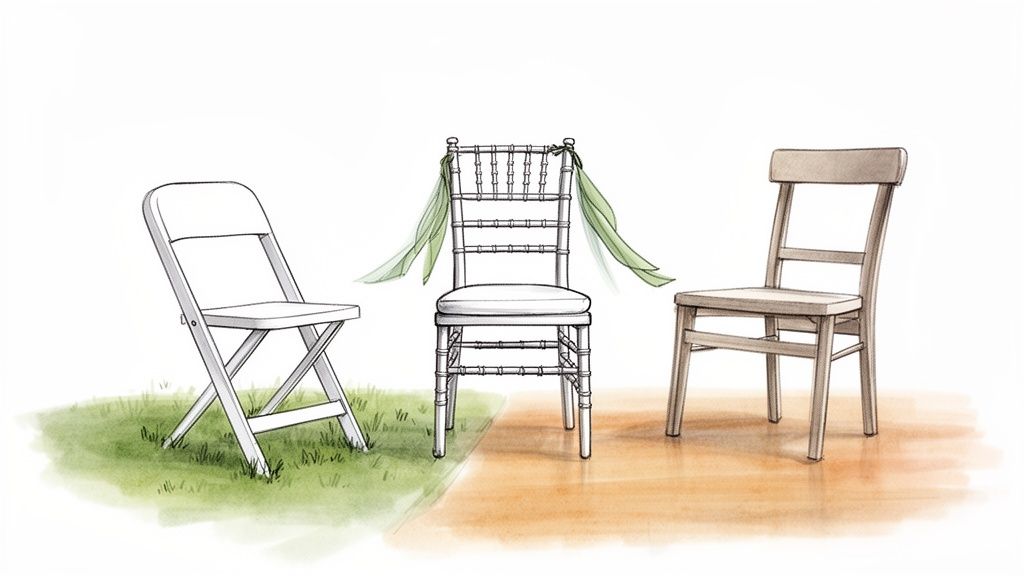
What do chairs really do?
It helps to remember that chairs have two jobs. The first is practical, and the second is emotional.
- Practical: Chairs need to be a comfortable place for your guests to sit, especially during a ceremony or a long, seated dinner. Comfort matters more than people think. When guests are comfortable, they’re more present for the moments you want them to witness.
- Emotional: The style of the chair helps tell your story. It supports the atmosphere you want to create—whether that’s relaxed and informal or classic and elegant.
I’ve seen how a simple white folding chair can feel crisp and lovely for a ceremony on our terrace overlooking the Mississippi River. I’ve also seen how the warm wood of a cross-back chair can make our ballroom feel even more inviting. One isn’t better than the other; they just create different feelings.
There’s a moment when couples realize the chairs aren’t just furniture. They are part of the welcome. They signal to your guests what kind of gathering this will be and how much you’ve considered their comfort.
How do we keep our perspective?
Many couples worry they’ll make the wrong choice. I’ve found it helps to take a step back and ask a few quiet questions. Does this chair feel like it belongs with the rest of our plans? Does it feel sturdy and welcoming? When you picture your guests arriving, does the scene feel right?
Here in Muscatine, we’re used to a certain pace. There's a groundedness that often finds its way into the weddings we host. This same feeling can guide your decisions. It’s not about chasing a trend you saw online, but about choosing something that feels authentic to you and the celebration you're putting together.
The truth is, your guests will not analyze your chairs. They will not know the name of the style you chose. What they will remember is the feeling of the space—whether it felt comfortable, beautiful, and full of warmth. The right chairs are simply the ones that help create that feeling, allowing everything else to fall gracefully into place.
How do we choose the right style of chair?
The sheer number of chair styles can feel like one more decision you didn't know you had to make. I've had so many couples ask if their ceremony chairs need to match the reception, or if one style is somehow “better” than another.
It’s a normal question. The answer almost always comes back to the feeling you want for your day. The choice gets easier when you stop seeing a chair as just an object and start picturing it holding the people you love.
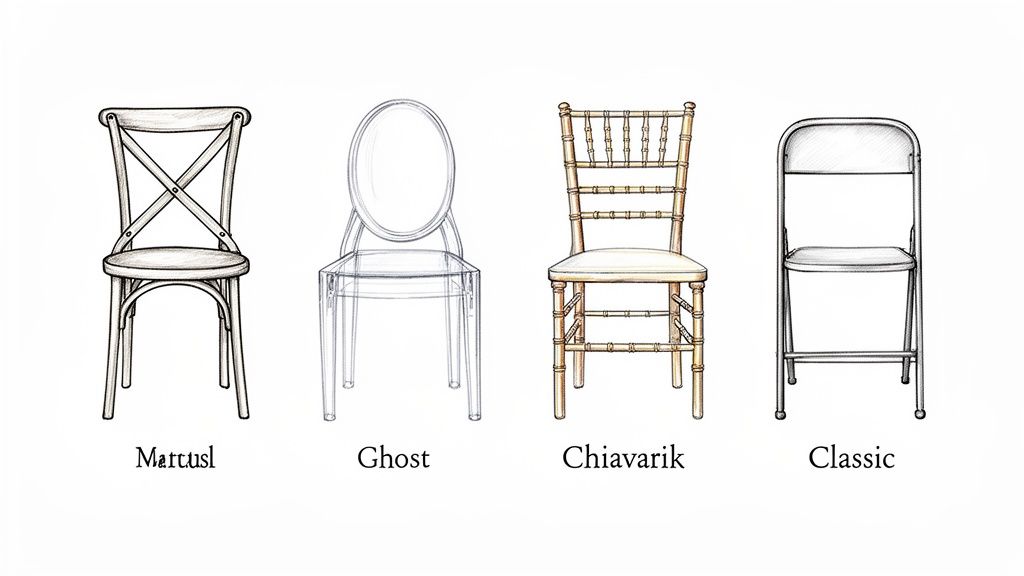
Seeing the feeling in the style
Different chairs bring a different kind of energy into a room. A wooden cross-back chair, for instance, has a relaxed, almost organic feel. It works beautifully with the natural light we get here at The Merrill, making a space feel grounded and warm.
Then you have something like a modern ghost chair, which feels light and almost invisible. I’ve seen them used for ceremonies overlooking the Mississippi, where the couple wanted nothing to obstruct that view. The chairs just seem to disappear, letting the river and the sky hold the focus.
It’s no surprise that chairs are a big part of the wedding experience. The global wedding furniture market was valued at USD 3.8 billion in 2024, and it continues to grow. Couples usually find that decor and rentals, including chairs, account for about 10-15% of their wedding budget. It makes sense—these are the details that build the world of your wedding. You can find more details on the growth of the wedding furniture market if you’re curious.
Do ceremony and reception chairs need to match?
This is a question I hear all the time, and there is no single rule.
Sometimes, using the same chair for both the ceremony and reception creates a sense of continuity. It’s also a practical choice, especially if your celebration is in one main space that needs to be reset during cocktail hour.
Other times, using two different styles helps to define the two distinct parts of your day. A simpler chair for an outdoor ceremony might feel right, followed by a more ornate chair for the reception to signal a shift in the evening's mood.
I’ve seen that the most important thing is that both choices feel like they belong to the same story. They don’t have to be identical, but they should feel like they’re in conversation with each other.
A guide to common wedding chair styles
Instead of getting lost in rental catalogs, it can help to think about the atmosphere you want to create first. That feeling can narrow down the options much faster. Here is a simple way to look at some common styles and the feeling they bring to a room.
| Chair Style | Common Atmosphere | Often Paired With |
|---|---|---|
| Chiavari | Classic, Formal, Elegant | Ballroom settings, formal tableware, lush florals |
| Cross-Back | Rustic, Warm, Relaxed | Long wooden tables, greenery, natural light |
| Ghost (Acrylic) | Modern, Minimalist, Airy | Riverfront views, contemporary decor, bold colors |
| Folding (Wood or Resin) | Simple, Clean, Versatile | Outdoor ceremonies, casual receptions, garden settings |
You do not need to know the history of every design. The only thing that matters is looking at a chair and asking, “Does this feel like us? Does this feel like the day we want to have?”
Choosing your chairs for the wedding is a quiet decision that has a big impact. When you find the style that fits, it helps all the other pieces fall into place. It’s one of those details that, once decided, lets you take a breath and move on to the next.
How many chairs do we actually need?
It’s one of those questions that feels simple at first. Then, the smaller, more specific ones start to follow. Do we need a seat for every single person at the ceremony? What about the photographer? Or the musicians?
Couples often feel a little flicker of uncertainty here. That is a normal part of the process. The goal isn’t just to land on a number, but to feel confident that everyone who is part of your day has a comfortable place, letting the whole thing flow with ease.
Let’s walk through it. The answer is usually more straightforward than you might think.
For the ceremony
For your ceremony, the math is simple. You need one chair for every confirmed guest. This includes any children who are old enough to sit on their own. If your final count is 150 people, you will want 150 chairs.
It can be tempting to order fewer, assuming a few people might stand, but I’ve seen this create a bit of awkwardness. Guests hesitate to take the last few seats, or family members end up standing in the back. Providing a seat for everyone is a small gesture of care that helps people settle in and be fully present for your vows.
It’s helpful to remember that your vendor team—photographers, planners, musicians—generally do not need seats during the ceremony. They’re usually moving around or have their own designated spots.
For the reception
This is where the numbers can shift depending on the kind of evening you are planning.
If you are having a formal, plated dinner, the answer is the most direct. Just like the ceremony, you will need one seat for every guest. This ensures everyone has a designated spot for the entire meal.
But if you are planning more of a cocktail-style reception with food stations and mingling, you can adjust your numbers. A good rule of thumb that I have seen work well is to provide seating for about 70-80% of your total guest count.
This gives people enough space to rest and set down their plates without needing a formal seat for everyone at once. It creates a nice, social energy in the room. Some people will be at high-top tables, others will be on the dance floor, and others will be sitting and chatting. It feels dynamic and relaxed.
The "flip" and the buffer
What if your ceremony and reception are in the same room, like our ballroom here at The Merrill? This is called a "flip"—where the room is reset during cocktail hour. In this case, you generally need just one set of chairs for your total guest count. They are simply rearranged from ceremony rows to reception tables.
No matter what you are planning, it is always wise to have a small buffer. I usually suggest adding 3 to 5 extra chairs to your final order. This covers any unexpected plus-ones or last-minute changes without causing any stress. They can be stored out of sight, ready if you need them.
Having those few extra chairs is a quiet form of insurance. It is one of those small details no one will notice unless they are missing. This is one reason why renting is so common. Rentals dominate the wedding furniture market with over a 60% share, making high-quality chairs for wedding events accessible. For a 150-guest wedding, venues might bring in 200 chairs or more to be ready for every part of the day. You can explore more data on how couples budget for wedding rentals if you find those details helpful.
Ultimately, counting your chairs is about anticipating the needs of the people you have invited. A little thoughtful planning here ensures the entire day feels comfortable and welcoming.
Where do all the chairs go?
After couples choose their chairs and figure out the count, a quieter question starts to surface: where do they all go? It can feel like a small detail, but I have seen how the arrangement of seats can completely shape the feeling of a room.
It’s not about just fitting people in. It is about creating pathways, encouraging connection, and designing a space that lets everyone feel at ease. The layout guides how your guests experience the most important moments of the day.
For the ceremony
For the ceremony, most couples immediately picture a traditional layout with a straight aisle down the center. It’s a classic for a reason—it creates a clear, beautiful focus for the processional.
But I’ve also watched couples create a softer, more intimate feeling with a gentle curve in their seating. By arching the rows, a larger space like our ballroom can feel more personal. It has a way of gathering everyone in, making it seem like your guests are encircling you with their support. This is especially lovely for ceremonies on our outdoor terrace, where a curved setup opens up the view of the Mississippi River behind you.
The most important thing I've noticed with ceremony layouts is ensuring a clear, wide aisle. It gives you, and your photographer, plenty of room. A little extra space allows for a graceful entrance and an unhurried exit, without anyone worrying about a gown catching on a chair.
For the reception
At the reception, the placement of tables and chairs sets the social tone for the entire evening. There are two common approaches, and each one creates a different kind of energy.
Round Tables: This is the familiar choice, and for good reason. They are wonderful for encouraging conversation. A round table lets a group of 8 to 10 guests all chat easily with one another, creating little hubs of energy around the room. It also makes it easy for guests to move between tables to mingle.
Long, Communal Tables: There's a special warmth to long, rectangular tables. They can create a grand, celebratory feeling, almost like a family feast. I’ve noticed they encourage guests to talk to the people sitting directly across from and beside them, fostering a different, more linear kind of connection.
This chart is a simple guide for thinking through how many chairs you’ll actually need for every part of your day.
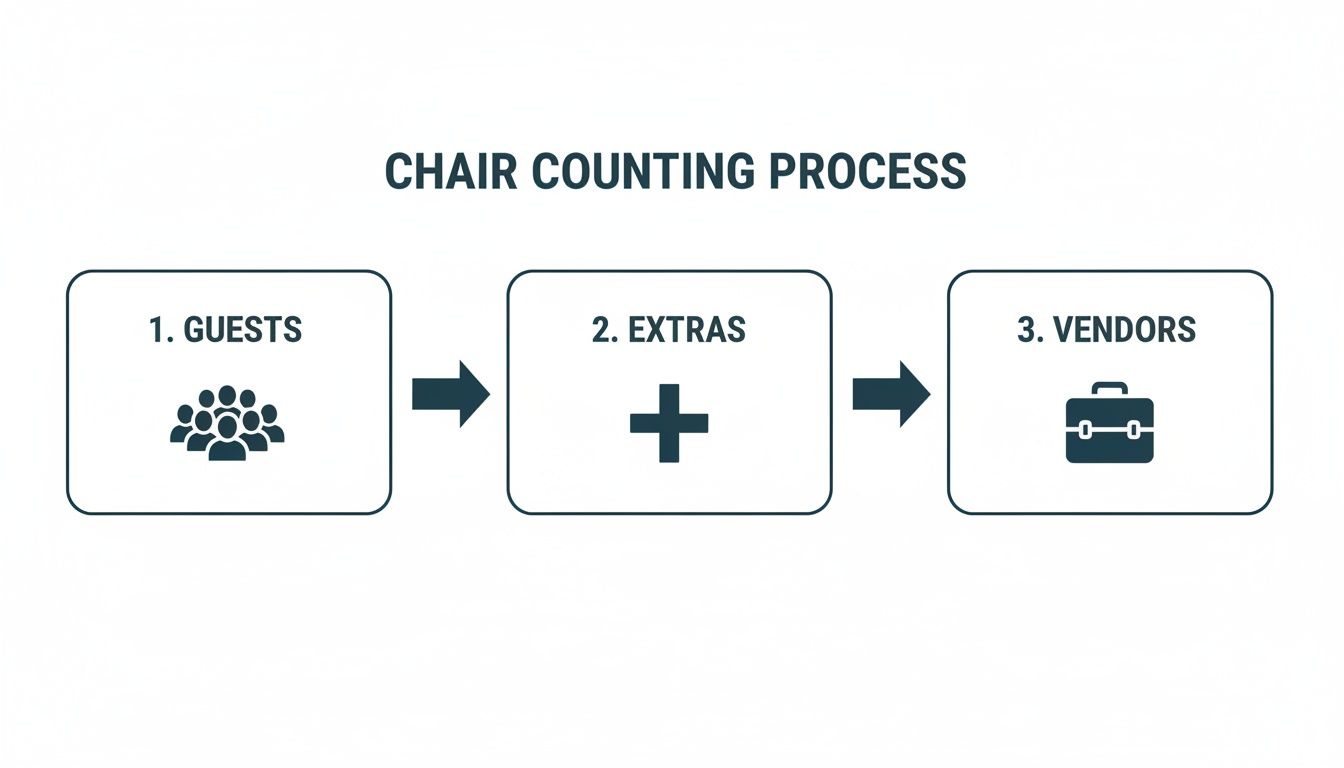
It highlights that the final number goes beyond just your guest list, reminding you to account for a few extras and any vendors who will need a seat during the meal.
Practical considerations
Beyond the style, a few practical thoughts can make all the difference in how the day unfolds. Thinking about clear pathways is one of them. You want to make sure there is enough space between tables for guests to move around comfortably and for vendors, like your catering staff or photographer, to do their work without being disruptive.
Considering accessibility is another quiet act of care. If you know you have guests who use a wheelchair or have mobility concerns, thinking ahead about where to place them can make their experience so much smoother. It is often as simple as reserving a spot at the end of a row or making sure there is an easy path to their table. You can find more on this in our guide on how you should arrange the room.
Ultimately, arranging the chairs is about more than logistics. It is about designing a space that brings your favorite people together, encourages them to connect, and allows everyone—including you—to settle in and feel completely present.
What about chairs for an outdoor ceremony?
When you plan a ceremony with a view of the Mississippi River, the practical details can feel surprisingly quiet. The ground might be softer than you think. The afternoon sun might hit at an angle you did not expect.
It is these small things, when handled ahead of time, that allow the day to unfold without a single worry.
For a ceremony on the lawn or our outdoor terrace, the first thing I look at is the ground itself. It tells you what kind of chair will feel most stable for your guests.
Chairs with thin, stiletto-like legs tend to sink into the grass, which can leave people feeling a little unsteady as they find their seats.
Choosing chairs for uneven ground
The solution is almost always a chair with a wider base. It distributes weight and keeps everyone feeling secure.
- Folding Chairs (Wood or Resin): A classic for a reason. Their legs have a flatter base that sits firmly on top of the grass.
- Cross-Back Chairs: Many of these styles are built with sturdier, block-style feet that resist sinking into softer ground.
It is less about a specific look and more about the simple mechanics of the chair's footprint. Just a quick check of the legs can make a huge difference.
I’ve seen that look of relief on a couple's face when they realize the chair they love is also the most practical one. It is a small moment where you can feel the plan just clicking into place.
Thinking about the guest experience
An outdoor ceremony in Muscatine means the weather becomes a part of the day. The sun, the breeze—they are guests, too.
One of the kindest things you can do is notice where the sun will be at your ceremony time. We can help you arrange the chairs so that your guests are not squinting directly into the light to see you exchange your vows. It is a quiet detail that lets everyone feel present.
Depending on the season, other small touches make guests feel truly cared for. For a warm summer day, a simple fan placed on each seat is a welcome relief. For a cooler spring or fall afternoon, I have watched couples drape a soft blanket over each chair. If you are looking for more ways to embrace the view, our guide to outdoor wedding ceremony ideas has some thoughts.
These are not grand, dramatic gestures. They are small acts of hospitality. They signal that you thought about your guests' comfort, which frees everyone up to relax and focus on the reason they are all there.
How do we coordinate all of this with our vendors?
There is a point in the planning process where your work is mostly done. You have made the decisions, and now it is time to trust other people to bring it all to life.
For many couples, this is the moment that feels the most uncertain. But what I have seen time and again is that this is where the real ease begins. It is in the quiet conversations that happen behind the scenes—between your planner, your rental company, and your venue—that ensure everything is in place long before you arrive.
The goal is simple. We want you to walk into your ceremony and reception and find the space looking and feeling exactly as you had hoped, without you ever having to think about a single chair.
The quiet hand-off
Once you have selected your chairs for the wedding, your rental company and our venue coordinator begin to speak a language you do not need to learn. They will talk about delivery windows, loading dock access, and setup timing.
Here at The Merrill, this is a conversation we have every week. We confirm with the rental company when their truck will arrive, where they can unload, and the moment our team will be ready for the chairs to be brought into the ballroom or out to the terrace.
These small logistical details are the invisible threads that hold the day together. They are handled quietly so that your focus can remain where it belongs.
I’ve found that the most seamless wedding days are built on clear, calm communication in the weeks leading up. It is a steady exchange of information that happens long before your first guest walks through the door.
Who is responsible for what?
A question I hear all the time is, "So, who actually sets up the chairs?" It is a good question because the answer helps clarify everyone’s role.
Rental Company: Their team is responsible for delivering the chairs to the venue and stacking them in a designated spot. After the event, they return to pick them up.
Venue or Planner: The responsibility for arranging the chairs for the ceremony and then setting them at the reception tables usually falls to the venue staff or your wedding coordinator’s team.
Here, that is part of the support we provide. Our team takes the layout you have approved and physically arranges every row for the ceremony. Later, while your guests enjoy cocktail hour, we reset those same chairs around each reception table. This is how a single room transforms so smoothly. Understanding this flow helps couples feel more confident, and you can learn more about how a coordinator manages these details behind the scenes.
Trusting the process
It is completely understandable to feel a little removed from this part of the planning. You have held all the details so closely for so long. But trusting your team is what allows you to be fully present.
This coordination is happening constantly. Industry data shows that planning for major events often peaks in the winter, with searches for 'wedding chairs' hitting their highest point in January as couples and venues lock in designs. This trend just highlights how venues everywhere prepare well in advance, making sure everything is sourced and ready. You can see more on how the industry prepares for peak seasons at accio.com if you're curious.
This is a well-practiced rhythm. It is a dance of timing and teamwork that unfolds behind the scenes, all designed to create a space that feels effortless and welcoming for you and your guests. It is one less thing for you to hold onto.