
There's a point in planning when the spreadsheets and vendor lists start to feel louder than they should. The phrase “all-inclusive” often comes up during that time, sounding like a promise of relief. It suggests a simpler path when things feel unnecessarily complex. For many couples, finding an affordable all-inclusive wedding venue is the first step toward a calmer planning experience.
What does “all-inclusive” really mean?
The term can mean slightly different things from one place to the next. I have found it’s less about a strict definition and more about an approach. Instead of building your wedding day from dozens of separate contracts, you begin with a foundation that is already thoughtfully arranged.
The idea is to bundle the essential parts of the day into one clear agreement. This quiets the noise of coordinating many different people so you can focus on the feeling you want to create for your guests, and for yourselves.
What is usually part of the package?
At its core, an all-inclusive package covers the major elements of your reception. Think of it as having someone handle the things a wedding needs, which frees you to personalize the details that are unique to you.
Here is a quiet look at what is often bundled versus what is handled separately.
What 'all inclusive' often covers
| Usually Included | Sometimes Included (It helps to ask) | Usually Separate |
|---|---|---|
| Ceremony & Reception Space | Ceremony Officiant | Photographer & Videographer |
| In-House Catering (Food & Beverage) | Floral Arrangements & Centerpieces | Wedding Attire |
| Bar Service & Bartenders | Wedding Cake or Dessert Bar | Hair & Makeup Artists |
| Tables, Chairs, Linens, Glassware | DJ or Live Music | Wedding Planner or Day-Of Coordinator |
| Service Staff (Setup, Serving, Cleanup) | Specialty Lighting or Draping | Invitations & Stationery |
| On-site Venue Manager | A/V Equipment (Microphones, Projectors) | Guest Favors & Welcome Bags |
| Cake Cutting Service | Valet Parking or Shuttle Service | Marriage License Fees |
| Standard Table Settings | Coat Check Service | Transportation for the Couple & Wedding Party |
Knowing what is included from the start prevents surprises and helps you see the true value in a package. It is about clarity, not compromise.
This consolidation is where couples often find both financial clarity and peace of mind. The wedding venue is almost always the largest single expense. The average cost can be a substantial part of the budget, but that number changes quite a bit depending on location. A wedding in a major city, for example, can cost twice as much as a similar event in a smaller town like Muscatine. It shows how much value regional venues can offer. You can read more about how wedding costs vary by location.
What I’ve seen is that the best all-inclusive venues do not offer a one-size-fits-all day. Instead, they provide a reliable, elegant framework that removes logistical stress, giving you the freedom to bring your personal vision to life within it.
Choosing this path is not about giving up control. It is about deciding where you want to place your energy. When the foundational pieces are handled by one trusted team, you create more space to think about your vows, your guests, and the quiet moments you will remember long after the music stops.
Why do some couples prefer an all-inclusive path?
There is a moment in planning when you realize you are not just hosting a party—you are coordinating a small company for a day. You have a caterer, a florist, a rental service, a bar staff. Each has its own contract, its own point of view, its own timeline. For some, this is an exciting challenge. For most, it is the beginning of a low, steady hum of stress.
Choosing an all-inclusive path is about more than just numbers on a page. It is a decision to reclaim your own energy. It is about simplifying the logistics so you can be present for the day you have been working toward.
The relief of having one central point of contact is hard to overstate. Instead of managing a dozen vendors and hoping they all communicate, you have a single team. A team that already knows how all the pieces are supposed to fit together.
Does it make the budget clearer?
This approach gives you a clearer view from the very beginning. You are not just looking at a list of individual costs; you are looking at a complete picture for the day.
This can help you understand what is typically covered versus what might be separate.
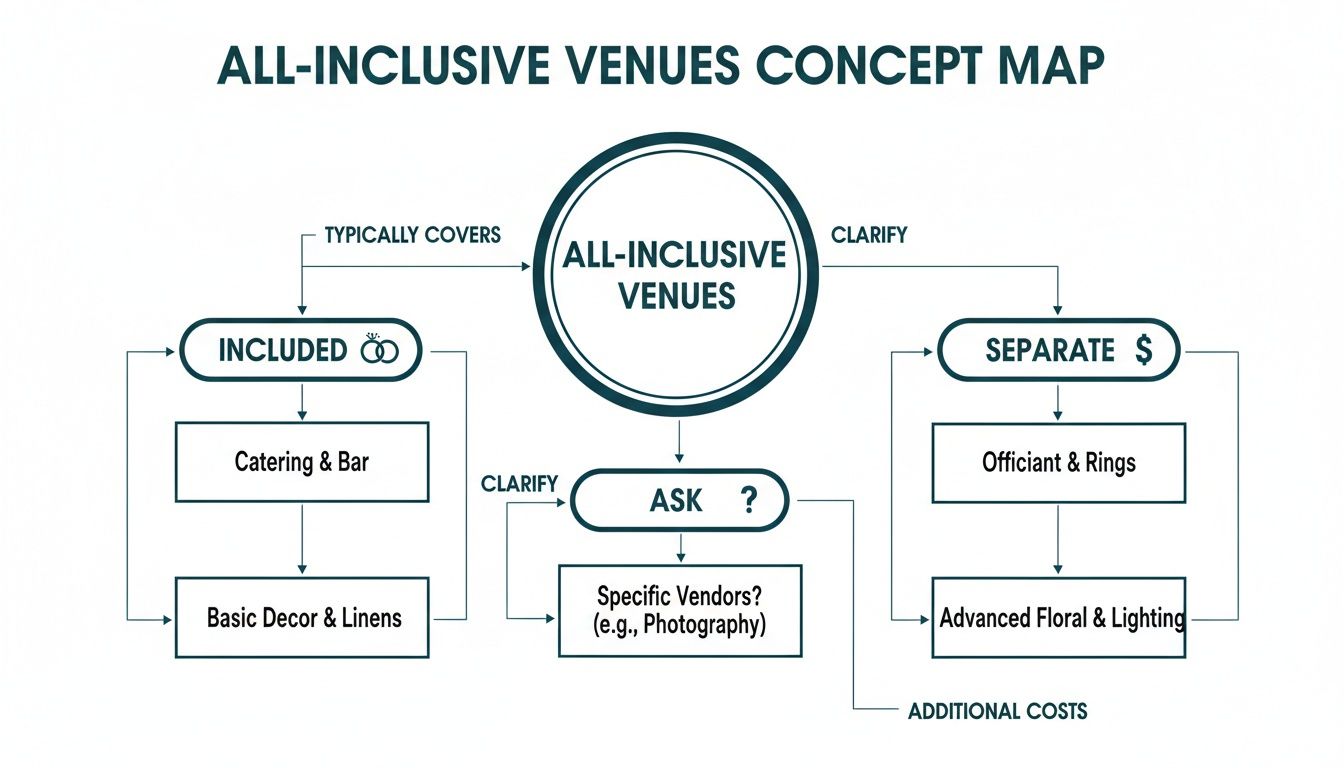
Knowing these categories helps you ask better questions. It gives you confidence when you are comparing affordable all inclusive wedding venues because you know what you are really looking for.
There is a quiet confidence that comes from knowing the core elements—the food, the space, the service—are already in harmony. The foundation is set, allowing you to focus on personal touches rather than foundational logistics.
This move toward simplicity is not just a feeling; it is something more couples are seeking. They want meaningful experiences without the stress that can come with them. You can read more about the rise of simplified wedding planning and see how this idea is shaping celebrations everywhere.
Ultimately, choosing an inclusive venue is about creating a day where the logistics feel held. When you feel supported by the process, you have more emotional space to hold onto the memories. It is a practical decision that serves a deeply emotional purpose.
Are there costs I might not be seeing?
The word “affordable” should feel like a relief, not a reason for suspicion. Still, I have seen many couples look at a quote and wonder what is not being said. It is a completely normal feeling when making such a big decision.
The goal is not to find fault, but to gain clarity so you can feel confident.
Most of the time, the costs that feel "hidden" are just the standard operational details of putting on a large event. They are not meant to be deceptive, but they can be a surprise if you are not expecting them. Understanding them from the start brings a lot of peace.
These are the items that deserve a second look on any contract. It helps to think of them not as hidden fees, but as the final pieces of the complete financial picture.
What should I look for in the contract?
A good venue will be happy to walk you through these line items. Asking about them is the sign of a thoughtful planner, not a distrustful client.
-
Service Charges: This is often the most confusing line item. A service charge is not the same as a gratuity. It is usually a percentage of the food and beverage total that covers the venue's operational costs—from the event staff's wages to the behind-the-scenes work. It is what allows the entire event to run smoothly.
-
Gratuities: This is the tip for the service staff, like the bartenders and servers. Some venues include this in their service charge, while others leave it to the couple's discretion. It is always best to ask for clarification.
-
Taxes: Sales tax will be applied to most of your wedding expenses, and it is almost never included in the initial price per person. Seeing this final number can feel like a jolt if you have not accounted for it.
-
Overtime Fees: Most venue rentals are for a set block of time. If your celebration runs longer, there will likely be fees for the extra time—both for the space and for the staff who stay. It is wise to know this rate in advance.
I have seen couples feel much more at ease when they understand the complete financial picture from the start. The best partnerships are built on clarity, and your venue should feel like a partner.
The guest count is another area that can shift the final price. Even with an inclusive package, a final count that is higher than your initial estimate will adjust the total. Likewise, if your numbers drop significantly, some venues have a minimum spend you will still be required to meet.
Having these conversations early prevents stress later on. Knowing you can offer comfortable accommodations for your guests is also a key part of planning, which is why considering wedding venues with on-site lodging can simplify things even further.
The goal is to ask questions that lead to confidence, ensuring the price you agree to is the price you actually pay.
How can I compare different venues?
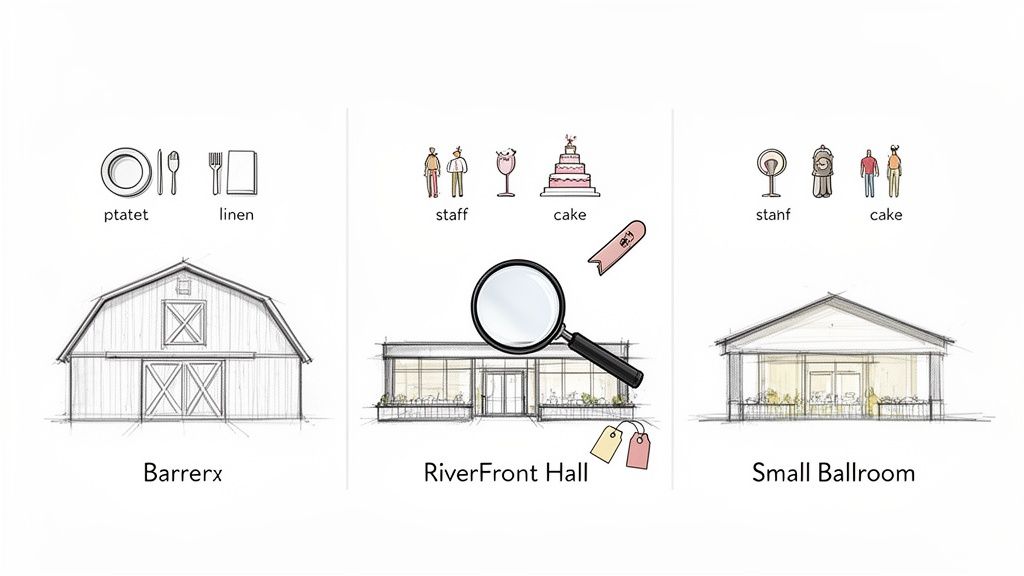
Once you start looking, you realize something pretty quickly. The phrase “all-inclusive” does not have one clear definition. Every venue interprets it a little differently, which can make a straightforward decision feel surprisingly confusing.
The best way to compare is not with a rigid checklist. It is about understanding the real value each place is offering. A lower price might catch your eye, but what is behind that number matters more. Does the included menu feel special, or just standard? Are the linens and plates the style you actually want, or will you end up renting different ones anyway? Those small details are what make the day feel like yours.
Is there more to it than the price?
The feeling of a place is part of the package, too. When you visit a venue or talk to the staff, notice how you feel. Calm? Rushed? Cared for? A contract cannot capture the warmth of an attentive team or a space that just feels right, but those are the things you and your guests will remember most.
Sometimes, a venue just a short drive away can make all the difference. Places like ours here in Muscatine offer that feeling of getting away without the logistics of a full destination wedding. The lower costs in smaller towns are a real advantage. It is not uncommon for a wedding here to cost nearly half of what it would in a major city, which means a budget can go so much further without cutting corners on quality.
How do I find that sense of ease?
It helps to compare the experience each venue promises, not just the line items. One place might offer a standard bar package. Another might include signature cocktails that tell a piece of your story. Neither is wrong, but one will feel more like you. It is about finding the best fit for the day you actually want to have.
When you are looking at different affordable all inclusive wedding venues, think about what they are truly providing. You will find some all-inclusive wedding venue packages are built from the ground up to make every step feel simpler, from the first tour to the last dance.
When you are trying to weigh your options, the decision rarely comes down to a spreadsheet. It is about a feeling—a sense of quiet confidence that a venue understands what you are trying to create. These are the questions that can help you get there.
Questions to ask yourself when comparing venues
| The Financials | The Guest Experience | Your Own Feeling |
|---|---|---|
| Does the price feel clear, or are there parts I cannot quite pin down? | Will my guests feel relaxed and cared for here? | When I picture my wedding day here, do I feel calm or stressed? |
| Is the quality of the included items (food, chairs, linens) what I would choose myself? | How will the space flow between events? Does it feel natural? | Does the team listen to what I am saying, or are they selling a package? |
| What is the backup plan for weather, and is there an extra cost? | Is the location easy for my most important guests to get to? | Can I see myself having a quiet moment here during the celebration? |
These questions are not about getting a "yes" or "no" answer. They are about helping you notice the details that separate a good venue from the right one for you.
Ultimately, the best value is found in the venue that feels less like a vendor and more like a partner. It is the place that offers not just a beautiful room and a clear price, but a genuine sense of calm that lets you know everything is going to be okay.
What should I ask before signing the contract?
This is the moment it all starts to feel real. You have found a place you can picture your wedding day unfolding, and a contract is sitting in front of you. It is completely normal to feel a mix of excitement and quiet nerves.
The questions you ask now are not born from distrust. They are the foundation of a good partnership. A venue that is truly going to take care of you will welcome these questions and have calm, reassuring answers. They see it as a sign that you are being thoughtful.
Getting the practical details clear ahead of time is what prevents stress on the day itself. It is about creating a shared understanding so that when your wedding day arrives, you can simply let go and be present.
How can we build a foundation of trust?
Think of this conversation as the first step in building the team that will support you. Clarity now leads to calm later.
-
Payment Schedule: It helps to know when payments are due. Is it a series of smaller payments, or are there two or three larger ones? Knowing the timeline helps you plan your finances without any last-minute surprises.
-
Cancellation Policy: Nobody plans to cancel, but life can be unpredictable. Understanding the policy from the start is just a practical matter. It provides peace of mind to know what the process would be, just in case.
-
Your Day-Of Contact: Who will be your point person on the actual wedding day? Knowing who that person is—and that they will be there to guide the flow of events—is incredibly reassuring.
What I have seen is that the most peaceful weddings are the ones where the couple feels completely confident in the team behind the scenes. This confidence starts with clear communication long before the day itself.
It is also helpful to ask about the timeline for your other vendors. When can your florist or photographer arrive for setup? When does everything need to be cleared out at the end of the night? Having these answers makes it easier for everyone you have hired to work together seamlessly.
A comprehensive wedding venue tour checklist can help organize these thoughts so you feel prepared.
These questions are not just about logistics. They are about building a foundation of trust. When you feel you have a true partner in your venue, you can move forward with nothing but peace about your decision.
Finding calm in your venue decision
After all the tours, spreadsheets, and late-night talks, the final decision usually comes down to a quiet feeling. It is about which place lets you close your eyes and imagine the day unfolding with a sense of ease, not anxiety.
The search is not for perfection, but for the right fit—a place that feels supportive, honest, and clear in its communication. A place that understands what you are trying to create.
It helps to pause and just listen to your intuition. When you think about a particular venue, do you feel more relaxed or more tense? The answer to that quiet question often holds the most truth.
It is something I have seen time and again. The right venue does not just provide a beautiful space. It provides a sense of calm that carries you through the entire planning process.
Your wedding is one day, but the feeling of being cared for and understood lasts much longer. The right choice is the one that makes you feel that your celebration is in good hands, allowing you to breathe a little easier.
When you find that place, you will know. You will feel calmer just having made the decision, confident that the most important pieces have finally settled into place.
A few final questions that come up
After you have sorted through the big decisions, a few smaller, more practical questions usually start to appear. It is a normal part of the process. You are getting closer, and the details are starting to matter more. These are the ones I hear most often from couples standing right where you are now.
The hope is that these answers give you a little more clarity, and maybe even a little more calm.
Does "all-inclusive" mean our wedding will be less personal?
This is a common worry. I think it comes from the idea that a package means a standardized event. But what I have seen time and again is that the opposite is usually true.
When a venue handles the foundational logistics—the tables, the food, the staff—it actually frees you up. You have more time and mental energy to focus on the things that make the day yours. The vows. The music. A special toast from a friend. The structure is there to support you, not to box you in. Think of it as a canvas, not a copy.
A good all-inclusive venue does not give you their wedding. It gives you the support you need to create your own. The best ones make the planning process feel so held that your personal style actually shines through even more brightly.
Will an all-inclusive venue actually save us money?
In most cases, yes, though maybe not in the way you would expect. A lot of the savings come from bundling. A venue that handles its own catering has systems and relationships that are more efficient than hiring an outside company, and those efficiencies get passed on to you.
But the real financial benefit I have seen is clarity. With an affordable all-inclusive wedding venue, you get a much clearer picture of the total cost right from the beginning. You avoid that slow, stressful creep of a dozen smaller contracts, each with its own service fees and taxes. That kind of financial predictability is its own form of savings. It saves you months of budget anxiety and lets you plan with confidence.
What if we want to use some of our own vendors?
This is a great question, and one you should ask early. Every venue handles this differently. Some have a trusted list of exclusive partners they work with, which ensures a high standard of quality and a team that knows the space inside and out.
Others are more flexible, especially for services like photography, flowers, or entertainment. Most venues understand that you have people you really connect with. The key is to have that conversation upfront. A good venue will be transparent about their policies so you can build the team that feels right for you, without any surprises down the road.
At The Merrill Hotel, our goal is to provide a clear, supportive foundation for your day so you can focus on what truly matters. We handle the details with quiet care, allowing you to be present for every moment. Find out more about building your day with us at momentsatthemerrill.com.