
There is a moment most couples run into, usually when they are sitting with a stack of envelopes and a guest list. It’s when you realize that addressing wedding invitations is more than just a task. Suddenly, a spreadsheet of names becomes a room full of people you love.
This is often one of the first parts of planning where you are not just making decisions for you, but actively reaching out to your guests. The way you address an envelope is, in a way, the very first act of welcome. It sets a quiet tone.
The goal isn't to follow a rigid set of old rules. It’s to make each person feel seen, considered, and genuinely wanted. An invitation that has been thoughtfully addressed does just that. It shows you care before they even open it.
How Does an Invitation Set the Tone?
I think of it like this: when guests drive into Muscatine for a wedding weekend, their first glimpse of the Mississippi River sets a mood. It feels peaceful and expansive. That slow curve of the water signals what the weekend might feel like. Your invitations do the same work.
The formality you choose, the names you include, the care you put into the address—it all sends a quiet message. These small details hint at the kind of day you are planning and the warmth your guests will feel when they arrive.
There is a gentle authority in an invitation that feels personal. It assures your guests that they were not just on a list, but were specifically thought of and are truly wanted there to celebrate with you.
Couples often get anxious about getting it wrong, especially with modern family structures. It is a common worry. But I have learned that grace is found in thoughtfulness, not in perfect etiquette.
There are simple, elegant ways to handle every scenario, from addressing a doctor to including a new partner or inviting a family with young children. The best approaches I have seen all have one thing in common: they prioritize the person over the protocol.
This is not a test. It is an opportunity. It is your first chance to extend a hand of hospitality, long before your guests walk through our doors. It is a quiet task, but it is one of the meaningful ones.
How Do I Address an Invitation to a Couple?
This is where the pen meets the paper, and it is usually where the most questions come up. The goal is not to pass some old-fashioned etiquette test. It is simply to make your guests feel seen and respected before they even open the envelope.
There are traditional ways to do this, and they have a certain rhythm that many people still appreciate. The conventions you see are less about rigid rules and more about creating clarity and warmth. When couples focus on that, I have found this part of the process gets a lot easier.
For Married Couples with the Same Last Name
When a couple shares a last name, the approach is quite straightforward. The most traditional format is "Mr. and Mrs. James Smith." It is classic and communicates a sense of formality.
For the inner envelope, the greeting softens a bit. "Mr. and Mrs. Smith" is enough. If you are close with the couple, some choose to use just their first names on the inner envelope, like "James and Sarah." It feels more personal.
For Unmarried Couples Living Together
This is a very common scenario, and the way to handle it is both simple and respectful. You address the invitation to both people, using their full names. Typically, their names are listed on separate lines.
If you know them both equally well, listing them alphabetically is a nice touch. If you are closer to one person, it is thoughtful to put their name first. The inner envelope would follow suit, often dropping the last names for a more personal feel: "James" on the first line, and "Sarah" on the second.
A thoughtfully addressed invitation does more than just give information. It’s a quiet gesture that says, "We see you, we honor your relationship, and we want you here with us." This personal touch has always mattered.
It is interesting how this tradition of care has persisted. After World War II, when formal invitations became more accessible, handwriting each address was a key part of the experience. Studies from TheKnotWW.com have even shown that a carefully addressed invitation can improve response rates because it makes guests feel personally welcomed. This small effort is especially meaningful when you are hosting a full weekend with multiple events.
A Simple Guide for Common Households
I have seen that having a few examples side-by-side can bring a lot of calm to this process. It helps to see the structure and realize how simple it can be. Here is a quick breakdown.
| Guest Household | Outer Envelope Example | Inner Envelope Example |
|---|---|---|
| Married Couple | Mr. and Mrs. David Rose |
Mr. and Mrs. Rose |
| Unmarried Couple | Mr. David Rose Ms. Alexis Rose |
David and Alexis |
| Single Individual | Ms. Stevie Budd |
Stevie |
Ultimately, what I have seen over the years is that guests appreciate the thought you put into it. The care you take in getting their names and their relationship right is what truly matters. It is a quiet signal that they are important to you, and that is a message that always comes through.
What About Families, Children, and Guests with Titles?
There are always a few names on the list that make couples pause. It is often the families with children or guests who hold special titles, like doctors or judges. The hesitation is completely normal. You want to show respect and be clear, and sometimes the old-fashioned rules feel a little stiff.
What I have seen is that this is less about strict etiquette and more about thoughtful communication. The goal is simply to make your guests feel seen and to gently clarify who is being invited. There are quiet, graceful ways to do this for every situation.
How to Address Invitations to Families with Children
This is where the inner envelope, if you are using one, becomes a helpful tool. It lets you be both formal on the outside and wonderfully clear on the inside.
On the outer envelope, you can keep it simple. Addressing it to “The Smith Family” is warm and inclusive. Another common approach is to just list the parents, such as “Mr. and Mrs. John Smith.”
The inner envelope is where you provide that gentle clarity. Here, you can list the parents on the first line (“Mr. and Mrs. Smith”) and then add the children’s names on the line below (“Michael and Emily”). This quietly communicates that the kids are welcome.
If you are not inviting children, simply address both envelopes to the parents only. The absence of the children’s names is the message. It is a subtle and widely understood way to indicate an adults-only reception.
This visual reference often helps couples see the underlying logic.
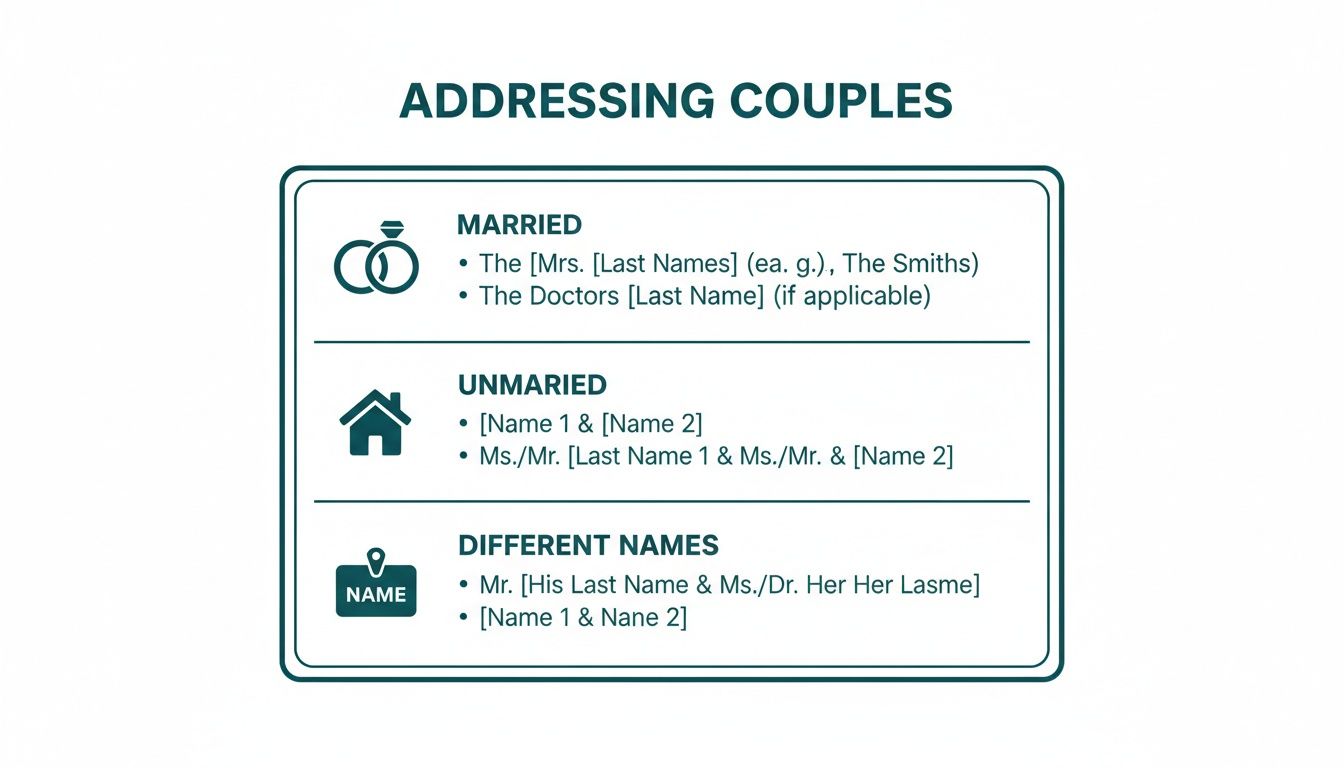
Seeing these formats side-by-side often helps couples realize the goal is just clear, respectful communication for each household.
Acknowledging Professional and Military Titles
When you have guests who are doctors, judges, or active military personnel, using their title is a simple act of respect. It acknowledges a significant part of their life. Couples worry this might feel too formal, but I have found it is almost always received as a thoughtful gesture.
For a medical doctor, "Doctor" or "Dr." simply replaces "Mr." or "Ms." If a wife is a doctor and her husband is not, her name would traditionally come first.
- Outer Envelope Example:
Doctor Jane Miller and Mr. Robert Miller
If both are doctors, you have a few graceful options.
- Outer Envelope Example:
The Doctors MillerorDrs. Jane and Robert Miller
It helps to remember that these titles are not just words; they represent years of dedication. Acknowledging that on an envelope is a small but meaningful way to honor your guest.
The same principle applies to military ranks or formal titles like "The Honorable" for a judge. The title is listed first, showing deference to their position or service. The key is consistency and respect.
In the end, all these small decisions about how you address wedding invitations are rooted in the same idea. You are starting a conversation with your guests, and the kindest way to begin is by acknowledging them fully and clearly.
How Do We Handle Modern and Blended Family Situations?
Family life is rarely as simple as the old etiquette books suggest. I see it all the time—couples holding their breath when they get to a tricky part of their guest list. Divorced parents, remarried partners, same-sex couples. It is a common feeling, and it comes from a good place: wanting to be respectful.
The most important thing to remember is that modern etiquette is really just about kindness. The goal is not to find one rigid rule that fits everyone. It is to thoughtfully reflect the reality of your guests' lives on the envelope. More and more, I see couples choosing what feels personal over what feels traditional.
Addressing Same-Sex Couples
When you are addressing an invitation to a same-sex couple, the approach is simple and should feel completely natural. Whether they share a last name or have different ones, the format is nearly identical to any other couple.
For a married couple with the same last name, you can use "Mr. and Mr. Smith" or "Mrs. and Mrs. Jones." If they have different last names, you list them on the same line, joined by "and."
- Example:
Mr. David Rose and Mr. Patrick Brewer
The question of whose name to list first comes up a lot. A simple, fair solution is to list them alphabetically by last name. It is a quiet, neutral choice that just works.
For Married Couples with Different Last Names
It is very common for partners to keep their own last names. When addressing an invitation to them, the most respectful approach is to list both of their full names. Traditionally, the woman’s name was listed first, but modern etiquette is much more flexible.
You can list the person you know better first, or you can simply go alphabetically. Either way shows you see and respect their individual identities within their partnership.
An invitation should feel like a warm welcome, not a formal summons. By reflecting your guests' real lives on the envelope, you are telling them, "We see you, we value you, and we can’t wait to celebrate with you."
This shift toward more personal details is real. Modern stationers like CottonandBow.com have noted that more couples are personalizing their invitations to feel true to them, whether in the wording or the design itself. It is part of a bigger desire for the day to feel authentic.
Navigating Divorced or Remarried Parents
This situation often requires the most thought, but the solution is usually straightforward. When parents are divorced, you send a separate invitation to each parent. It is a simple gesture that acknowledges their separate lives.
If a parent has remarried, you address the invitation to them and their new spouse as a couple. If a parent has a partner but is not married, you would list them on separate lines, just as you would for any unmarried couple. Thinking through these scenarios while you are doing your wedding guest list planning can make the whole process much smoother.
Ultimately, every family is unique. The most graceful approach is always to address people in the way that best reflects who they are. If you are ever truly unsure, a quiet and respectful phone call to ask their preference is never the wrong move.
What Are the Practical Details of Assembling and Mailing?
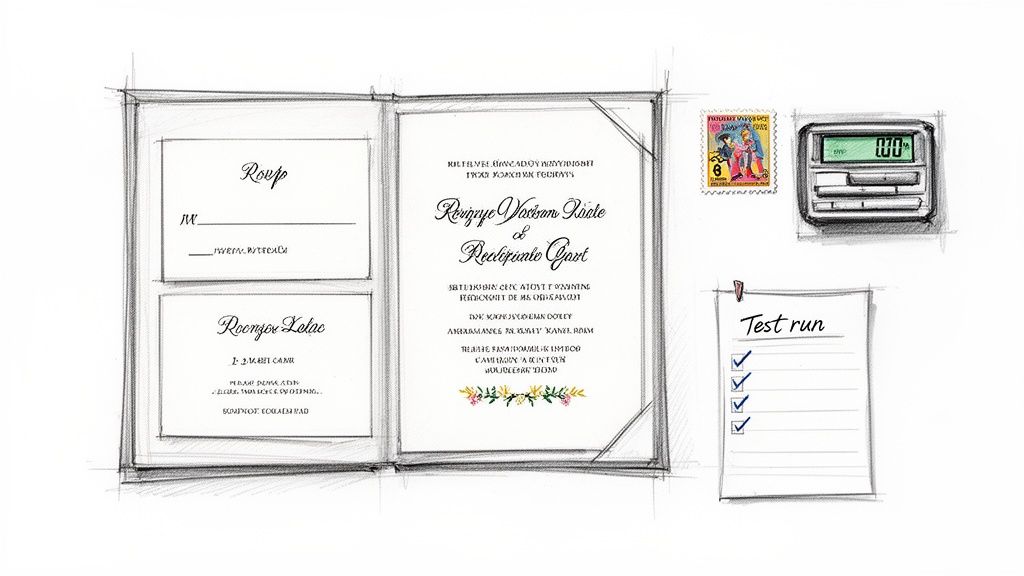
After all the decisions about how to address wedding invitations are made, the work shifts from etiquette to logistics. This is the moment you gather every piece and start building the little packages that will land in your guests' mailboxes.
It is a quiet, mechanical task that holds more weight than you might expect. This is often the last small step before your wedding feels truly real to everyone else.
The Gentle Art of Assembling an Invitation
I have seen so many couples spread out across a dining room table, surrounded by stacks of paper. There is a simple rhythm to assembling an invitation suite, and it can be quite calming once you find it.
Traditionally, you stack items by size. The invitation goes on the bottom. Smaller cards, like reception details, are placed on top. The RSVP card should be tucked just under the flap of its pre-addressed envelope before being placed on top of the stack.
This bundle then slides into the inner envelope, with the invitation facing the flap. That unsealed inner envelope goes into the outer one, with the guests’ names facing the back so they are the first thing seen upon opening.
A Small but Important Trip to the Post Office
Before you seal a single envelope, I always suggest doing a small test run. Assemble one complete invitation, with every insert.
Take that one invitation to the post office and ask them to weigh it. I have seen the quiet frustration that comes from realizing too late that your beautiful cardstock requires extra postage. A five-minute visit can save dozens of invitations from being returned.
While you are there, you might ask about "hand-canceling." This is where a postal worker marks each stamp by hand instead of sending it through a machine, which can sometimes bend or smudge the envelopes. It is a small detail that helps your invitations arrive looking as lovely as when they left your hands.
Thinking About Timing and Travel
The question of when to mail invitations is a practical one. The standard advice is six to eight weeks before the wedding, but it is wise to think about your specific guests.
Here in Muscatine, we often welcome guests traveling from Des Moines, Chicago, or even further. For a wedding that involves flights and hotel stays, sending invitations closer to the ten or twelve-week mark is a thoughtful gesture. It gives people time to plan without feeling rushed. This is one of those small adjustments in your planning a wedding checklist that can make a large difference for your guests.
It helps to remember that an invitation is not just a piece of mail. It is the beginning of your guests' journey to your wedding day. Giving them a little extra time is a simple act of hospitality.
This final step of mailing is a moment of release. You have put so much thought into the names, the paper, the wording. Now, you send those welcomes out into the world. It is a quiet, significant milestone.
Common Questions I Hear from Couples
Over the years, certain questions about how to address wedding invitations come up again and again. They are usually asked in quiet moments. The concerns are always valid, and they come from a place of wanting to do things with care.
Here are a few of those common questions, along with the answers I have found to be most reassuring.
Is It Better to Handwrite or Print the Addresses?
This is a question many couples wrestle with. The honest answer I have seen is that both are perfectly acceptable. What matters more than the method is the neatness and thoughtfulness of the result.
A beautifully handwritten address feels personal and warm. However, not everyone feels confident in their calligraphy skills, and that is completely fine.
Printed labels, especially clear ones that blend into the envelope, can look elegant and polished. They ensure every address is legible, which is a very practical concern. The most important thing is that the address is accurate and presented with care.
What Should I Do If I Make a Mistake?
It will happen. A name will be misspelled, or ink will smudge. My best advice is to take a deep breath and simply start over with a new envelope.
It is always wise to order about 15-20% extra envelopes from your stationer for this very reason. Having spares on hand removes the pressure of getting every single one right on the first try. Trying to correct a mistake often draws more attention to the error than the original mistake would have.
A pristine envelope is nice, but a guest feeling truly wanted is better. If you must send one with a small imperfection, it is okay. The love behind the invitation is what they will remember.
This is not a test of perfection. It is an act of welcome, and a small smudge does not diminish the warmth of your invitation. Just set the flawed envelope aside and reach for a fresh one.
Does the Return Address Go on the Front or the Back?
This is a simple detail that causes a lot of quiet confusion. The most traditional and practical place for the return address is on the back flap of the outer envelope.
Placing it on the back keeps the front of the envelope looking clean and formal, with the focus entirely on your guest’s name and address. It also serves its purpose perfectly. If the invitation cannot be delivered, the post office will know exactly where to send it back.
I have seen some modern invitation designs incorporate the return address on the front, and that can work, too. But for a classic, uncluttered look, the back flap is the standard I have seen most often.
How Do We Handle Digital RSVPs with a Physical Invitation?
This is a very common and practical approach today. You send a beautiful, physical invitation in the mail, but direct guests to your wedding website to RSVP.
The best way to do this is with a small, separate insert card. This card can be designed to match your invitation suite. It should clearly state the website address and the date by which you would like guests to respond.
- Example Wording: “To reply, please visit our wedding website by May Fifteenth. [YourWebsite.com]”
This method combines the tangible feeling of a mailed invitation with the convenience of managing your guest list online. It is a graceful way to blend tradition with modern practicality. It also provides a central hub for other details, like those for the rehearsal dinner. We offer some gentle guidance on who you invite to the rehearsal dinner if that question is on your mind.
In all these small decisions, remember the goal. You are inviting people you love to be with you on an important day. As long as you lead with thoughtfulness and clarity, you are doing it right.